
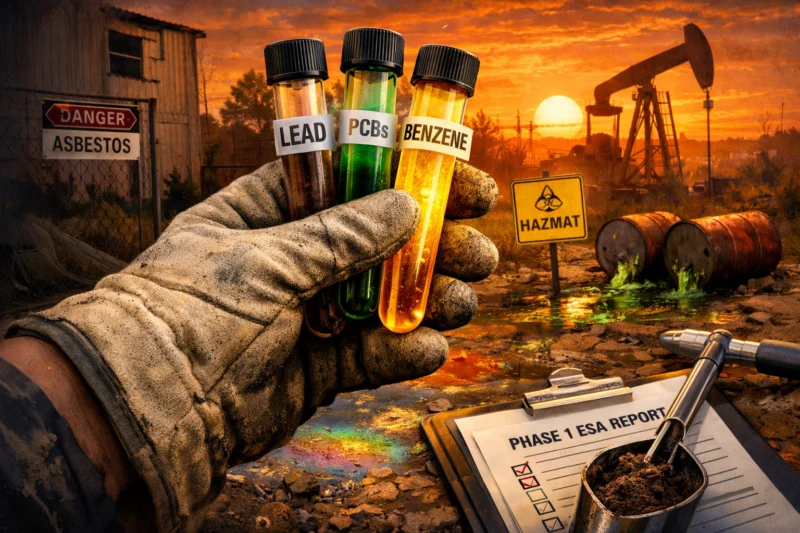
Hidden hazards in a Phase 1 ESA are typically “unveiled” through evidence-based inference—records, historic uses, and observable site conditions—rather than through soil or groundwater sampling. That means the common contaminants found during a phase 1 ESA often first appear as suspected sources and release pathways (for example, former fuel systems, degreasing areas, or legacy waste handling), which then guide whether Phase 2 is needed. In practice, what makes hazards “hidden” is the gap between the current property appearance and the information that came before it: earlier tenants, underground infrastructure that’s no longer present, imported fill, or engineering controls that mask what lies beneath. This article explains which contaminant categories most frequently show up in Phase 1 narratives, how ASTM E1527-21 logic shapes “recognized environmental conditions” (RECs), and what to do when Phase 1 suggests uncertainty you can’t ignore.
In a Phase 1 ESA, “hidden hazards” usually refers to environmental concerns that are not directly measurable on day one because the investigation is largely non-intrusive. Instead, contaminants are identified indirectly through evidence that a substance was likely present (or likely released) based on past uses, infrastructure, waste practices, and on-site indicators. When people ask about the risks uncovered during Phase 1, they are typically asking: “Which contaminant categories can be suspected, and what triggers the next investigation step?”
Phase 1 is designed to be a structured evidence review. Under ASTM E1527-21, the consultant evaluates recognized environmental conditions (RECs) by looking for credible clues that a release has occurred (or may have occurred), even if the property looks clean today. Common “contaminant stories” start with things you can’t see in the current building footprint: underground storage tank systems that were removed but whose piping locations weren’t fully mapped, floor drains that were filled after a remodel, or loading areas where spills were possible. On-site observations help corroborate or challenge the records narrative—staining, odors, stressed vegetation patterns, distressed pavement, the presence of stained soil or debris, or remnants of older infrastructure.
Practically, readers should expect Phase 1 findings to separate what is known from what is inferred. A Phase 1 report may document RECs tied to a former heating oil tank, a past industrial tenant with solvent use, or a localized waste area suggested by historical maps and current site features. But it may also state “no RECs” while still noting areas of uncertainty that could be clarified in a targeted Phase 2 investigation. This is why Phase 1 should be read as a decision tool, not a definitive chemical map.
There are real tradeoffs. Without sampling, Phase 1 cannot confirm concentrations or delineate contamination boundaries; it can only evaluate whether evidence supports the presence of a likely source and release pathway. A common edge case is a site with multiple redevelopment phases: demolition materials and cap layers can hide surface indicators, leaving records review as the primary evidence. Another common mistake is assuming that if staining or odors are not observed, there is no potential concern—whereas a lack of visible indicators can be compatible with hidden hazards, especially when features were removed or covered during renovation.
Common contaminant categories that surface in Phase 1 records and observations
Many of the contaminants people associate with environmental risk appear in Phase 1 ESA documents as categories tied to past activities and observable clues. While Phase 1 does not sample, it often flags petroleum-related concerns, volatile organic compounds (VOCs) from degreasing solvents, metals linked to older processes, and building-material risks such as asbestos-containing materials (ACM) and lead-based paint (LBP). These are among the most frequent “common contaminant” themes because they align with widespread historical site uses and infrastructure patterns.
Petroleum hydrocarbons are commonly implicated when Phase 1 records mention former or existing fuel storage and distribution—such as underground storage tanks, aboveground storage tanks, piping, dispenser islands, or bulk delivery points. Even when tanks are removed, Phase 1 may reference tank-related components and potential subsurface migration pathways. Evidence might include historical UST permits, tank removal documentation gaps, proximity of former fueling areas to current building foundations, and on-site indicators like stained soil near tank excavation footprints or abnormal subsurface conditions near former piping routes.
VOCs and solvent-related risks frequently emerge where Phase 1 documents describe industrial operations: degreasing, equipment cleaning, parts washing, printing, or manufacturing processes involving chemical baths. In Phase 1, the logic typically hinges on credible evidence of solvent use and waste handling, plus reconciliation with how those operations were managed (for example, floor drains, sumps, wash bays, or waste drum storage). The key is release pathway reasoning: where would solvents have gone if a spill occurred, or if waste was discharged to drainage systems?
Metals concerns often tie to older industrial activities (painting and blasting, firing processes, metalworking, or historic fill practices). Phase 1 may note evidence such as historic paint-related operations, demolition debris consistent with metal-containing materials, or areas where ash or slag might have been used as fill. Metals are also frequently “adjacent-property influenced”: runoff and drainage patterns from nearby industrial corridors can be treated as part of the recognized environmental conditions discussion, depending on what the evidence supports about direction of migration and proximity.

ACM and LBP are often discussed alongside chemical contamination risk because they can materially affect property condition and redevelopment planning, even when they are not “soil contaminant” issues in the traditional sense. For example, older building renovations can create demolition-disposal risks tied to ACM, and deteriorating painted surfaces can require lead abatement during remodeling. A deeper nuance is that Phase 1 may treat these as environmental concerns requiring additional review or specialized assessments, rather than confirming subsurface chemical contamination.
What most guides get wrong is reducing the discussion to a “checklist of contaminants.” In real Phase 1 ESA narratives, the differentiator is evidence quality: whether the report documents a credible source and pathway based on records and observations. An edge case is a site where historic activities were “successfully remediated” or capped long ago. The report might reference institutional controls or remediation records, which can change how risk is framed and what additional investigation is warranted.
How ASTM E1527-21 (and AAI) shapes what counts as a “recognized” contaminant hazard
ASTM E1527-21 shapes Phase 1 findings by defining when a condition is a recognized environmental condition (REC) based on credible evidence of a release and a plausible source-pathway relationship—not by confirming chemical presence through sampling. This is why “common contaminants” often show up as suspects with a documented rationale, and why the same contaminant category may or may not become an REC depending on the evidence.
Practically, ASTM E1527-21 encourages consultants to evaluate RECs, including “historical” and “controlled” scenarios, and to document how they classified each condition. This matters because it affects the decision downstream: an REC typically triggers consideration of Phase 2, additional due diligence, or at minimum tighter scoping. When you read a Phase 1 report, you are looking for whether the report identifies recognized environmental conditions and explains the underlying evidence (records, maps, facility operations, and observations).
The nuance for readers is that the contaminant category alone is not the deciding factor. A petroleum-related label is meaningful, but it becomes an REC through documented evidence of former storage, infrastructure, or plausible release pathways. Similarly, VOC concerns are not merely about “solvent words” in old documents; they become more actionable when tied to the site’s operations, waste management practices, drainage connections, and on-site confirmation of relevant features or conditions.
For compliance and reliance purposes, Phase 1 documentation practices can matter. In the U.S., liability protection frameworks rely on meeting specific criteria that are described in guidance aligned with ASTM-informed practice, including the “All Appropriate Inquiries” (AAI) requirements referenced in 40 CFR Part 312. Phase 1 reports often discuss AAI-related expectations alongside ASTM E1527-21 methods, particularly around the adequacy of the search, documentation of sources, and disclosure of limitations. A deeper insight is that AAI concepts can influence the level of evidentiary thoroughness and the clarity of limitations; this can change whether subsequent parties consider the Phase 1 work sufficiently defensible.
It is also important to recognize the edge case where Phase 1 concludes “no RECs” but still identifies uncertainties that could warrant targeted Phase 2. For example, a report might document no RECs tied to petroleum hydrocarbons based on missing records, yet recommend further evaluation where fill uncertainty or drainage pathway questions remain. “No REC” is not always “no potential concern”; it often means the evidence did not meet the REC threshold. The practical takeaway is to track the report’s reasoning—not just the headline conclusion.
For readers who want baseline reference points, ASTM E1527-21 is the central method for U.S. Phase 1 practice, and U.S. EPA’s AAI framework provides context on how Phase 1 work aligns with liability protection. See the overview and official references at the U.S. EPA website and the ASTM standard for detailed definitions of RECs and related classification logic, as used in contemporary Phase 1 reports.
References: ASTM E1527-21 is the governing standard for Phase 1 ESA method structure, and U.S. EPA provides the AAI framework described in 40 CFR Part 312. See [U.S. EPA All Appropriate Inquiries (AAI) information](All Appropriate Inquiries Aai) and [40 CFR Part 312](Part 312) for authoritative context.
Where Phase 1 ESAs most often uncover release pathways (not just the substances)
Phase 1 ESAs more often “uncover” contaminants by identifying release pathways—where a substance could have been stored, used, discharged, or spilled—than by naming chemicals outright. This matters because many common contaminant categories are only hazardous in the presence of plausible sources and migration routes. When Phase 1 records and observations connect a plausible pathway to a likely source, the contaminant narrative becomes actionable.
Consider former fuel infrastructure. Records might show a former UST system or repeated fuel delivery activity, while observations might show former dispenser islands, patched pavement, excavation scars, or inconsistencies between current grading and historical utility corridors. Even if the tanks are gone, release pathways can remain relevant: product remnants in soils, vapor migration considerations where appropriate, or pathway changes due to later construction. Phase 1 readers should expect the report to map how the site’s physical layout aligns with historic storage and delivery points.
In industrial and commercial settings, degreasing and manufacturing areas are another common pathway source. Evidence can include historic tenant descriptions, permit records for cleaning processes, or the physical presence of floor drains, sumps, or wash bays. The “how it works” is straightforward: if a facility discharged solvent-contaminated liquids to drainage systems (or if spills occurred near drains and sumps), the site could have become a pathway for VOCs or petroleum-related compounds. Phase 1 doesn’t verify concentrations, but it can identify where further investigation should focus if those operations are credible and relevant.
Waste accumulation zones, including loading docks, dumpster staging areas, and drum storage locations, are also typical pathway triggers. Records might mention waste manifests or procurement tied to industrial operations, while on-site observations might show debris patterns consistent with older handling areas. Stormwater and sewer connections add another layer. Even when the main suspect is petroleum or metals, stormwater routing can move contaminants across the site surface or into drainage features.
A deeper-than-obvious nuance is that “typical contaminants” do not always produce typical evidence. A site that underwent aggressive redevelopment may have removed all visible signs of older uses. In that case, the contaminant narrative can still be strong if historic aerials, Sanborn-like mappings, fire insurance maps, or permits clearly show relevant operations and infrastructure footprints—even if modern observations look “new.” The common mistake is to rely on current appearance alone and to treat redevelopment as proof of absence rather than as a factor that can mask evidence.
A decision path for handling suspected contaminants after Phase 1 (what to do next)
A Phase 1 ESA helps you decide whether concerns are substantial enough to justify further investigation. The most practical decision path is to interpret the Phase 1 findings, assess evidence strength, and then decide whether Phase 2 (or a targeted “question-driven” investigation) is warranted. This is where “common contaminants found during a phase 1 ESA” become decision inputs: petroleum-related concerns often lead to tank-focused or pathway-focused Phase 2 scoping, while solvent-related concerns often lead to targeted evaluation of cleaning and drainage features.
Start by separating three ideas that readers often blend: the report’s classification (for example, RECs versus “no RECs”), the contaminant category discussed, and the evidence strength tied to specific locations. If Phase 1 identifies a likely release pathway with good support—such as credible records of a former tank near current foundations or documented industrial activities tied to drains—then targeted Phase 2 is commonly justified to clarify subsurface conditions. If the report suggests possible concerns based on weak or incomplete evidence, a narrower scope can often reduce unnecessary intrusion and cost.

Next, use triggers that match the site’s uncertainty. Common triggers include uncertainty about historic tank locations or piping routes, unexplained staining or odors that align with a credible use history, and insufficient understanding of imported fill composition or grade-raising events. For VOC concerns, triggers might include solvent-related operations and the presence of drainage infrastructure that could have served as a disposal pathway. For metals, triggers might include legacy fill or activities linked to metal-bearing waste, especially if there are surface or near-surface indicators consistent with those operations.
Tradeoffs matter. Overreacting can mean expanding Phase 2 beyond what evidence supports—turning a question into a broad drilling program. The better approach is often “defensible narrowing”: Phase 1 identifies where uncertainty matters most, and Phase 2 uses that to craft sampling locations that address the specific question raised by Phase 1. A real-world example is a property where Phase 1 records suggest a former cleaning area but the building was replaced. Phase 2 can sometimes be scoped around the likely footprints and drainage features shown in the historical records, rather than treating the entire property as a contamination zone.
Finally, coordinate timing with closing schedules, redevelopment planning, and permitting. Waiting too long can force late-stage redesign if remediation is needed, while moving too early without clarity can create scope creep. An edge case is a site with ongoing remediation or engineering controls; Phase 1 might identify restricted areas or incomplete documentation. In that situation, the next step may not be broad sampling—it may be a document review plus targeted investigation aligned with the remediation boundaries and current site controls.
Common mistakes and misconceptions during Phase 1 reviews of contamination risks
Many missed or misinterpreted hazards come from treating Phase 1 as either “visual confirmation only” or “guaranteed proof.” The real risk is when readers confuse suspected conditions with confirmed contamination, or when they assume that similar property use history automatically equals the same release risks. Phase 1 is evidence-based and classification-based, so misunderstandings about what the standard is doing can lead to bad decisions.
One common mistake is assuming that visual cues alone can confirm contamination—or that visual absence proves safety. Phase 1 relies on records and observations together. A site might show no obvious staining because older equipment was removed and the area was paved or regraded. Conversely, stressed vegetation or surface staining can have non-environmental causes (routine construction materials, leaks from newer systems, or weathering). The “how it works” part is that Phase 1 weighs evidence credibility and ties observations to historic uses and infrastructure context.
Another misconception is overreliance on assumptions about “similar properties.” A consultant may locate nearby industrial uses, but Phase 1 requires linking evidence to the subject property and its timeframe. Ignoring neighboring facility timelines is also problematic: a nearby source may have existed only after the subject property’s historic use, or vice versa. Phase 1 reviews must be careful with chronology to avoid treating future risk as past risk (or past risk as present risk) without evidence supporting the relevance.
Record-search pitfalls are just as common. These include failing to properly capture historical aerials or misreading land-use changes, missing utility documents that explain drainage and sewer connections, or failing to document search limitations. When a Phase 1 report discloses limitations, readers should understand what that limitation could affect: for example, unknown fill depth might affect how conclusions are framed, while missing tank-related documentation can affect whether petroleum-related conditions become an REC.
Report interpretation errors also appear frequently. Readers might treat “possible” language as “probable,” or misunderstand controlled conditions and ongoing remediation references. A deeper insight is that not all “environmental issues” behave like chemical contamination. ACM and LBP concerns can be materially significant for redevelopment and liability, even when they are not the primary hazard affecting groundwater or soil sampling decisions.
Finally, an edge case: unknown fill or mixed demolition debris. Even if the contaminant categories you expect do not appear in the narrative, unusual fill composition can introduce site-specific hazards. This is one reason strong Phase 1 documentation should include a clear explanation of what was searched, what was not found, and how that affects the defensibility of the conclusions.
Comparisons and alternatives: how different Phase 1 approaches change what contaminants are likely to be found
Different Phase 1 workflows can change how likely it is that common contaminant categories are recognized, even though ASTM’s intent remains the same. The difference is not about “changing the standard,” but about how much evidence is gathered, how the evidence is mapped to locations, and how uncertainty is resolved during desktop work and reconnaissance. A stronger evidence workflow often reduces false negatives by improving traceability and spatial accuracy.
Traditional records plus on-site observation is the foundational approach: it checks historic uses, permits where accessible, and correlates operations with visible site features. Enhanced desktop research goes further by expanding the range and depth of sources—such as broader historic aerial coverage, additional permit databases, and specialized historical maps that better locate historic structures. Targeted reconnaissance for higher-risk features adds another layer: instead of general walking tours, the consultant concentrates on features like likely tank-related zones, loading/unloading areas, and building corners that match industrial activity footprints.
Modern innovations can improve evidence gathering without converting Phase 1 into a fully intrusive program. GIS mapping and layering help reconcile historic land uses with modern coordinates, making it easier to identify where former infrastructure could have been located. Drones and photogrammetry can improve documentation of grade changes, rooflines, and hard-to-access features. Geophysics such as GPR may be used as a supportive tool in appropriate situations to address subsurface uncertainty, but it should not be treated as a substitute for the evidence threshold required for RECs. Digital workflows and data platforms can improve traceability: better document provenance, consistent location tagging, and clearer presentation of limitations and supporting evidence chains.
The tradeoffs are practical. Better mapping can produce more leads, but consultants still must decide whether evidence meets the REC standard. Data quality matters more than data volume; a large number of unverified documents can create confusion rather than clarity. Access limitations are another constraint: locked areas, security boundaries, or redevelopment hoarding can prevent observation. Budget also plays a role; the best practice is prioritizing higher-risk features identified by the records review, rather than spending equally across low-likelihood zones.
A deeper insight is that improved technology can reduce missed hazards, but it cannot replace ASTM evidentiary reasoning. An edge case is a site where GIS suggests a likely former tank location, but records do not support it or the chronology doesn’t match the evidence. In that scenario, the technology may help narrow questions for Phase 2, yet the Phase 1 conclusion about RECs must still remain evidence-based.
Comparison overview:
| Phase 1 approach | What it improves | Limitations | Best-fit scenarios |
|---|---|---|---|
| Traditional desktop + standard site reconnaissance | Baseline identification of likely sources and pathways | May miss spatial nuance if historic footprints are unclear | Lower-complexity sites with complete records |
| Enhanced desktop research | More complete timeline and infrastructure context | More time; may still face record gaps | Older industrial properties or fragmented records |
| Targeted reconnaissance for high-risk features | Better correlation of evidence to specific locations | Access constraints can reduce observability | Sites with known tank/solvent indicators |
| Tech-supported mapping (GIS, drones, digital evidence chains) | Improved spatial accuracy and documentation traceability | Cannot confirm subsurface chemistry | Redevelopment sites with limited visible footprints |
| Supportive geophysics (where appropriate) | Helps address subsurface uncertainty questions | May require careful interpretation and permission | When evidence suggests buried features but location is uncertain |
These choices often influence what contaminant categories get discussed with confidence. But the core outcome still hinges on whether the evidence supports recognized environmental conditions and defensible inferences.

Advanced considerations: edge cases that can hide or reshape contamination conclusions
Some sites make “hidden hazards” more likely by design—through redevelopment that removes evidence, multi-tenant histories that layer operational timelines, or imported fill events that change how contamination could present. In these edge cases, Phase 1 conclusions can be reshaped, sometimes by highlighting new uncertainties rather than by confirming contamination. Understanding these scenarios helps readers interpret Phase 1 results responsibly, especially when common contaminant categories appear incomplete or when the evidence seems unusually complex.
Redevelopment with limited remaining site features is a classic edge case. When demolition clears away older structures, the consultant has fewer on-site indicators to corroborate historic uses. Phase 1 then becomes more dependent on records and mapping accuracy. If historical documentation is strong, a Phase 1 can still flag RECs based on credible source-and-pathway evidence. If records are weak or missing, Phase 1 may disclose limitations and recommend targeted Phase 2 to close key gaps.
Properties with multiple historical tenants/uses can also complicate conclusions. Different tenants may have used different chemicals, storage methods, or waste discharge systems across decades. This can create overlapping risks: petroleum-era infrastructure could coexist with later solvent-related uses. Phase 1 needs to reconcile chronology—what happened when—and where each activity likely occurred within the property footprint.
Unknown or imported fill and grade-raising events can hide contaminant impacts in subtle ways. A site that has been filled to regrade can move surface indicators away from the original release location. Metals and petroleum-related risks can present differently when fill has changed the near-surface context. Even though Phase 1 does not sample, it can still flag uncertainties that require Phase 2, particularly when records indicate fill events and the consultant cannot confirm what materials were imported.
Interactions with remediation and management programs add another layer. If soil caps, engineering controls, or institutional controls exist, Phase 1 may need to document them accurately and interpret how they affect potential exposure and migration pathways. A deeper insight is that ongoing remediation documentation can reduce uncertainty in some areas while increasing it in others—particularly where remediation boundaries are unclear or where historical records of effectiveness are limited.
It is also useful to address skeptical objections a buyer or owner might raise. Claims like “we never had spills” or “neighbors were clean” are not automatically decisive in Phase 1 logic because the standard is evidence-based and does not require a documented spill report to identify a recognized environmental condition. What matters is whether the evidence supports likely sources and release pathways for the subject property. The common mistake is treating community reputation as a substitute for property-specific evidence.
Finally, remember that not all “hazards” are chemical release risks. ACM and LBP can represent significant redevelopment and compliance challenges even if the primary contaminant narrative is incomplete. That means Phase 1 readers should interpret “hidden hazards” as broader environmental risk categories—not solely substances in soil or groundwater.
Frequently Asked Questions About Unveiling Hidden Hazards: Common Contaminants Found During Phase 1 Assessments
What contaminants are most commonly implicated in Phase 1 ESA findings?
Phase 1 findings most often implicate petroleum hydrocarbons (such as fuel or heating oil tied to historic tanks or fueling infrastructure), VOCs associated with solvent use and degreasing, and metals linked to older industrial processes or legacy fill. Many reports also address ACM and lead-based paint as environmental concerns that can affect redevelopment even if they are not confirmed as soil contamination. In most cases, Phase 1 identifies these categories through records and site observations that suggest credible source-and-pathway scenarios.
If a Phase 1 ESA shows no RECs, does that mean there are no contaminants at all?
No RECs generally means the evidence did not rise to the Phase 1 REC threshold, not that the property is chemically clean in an absolute sense. A Phase 1 report can still flag uncertainties, such as unresolved fill history, limited access to certain areas, or unresolved details about drainage systems, which may justify targeted Phase 2. In practice, “no RECs” should be read alongside the report’s limitations and recommended follow-up considerations.
What evidence in a Phase 1 report most strongly suggests petroleum contamination?
The strongest petroleum indicators in Phase 1 are records and documentation showing historic or current tank storage, piping, dispenser locations, or fuel-handling activity, especially when the records clearly associate these features with plausible release pathways. Corroborating site observations—such as stained soil near tank-related areas, evidence of removed infrastructure footprints, or inconsistent site grading—can strengthen the conclusion. If tank removal documentation is incomplete or missing, that uncertainty can matter substantially in the Phase 1 reasoning.
How do VOC concerns get evaluated during a Phase 1 ESA when there’s no sampling?
VOCs are evaluated by connecting credible evidence of solvent-related operations (for example, degreasing, equipment cleaning, parts washing, or chemical use) to likely disposal or release pathways such as floor drains, sumps, wash bays, and other drainage features. Phase 1 may also consider waste handling narratives and the presence or absence of relevant site features. Without sampling, the report focuses on whether the evidence supports concern rather than whether VOC concentrations exceed standards.
What are common contaminants found during a phase 1 ESA in older industrial properties?
In older industrial properties, Phase 1 reports commonly discuss petroleum hydrocarbons and VOC-related concerns due to historic fueling and solvent use. Metals may also appear due to historic processes, and ACM or LBP may be addressed because older buildings often contain these materials. The contaminant category is important, but Phase 1 ties these discussions to what the records and site observations indicate about likely sources and release pathways.
How does ASTM E1527-21 affect what gets labeled as a recognized environmental condition?
ASTM E1527-21 influences how conditions are classified by setting an evidence-focused framework for recognized environmental conditions (RECs). Under this approach, consultants document why a condition is considered a REC (or not), based on credible evidence of source and pathway rather than speculation. This affects how confidently common contaminant categories are framed and whether follow-up investigation is recommended.
When should you request Phase 2 because of suspected contaminants identified in Phase 1?
You typically request Phase 2 when Phase 1 identifies specific locations tied to RECs, or when there is credible uncertainty about critical details like historic tank locations, drainage pathways, or fill composition. Triggers include unexplained site observations (such as odors or staining) that align with record-based operations, or gaps that prevent the consultant from confidently concluding there is no concern. The goal is to scope Phase 2 to the questions raised by Phase 1, rather than expand broadly without a clear reason.
Are asbestos-containing materials and lead-based paint treated as part of Phase 1 ESA “contamination”?
ACM and LBP are commonly discussed as environmental concerns in the broader due diligence context, but they are not always the same type of “contamination” as subsurface petroleum or VOC impacts. Phase 1 typically documents these issues as relevant risks that may require specialized testing or building-material assessment, especially prior to demolition or renovation. The interpretation is closely tied to what the report can confirm and what it recommends for next steps.
What should buyers verify about the Phase 1 search process and limitations?
Buyers should verify what sources were searched, what timeframe was covered, and whether the report clearly documents limitations (such as unavailable records or restricted access). The report should also explain how findings were tied to specific locations and why certain conditions were or were not classified as RECs. If limitations are significant, buyers should ask how those gaps affect confidence and what targeted follow-up might address them.
Could upgraded technology like GIS or drones reduce the chance of missing common contaminants in Phase 1?
GIS and drones can reduce the chance of missing relevant evidence by improving spatial accuracy, documenting features that are hard to view, and strengthening traceability of where historic uses likely occurred. However, technology cannot replace the evidentiary threshold required under ASTM E1527-21 for calling a condition a REC. In practice, these tools help the investigation better support defensible conclusions, especially on complex or redevelopment-heavy sites.
Conclusion
Unveiling hidden hazards during a Phase 1 ESA is less about “finding chemicals” and more about documenting the evidence that makes certain contaminant categories plausible through source-and-release pathways. The common contaminants found during a phase 1 ESA typically appear as reasoned suspicions—petroleum hydrocarbons tied to historic fuel infrastructure, VOC concerns linked to solvent use and drainage features, metals associated with legacy processes or fill, and building-material hazards like ACM and LBP that affect redevelopment decisions. When Phase 1 is done well, it gives you more than a label: it provides a transparent logic trail connecting records, observations, and ASTM E1527-21 REC reasoning.
Use Phase 1 as a structured risk evaluation that guides a defensible next step—whether that is a targeted Phase 2 investigation, a focused question to resolve a key uncertainty, or a go/no-go decision based on confidence levels. The best outcomes come from high-quality search depth, careful documentation of limitations, and clear explanation of why specific locations were categorized as RECs (or why the evidence did not meet that threshold). Where reliance and liability protection concepts are relevant, aligning the work with AAI expectations referenced in 40 CFR Part 312 can further strengthen defensibility.
If you are making decisions about a property in 2026, treat the Phase 1 report as the start of a risk conversation: review the evidence, examine the recommended follow-ups, and consult an experienced environmental professional to interpret findings for your specific site history, redevelopment plans, and risk tolerance. With that approach, Phase 1 becomes a practical early warning system—one that helps you uncover hidden hazards before they become expensive surprises.
Updated August 2026