
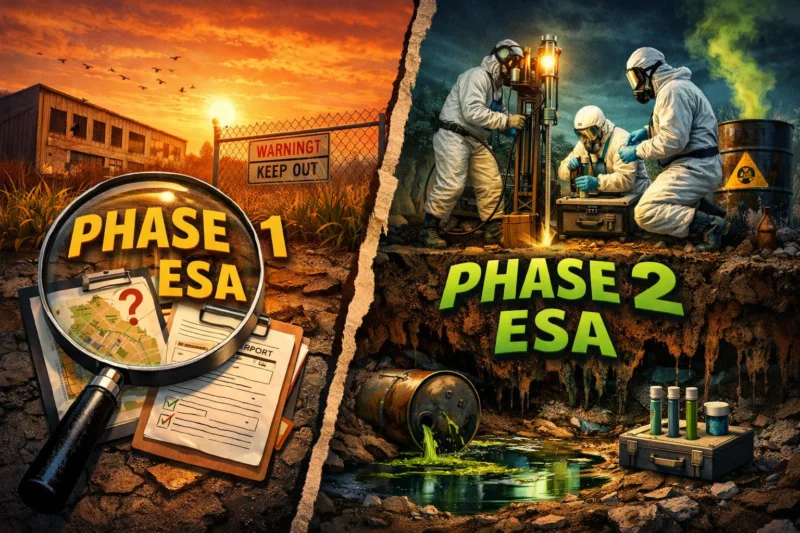
The practical difference between Phase 1 and Phase 2 Environmental Site Assessments is simple: Phase 1 identifies potential historical and current conditions that may indicate contamination, while Phase 2 confirms, quantifies, and delineates suspected issues through sampling and analytical testing. In real projects, this is often framed as phase 1 vs phase 2 ESA differences because the handoff from “potential concern” to “verified environmental condition” determines whether underwriting, purchase decisions, or redevelopment design can move forward safely. In 2026, modern workflows—including digital records, GIS mapping, and more targeted fieldwork planning—can make that handoff clearer and more defensible, even though the core standards still anchor the scope and reporting expectations. This guide is for buyers, lenders, brokers, developers, and environmental consultants who need to understand what each phase is trying to prove, what deliverables they should expect, and how decisions are typically made when evidence is incomplete or access is limited.
Phase 1 ESA vs. Phase 2 ESA: what each is designed to determine (and why it matters)
Phase 1 Environmental Site Assessments are designed to identify potential environmental risks by reviewing records and observing site conditions, resulting in conclusions about Recognized Environmental Conditions (RECs) and controlled conditions. Phase 2 ESAs are designed to confirm or rule out those potential risks by collecting samples and using laboratory testing to quantify the presence, nature, and, when needed, the extent of contamination. The “why it matters” is direct: Phase 1 helps stakeholders decide whether additional investigation is warranted, while Phase 2 helps them decide what to do next—financing, remediation planning, risk acceptance, or construction planning.
How Phase 1 works is typically anchored in a structured process: a records search (often including historical land use and regulatory listings), interviews with people who know the property or adjacent operations, and a site reconnaissance to observe current conditions. The output is not “prove contamination,” but “flag conditions that could reasonably be associated with contamination.” That distinction helps explain why a Phase 1 report can be negative for RECs yet still recommend Phase 2 in limited circumstances; uncertainty can remain due to missing records, conflicting information, inaccessible areas, or the nature of suspected releases.
Phase 2 works differently by design. Instead of relying primarily on records and observations, Phase 2 uses a site-specific work plan to select sampling locations and analytes based on the Phase 1 findings, site layout, and plausible release pathways (for example, soil to groundwater, or vapors into indoor air). In practice, Phase 2 can range from targeted confirmatory sampling (to reduce uncertainty about a narrow concern) to more extensive delineation that supports regulatory discussions or risk-based closures. The tradeoff is that Phase 2 costs and field effort are materially higher, so stakeholders want Phase 2 objectives that match the decision they are trying to make.
Real-world scenarios show how the phases diverge. A commercial property with historical dry-cleaning records may trigger Phase 2 to test for solvent-related compounds in shallow soil and groundwater. A residential property with old fill and no visible staining might still justify targeted Phase 2 if the fill origin is unclear and exposure pathways (like shallow soil contact during renovation) are plausible. Common mistake: assuming Phase 1 “negative” always means no Phase 2 ever—and then later discovering the project needed confirmation for an underwriting condition or a construction design assumption. Another guide gets this wrong by treating the phases as a checklist rather than as linked decisions driven by risk, uncertainty, and intended use.
The standard framework: ASTM E1527-21, 40 CFR Part 312 (AAI), and how they shape scope
ASTM E1527-21 and the federal All Appropriate Inquiry framework in 40 CFR Part 312 (AAI) shape what Phase 1 typically must include and how a Phase 1 report is expected to be structured for defensible due diligence. Phase 2 is not governed in the same “template” way, but Phase 1’s scope and conclusions heavily inform what Phase 2 needs to accomplish. Understanding this framework matters because stakeholders often expect Phase 1 to provide liability-related protections, and they misunderstand what those standards do—and do not—require.
In practical terms, ASTM E1527-21 is commonly used as the Phase 1 framework for identifying RECs and controlled conditions, organizing report elements, and documenting the methods used (records review, interviews, and site reconnaissance). Separately, 40 CFR Part 312 (AAI) provides the federal lens for All Appropriate Inquiry related to CERCLA liability protections, including how an inquiry must be conducted to meet AAI requirements. In many transactions, Phase 1 reports are written to satisfy ASTM concepts while also aligning with AAI expectations—particularly regarding documentation, inquiry process, and how limitations are disclosed.
Phase 2 is different: it is typically developed through a property-specific work plan rather than a universal phase template. Still, Phase 2’s scope should be logically downstream from Phase 1 findings. For example, if Phase 1 identifies potential releases associated with historical industrial operations or hazardous material storage, Phase 2 should select sampling locations that address those plausible release points and pathways. If Phase 1 notes limited access to a portion of the property, Phase 2 might include targeted sampling in accessible locations and additional strategies to reduce uncertainty where feasible.
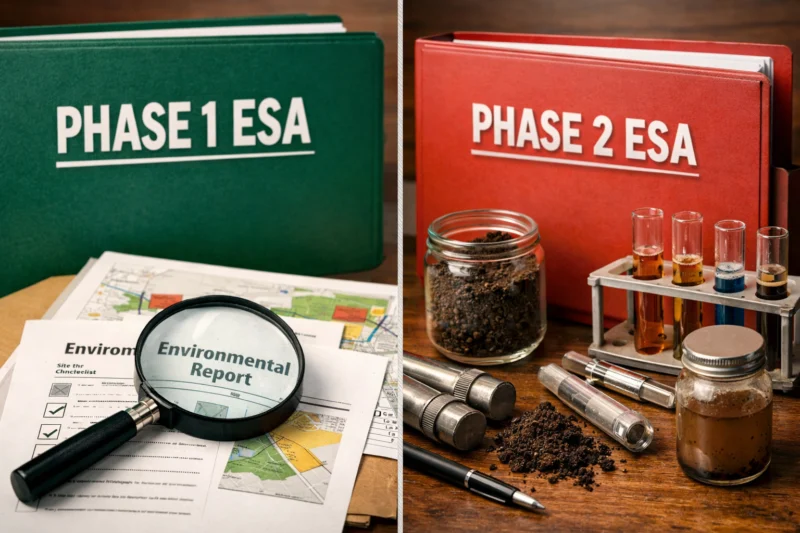
Edge cases reveal where misunderstandings create disputes. Some stakeholders expect Phase 1 to “test like Phase 2” by default; however, ASTM and AAI frameworks do not make sampling mandatory for every potential concern. Conversely, a Phase 1 might stop short of recommending sampling if it determines concerns are not credible enough or if the uncertainty is within an acceptable range for the project’s decision needs. When a budget assumes “no sampling unless there’s visible contamination,” but the lender or regulator expects confirmation, the Phase 2 objective becomes contentious. The deeper point: the standards influence the inquiry’s structure and defensibility, while project-specific risk management determines whether additional investigation is appropriate.
Sources and official guidance help ground these expectations. For AAI requirements, see EPA All Appropriate Inquiries (AAI). For ASTM E1527-21 context and general applicability of the standard framework, consult ASTM International E1527 guidance. In transaction settings, these sources are frequently used by underwriters and consultants to justify why Phase 1 is framed as records-and-observation due diligence rather than confirmatory testing.
Typical deliverables and decision checkpoints: from Phase 1 findings to Phase 2 work plans
Phase 1 deliverables typically include a site reconnaissance summary, records search results, interview documentation, maps or drawings, and conclusions identifying RECs and controlled conditions. Phase 2 deliverables then include a sampling and analytical testing plan, field and laboratory results, data interpretation, and—where needed—recommendations for delineation, risk-based action, or further study. This matters because stakeholders do not just “buy an ESA”—they need a clear decision bridge from Phase 1 uncertainty to Phase 2 objectives that match the reason the investigation is being commissioned.
What “moving to Phase 2” means operationally is where many projects stumble. After receiving a Phase 1 report, stakeholders (often the buyer, their environmental consultant, and sometimes the lender or legal team) translate the Phase 1 conclusions into Phase 2 objectives. Those objectives typically specify what conditions Phase 2 must confirm or characterize, where sampling should occur, which analytes should be measured, what QA/QC must be performed, and how results will be interpreted against appropriate benchmarks. The Phase 2 work plan becomes the contract-level “source of truth” for what the investigation is designed to prove.
Decision checkpoints usually occur when Phase 1 indicates plausible release scenarios or migration concerns. Common triggers include records or interviews pointing to historical industrial use (for instance, manufacturing, degreasing, chemical storage, or waste handling), visible or reported staining or odors, known or suspected releases (including underground storage tank indicators), evidence of landfill or uncharacterized fill, or conditions that suggest potential vapor pathways where indoor exposure could be relevant. The key tradeoff is representativeness: if Phase 1 suggests a concern but does not clearly define location and extent, Phase 2 might start confirmatory and then expand only if results exceed benchmarks or if the pattern is more widespread than expected.
Deeper insight comes from the “lack of evidence vs. evidence of absence” concept. A Phase 1 may conclude “no RECs identified” based on available records and observed conditions, but uncertainty can still remain due to incomplete historical data, undocumented tenant operations, or limited access during reconnaissance. Whether Phase 2 becomes necessary depends on risk tolerance and the decision being made. For example, a lender might require confirmation before closing if their risk policy is conservative, while a developer might accept residual uncertainty if the redevelopment plan can avoid exposure pathways and includes construction controls.
Real-world ambiguity frequently shows up as “data gaps.” If interviews are inconsistent, if the records search cannot verify historic use for a critical timeframe, or if access constraints prevent observing likely issue areas, then the Phase 2 objective may shift toward reducing uncertainty rather than proving contamination outright. This is also where disputes often begin: when Phase 2 scope does not reflect the Phase 1 limitations and assumptions, the later report may be challenged as not addressing what the decision-makers actually needed.
What Phase 2 usually includes: sampling, analytical strategy, and interpretation beyond “just testing”
Phase 2 typically includes field sampling designed to confirm suspected contamination and laboratory analysis to identify which constituents are present at what concentrations. It may also include delineation of horizontal or vertical extent and, depending on conditions, assessment of vapor pathways, building materials, or subsurface features. This matters because Phase 2 is not simply “collect samples”—it is a defensible, decision-oriented investigation that connects plausible release scenarios from Phase 1 to exposure pathways and action thresholds.
How the sampling strategy is built usually follows the logic of site history and pathways. Soil sampling might target specific depths based on the suspected source and historical operations, while groundwater sampling focuses on aquifer conditions and potential plume migration. If Phase 1 suggests volatile compounds and indoor exposure concerns, Phase 2 might include vapor assessment steps. If the property has buildings with potential material degradation (for example, in older structures) or if asbestos-related concerns are identified as separate scopes, field sampling can extend beyond typical soil/groundwater objectives—though those determinations are often managed under different compliance frameworks than petroleum or hazardous releases.
Analytical strategy should be analyte-targeted, not guesswork. A well-designed Phase 2 selects parameters based on the products used or stored (from records and interviews), plausible release mechanisms, and what receptors could be impacted. QA/QC is not optional; it ensures that the data can be defended in later reviews. Interpretation then compares results to applicable benchmarks and handles uncertainty when conditions are heterogeneous—such as when contamination appears as isolated “hot spots” or when fill materials vary across the property.
Scope variability is a major tradeoff. Phase 2 can remain relatively narrow when Phase 1 identifies a specific localized concern that can be resolved with a small set of targeted samples. It becomes larger when Phase 1 suggests widespread release potential, when fill materials and subsurface conditions are complex, or when indoor exposure pathways are plausible. The deeper issue is sampling design: biased sampling may find evidence but miss the true extent, while overly broad grid sampling can inflate cost without improving decisions if pathways are unlikely.
A common mistake is treating Phase 2 as a “one-size-fits-all” package. For instance, a Phase 2 work plan that samples only surface soil might miss the true source if the suspected release is deeper. Another mistake is weak rationale for placement and analyte selection, which can lead to inconclusive results and remobilization. Defensibility depends on how well the sampling design reflects Phase 1’s narrative and the decision needs. In modern 2026 workflows, consultants increasingly use digital mapping and GIS integration to refine sampling locations and document the traceability of decisions from Phase 1 to the Phase 2 work plan.
You can avoid rework by treating the Phase 1-to-Phase 2 transition as a structured decision, not an automatic escalation. In practice, this means aligning the Phase 2 objectives with the specific uncertainties and decision needs highlighted by Phase 1, then approving an executable work plan that explicitly addresses limitations, access issues, and defensibility requirements. This matters because most disputes are not about “whether sampling happened,” but whether sampling was designed to answer the right questions.
A useful process begins with commissioning Phase 1 with clear project objectives (for example, lender risk requirements, redevelopment planning, or purchase due diligence). Next, stakeholders should review the Phase 1 findings through the lens of RECs and controlled conditions, including any limitations in records search, interview coverage, or site access. Then, translate those Phase 1 outcomes into Phase 2 objectives that are measurable: what condition will Phase 2 confirm or characterize, and how will those results inform the final decision?
Scope alignment is a practical step that prevents common mismatches. If Phase 1 is conducted for a certain property boundary, but the redevelopment design assumes work extends beyond that boundary, Phase 2 objectives should be adjusted accordingly. If Phase 1 assumed a particular tenant operation timeframe, Phase 2 analyte selection should match that history rather than defaulting to generic suites. Governance matters too: buyers and lenders should ask whether the Phase 2 plan includes adequate QA/QC, whether sampling locations are representative, and whether the interpretation will meet the intended use.
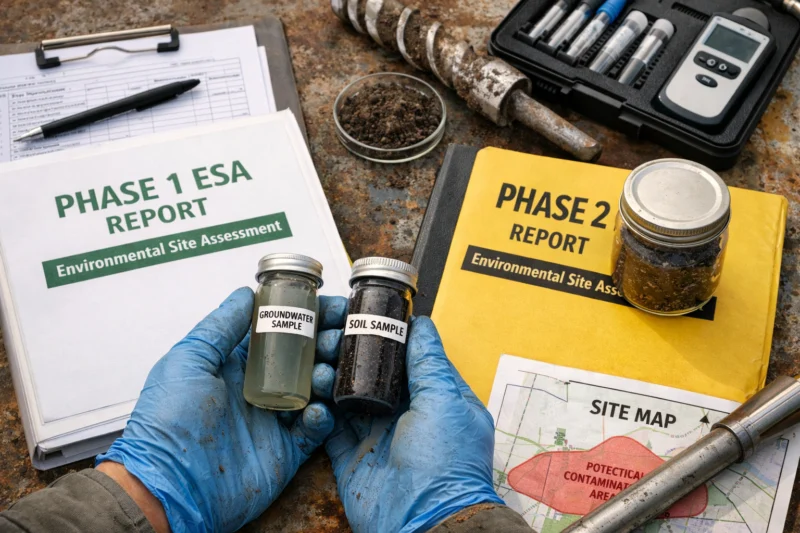
Deeper insight involves handling access limitations transparently. For example, if Phase 1 notes locked areas, occupied buildings, or refusal to grant drilling in certain zones, Phase 2 should reflect those constraints through an explicit approach—either alternative sampling strategies or clearly stated limitations that affect conclusions. A “silent assumption” (like assuming access will become available later) often leads to gaps in the final file and disagreements during underwriting review or closing discussions. Edge cases such as multiple historical tenants on a mixed-use property can also complicate objectives; Phase 2 may need to focus on the most credible release pathways rather than attempting to sample everything everywhere.
When you manage the transition well, Phase 1 context carries forward. This is similar to how strong data documentation practices improve other disciplines; for example, clear version control and traceability concepts are increasingly used in digital workflows across professional services. Getting that discipline right during ESAs helps later reviewers understand why Phase 2 was scoped the way it was, which can reduce time lost to revisions.
Common misconceptions and pitfalls in phase 1 vs phase 2 ESA differences (and how to prevent them)
The most common misconception is that a Phase 1 ESA result of “no RECs” automatically means there is no contamination. The correct framing is that Phase 1 provides a structured evaluation based on records, interviews, and site reconnaissance, and it can still leave uncertainty due to limited visibility, incomplete historical information, or inaccessible areas. Another misconception is that Phase 2 is always required after Phase 1, when in reality Phase 2 is risk- and objective-driven based on what Phase 1 indicates and what decisions are being made.
Pitfalls typically show up in how stakeholders interpret conclusions. Confusing ESA objectives is one of the most expensive errors: if the project needs design-ready information for redevelopment, the Phase 2 endpoints should reflect construction and exposure pathway planning—not only generic confirmation of chemicals. Alternatively, if the goal is lender risk support, Phase 2 might need to focus on issues that affect underwriting conditions, which could be different from a developer’s “design-ready” priorities. What many guides get wrong is focusing on “which phase comes first” rather than clarifying the evidence threshold and decision purpose.
Under-scoping Phase 2 is another frequent problem. If the work plan includes too few sampling locations, an incomplete analyte list, or weak rationale tied to Phase 1 observations, the results may be inconclusive. That can lead to remobilization, additional cost, and schedule impact. Even when the sampling finds nothing significant, stakeholders can dispute whether the sampling was representative or whether the correct pathways were assessed. A deeper failure mode is document transfer: if key Phase 1 details—such as reconnaissance limits, assumptions, or inconsistencies in interviews—are not carried into Phase 2 planning, the later work may not address what the Phase 1 report actually flagged.
Real-world example: a property’s Phase 1 suggests historical use of petroleum products in a prior tenant’s fueling activities, but Phase 2 only samples shallow soil near the current building footprint. If the plausible release point was deeper or located near a former storage area now paved over, the Phase 2 might miss the source and produce a defensible “no confirmation” result that nevertheless fails the decision-makers’ needs for redevelopment assurance. Prevention comes from reconciling Phase 1 narrative and assumptions with the Phase 2 work plan objectives before field mobilization.
Options and alternatives: when Phase 1/Phase 2 sequencing changes (and what to look for)
Not every project follows a strict, linear “Phase 1 then full Phase 2” sequence. Alternatives often exist when stakeholders want to reduce uncertainty efficiently—using targeted confirmatory work, tiered investigation, or supplemental records and reconnaissance before committing to broader sampling. This matters because “more investigation” is not always better if it does not match the specific decision being made.
One common approach is “Phase 2-triggered confirmation,” where Phase 2 is kept targeted to resolve a narrow question raised by Phase 1 (for example, confirming whether an isolated stain corresponds to a chemical release or is related to benign building materials). Another is “tiered investigation,” where Phase 2 begins with a confirmatory sampling step, and only expands to delineation if results exceed benchmarks or if the contamination pattern suggests broader impacts. A third approach is “focused building/material or vapor pathways,” where Phase 1 signals indoor exposure concerns and the project prioritizes pathway-specific evaluation rather than broad soil-only sampling.
Some projects also use “enhanced records/recon” or supplemental investigation to resolve specific data gaps before drilling. For example, if Phase 1 cannot locate critical historical documentation about past operations, a targeted supplemental records effort or additional reconnaissance may clarify whether Phase 2 should focus on petroleum, solvents, or metals. The key is that these alternatives should still produce defensible outputs—clear objectives, stated assumptions, and transparent limitations—rather than acting as informal attempts to avoid sampling.
When evaluating proposals, look for objectives and methods that are logically tied to Phase 1 findings. Even if the sequencing changes, a defensible plan should specify sampling design rationale, QA/QC, health and safety measures, and deliverable expectations. The tradeoff is scope “fit”: if budgets push a minimal sampling approach that does not match stated decision needs, the project risks inconclusive outcomes or rework. Edge cases like restricted access in occupied buildings or suspected buried tanks can make sequencing more complex; a good proposal addresses constraints in advance and explains how conclusions will be affected.
Finally, scope gaming is a hidden risk. A proposal might label itself as “confirmatory Phase 2” but include insufficient locations or a generic analyte suite that does not actually confirm the specific concern. Preventing this requires stakeholders to ask how sampling addresses plausible pathways from Phase 1 and how results will support the transaction or redevelopment decisions.
Advanced considerations (2026): technology, data platforms, and complex site edge cases
In 2026, the most meaningful ESA “advances” are often not about flashy new tests, but about better information management and defensible targeting—especially when projects involve complex histories or constrained access. GIS-based record integration, geophysical methods like GPR, drones for documentation, and digital workflows for report traceability all help teams connect Phase 1 findings to Phase 2 objectives more precisely. This matters because modern ESA scrutiny often includes review of documentation quality, QA/QC rigor, and how assumptions were derived.
Technology can enhance both phases. During Phase 1, GIS-based record integration and mapping can help organize historical uses, overlays regulatory or hazard data where appropriate, and visualize site reconnaissance observations in context. Geophysical methods such as GPR can complement investigation when subsurface conditions are uncertain, helping identify buried features that might influence sampling placement in Phase 2—though these methods typically do not replace sampling when the goal is confirmatory chemical data. Drones and photogrammetry can improve documentation of current conditions and accessibility planning, supporting better sampling location selection while improving the audit trail.
Digital workflows and data platforms are particularly important for defensibility. Digital data rooms, version control, and chain-of-custody documentation help maintain traceability from Phase 1 records and interview notes through the Phase 2 work plan and laboratory results. Data platforms for managing QA/QC metadata can ensure that sampling design rationale, deviations, and laboratory data quality indicators remain organized and reviewable. The limitation is that technology does not “make the science irrelevant”; a well-scoped sampling plan and defensible interpretation are still required.
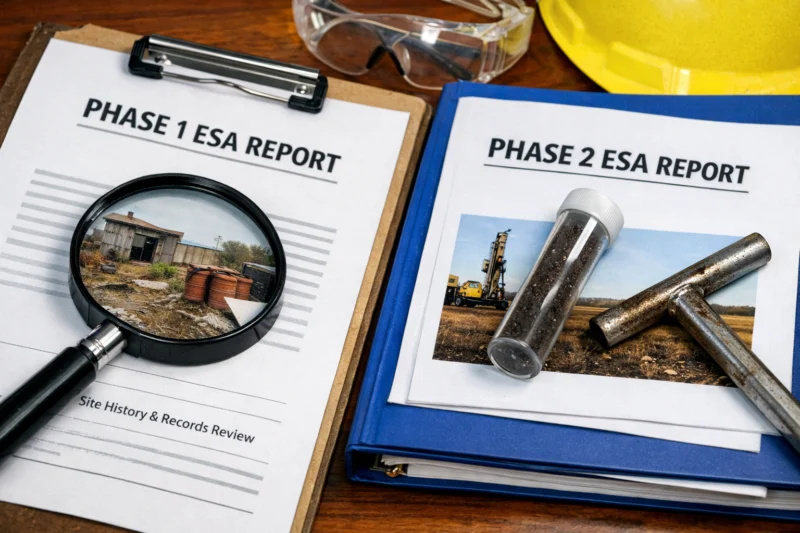
Edge cases illustrate where complexity changes execution. Mixed-use properties with multiple historical tenants may require careful interpretation of what each tenant likely did, when, and where releases could have occurred. Restricted access can shift Phase 2 into a more constrained approach, requiring explicit limitations and alternate confirmation strategies. Suspected buried tanks and complex fill materials can create heterogeneous conditions where sampling design must be robust to avoid missing hot spots. Even after Phase 2, regulatory and stakeholder complexity can require additional modeling or risk assessment steps depending on the use-case, exposure pathways, and local requirements—meaning Phase 2 is often a milestone, not always the final chapter.
From an admissibility and defensibility perspective, digital evidence trails and QA/QC rigor can matter later in audits or disputes. The deeper insight is that investigators should plan data structure up front: consistent identifiers for sample points, clear mapping between Phase 1 concerns and Phase 2 targets, and transparent handling of deviations make later reviews faster and less contentious.
Real-world focus: property transaction contexts (commercial, residential, redevelopment) and what changes between phases
Phase 1 vs Phase 2 ESA expectations can shift depending on whether a project is a commercial acquisition, a residential transfer, or redevelopment that will change the site’s exposure conditions. The core logic remains the same—Phase 1 flags potential issues, Phase 2 confirms and characterizes them—but the “what counts as enough” and the endpoints Phase 2 must support can differ substantially. This matters because stakeholders often use the same vocabulary (“Phase 1 negative,” “Phase 2 confirms”) while relying on different decision needs.
For commercial real estate, lender and underwriter expectations tend to focus on transaction risk, financing readiness, and defensible uncertainty management. If Phase 1 identifies a plausible source area, Phase 2 might be scoped to confirm concentration ranges and pathway relevance in a way that supports underwriting conditions. A common scenario is a multi-tenant property where a current tenant’s operations are not the historical concern; Phase 2 may need to focus on historic source zones identified during interviews and records review to support the lender’s risk model.
For residential transfers, the sensitivity to exposure receptors can be higher because indoor air and near-surface impacts are often more directly relevant to occupants. If Phase 1 suggests volatile compounds, shallow soil impacts, or uncharacterized fill, Phase 2 may expand to include pathway-based considerations. Tradeoff: homeowners and buyers may prefer minimal intrusion, but the work plan must still be defensible and responsive to plausible release scenarios. A Phase 2 that does not address indoor exposure potential when it is credible may be viewed as not meeting decision needs.
Redevelopment and new construction introduce another dimension: construction pathways. Phase 2 often needs to anticipate how excavation, grading, and engineered fill reuse could disturb contaminants and change exposure conditions. This can increase the importance of delineation and clarity on whether materials can be reused on-site or require specific handling. Deeper insight: scope drift across stakeholders is common. Brokers may want “transaction-only” reassurance, developers may want “design-ready” data, and consultants must reconcile these needs to avoid rework.
In 2026, digital records and more structured documentation help stakeholders manage this drift, especially when multiple parties review the file. When Phase 1 findings are mapped clearly to Phase 2 objectives, decisions tend to be cleaner and negotiations reduce friction.
Frequently Asked Questions About Unpacking the Differences: Phase 1 vs. Phase 2 Environmental Site Assessments
What triggers a Phase 2 Environmental Site Assessment after Phase 1?
Phase 2 is typically triggered when Phase 1 identifies RECs or controlled conditions that suggest a credible potential for release or migration. Common triggers include historical industrial operations, records indicating chemical use or disposal, indications of tanks or landfill fill, and observed conditions such as staining, odors, or distressed soils. The decision also depends on project objectives and what level of uncertainty the stakeholder can accept; sometimes a limited confirmatory Phase 2 is chosen rather than a broad investigation.
Can a Phase 1 ESA be considered “enough” for a transaction without Phase 2?
Yes, a Phase 1 ESA can be sufficient when the report identifies no RECs (and limitations are acceptable), or when the project’s decision-makers accept residual uncertainty based on risk tolerance. If Phase 1 concludes “no evidence of contamination,” that still reflects the scope of inquiry and available information, not proof of absence everywhere. In practice, lenders or regulators may still request targeted Phase 2 when a concern remains plausible or when access and records limitations are material to the decision.
How do ASTM E1527-21 and 40 CFR Part 312 (AAI) relate to Phase 1 and Phase 2?
ASTM E1527-21 provides a commonly used framework for Phase 1 ESA scope and reporting elements, including how RECs and controlled conditions are identified. 40 CFR Part 312 (AAI) provides the federal framework tied to All Appropriate Inquiry for CERCLA liability protections, which influences how the Phase 1 is conducted and documented. Phase 2 is generally not defined in the same standardized way by these references; instead, Phase 2 is scoped property-specifically to address Phase 1 uncertainties through sampling and analysis.
What does a Phase 2 work plan normally include and who approves it?
A Phase 2 work plan normally includes objectives tied to Phase 1 findings, a sampling design (locations, depths, and rationale), analyte selection, and QA/QC procedures. It should also include health and safety requirements, drilling or sampling methods, and a plan for interpreting results. Approval is typically handled by the environmental consultant’s client, with lender or legal stakeholders sometimes involved depending on the transaction’s requirements.
What’s the difference between identifying a REC and proving contamination in Phase 2?
RECs are identified when Phase 1 finds conditions that indicate a potential for contamination based on records, interviews, and site observations; they are not confirmation. Phase 2 proves (or rules out) contamination by measuring concentrations of specific constituents using laboratory testing and then interpreting results against applicable benchmarks. Because Phase 1 addresses plausible risk rather than definitive presence, the evidence threshold is lower in Phase 1 than in Phase 2.
How long does it usually take to go from Phase 1 to Phase 2?
The timeline varies based on access constraints, the complexity of the suspected release, and lab turnaround for analytes. Scheduling can also be affected by permitting or site logistics for drilling, plus the time needed to develop a defensible Phase 2 work plan aligned with Phase 1 findings. A thorough Phase 1-to-Phase 2 transition often takes longer when stakeholders require clear documentation for underwriting review, disputes prevention, or regulatory alignment.
Can Phase 2 results change the conclusions of Phase 1, and how are conflicts handled in the final file?
Phase 2 can lead to updated conclusions about the presence and extent of contamination, which may effectively refine how the Phase 1 concerns are interpreted. However, Phase 1 typically remains part of the original record; the final file generally includes both reports and may add an update or revised conclusion statement to reconcile findings. Consultants handle conflicts by clearly documenting what Phase 2 confirmed, what limitations remain, and how conclusions were revised to match the measured data.
What are the most common sampling design mistakes that lead to inconclusive Phase 2 results?
Inconclusive results often stem from a sampling design that is not representative of the suspected source area or does not address plausible release pathways. Other frequent issues include an analyte list that does not match the site history, too few sampling locations, and weak rationale tied to Phase 1 observations. Poor QA/QC documentation can also undermine confidence in the data and complicate interpretation.
Do I need Phase 2 if Phase 1 notes “historical operations” but no odors or visible staining?
You may, depending on how credible and specific the historical records are, whether critical source areas are accessible, and whether the project needs confirmation for its decision. Absence of odors or visible staining reduces the likelihood of an active or near-surface release, but it does not eliminate uncertainty if records indicate plausible releases or buried features. Often, a targeted confirmatory Phase 2 is used to resolve the specific uncertainty rather than performing broad sampling everywhere.
Is vapor intrusion assessment considered part of Phase 2, and when is it needed?
Vapor intrusion assessment can be part of the Phase 2 effort when Phase 1 suggests credible volatile compounds, potential subsurface migration, and plausible indoor exposure pathways. It is usually triggered by the combination of chemical plausibility and pathway relevance, such as certain historical uses, nearby industrial sources, or evidence of volatile constituents. In practice, the Phase 2 approach may include pathway-specific sampling and evaluation rather than defaulting to a full soil-and-groundwater program.
Conclusion
The core distinction behind Unpacking the Differences: Phase 1 vs. Phase 2 Environmental Site Assessments is that Phase 1 identifies potential conditions and frames risk through records and observations, while Phase 2 confirms and quantifies conditions through sampling and interpretation. The goal isn’t just sequencing; it is decision clarity. Phase 2 scope should be driven by Phase 1 findings plus the actual choices stakeholders need to make—financing, redevelopment design, exposure controls, or risk-based next steps.
To keep the process defensible, align objectives from the start: document what Phase 1 concluded, explain what uncertainty remains, and carry those limitations into the Phase 2 work plan. Before spending on drilling and laboratory testing, compare consultant proposals against standard expectations rooted in ASTM E1527-21 and 40 CFR Part 312 (AAI) concepts for Phase 1 documentation, then verify how those Phase 1 outcomes translate into measurable Phase 2 objectives. A well-run Phase 1-to-Phase-2 review meeting with stakeholders typically reduces rework because everyone agrees on what Phase 2 is meant to prove.
Call to action: ask your consultant to clearly map Phase 1 RECs or controlled conditions to Phase 2 sampling locations, analytes, and decision endpoints. If that mapping is missing or the work plan cannot explain why specific samples address the concerns, you are likely heading toward inconclusive results or disputes later.
Updated August 2026