
A Phase 1 Environmental Site Assessment is done to “unlock” the environmental story of a property for smarter, defensible decisions—before anyone digs, installs wells, or confirms contamination. At its core, it structures how qualified professionals review records, speak with knowledgeable people, and conduct phase 1 ESA site reconnaissance (the on-the-ground observation portion) to identify Recognized Environmental Conditions (RECs) and potential pathways. For 2026 practice, the goal is consistent: produce a standards-based, auditable report that supports due diligence, risk allocation, and—where required—environmental inquiry documentation tied to ASTM E1527-21 and the AAI framework under 40 CFR Part 312. This article breaks down the key components that make a Phase 1 useful in real transactions: what to look for in the evidence chain, how reconnaissance feeds REC determinations, what limitations must be stated, and why component-level quality often matters as much as the final “REC vs. no REC” outcome.
What is a Phase 1 Environmental Site Assessment for, and what decisions does it “unlock”?
A Phase 1 Environmental Site Assessment (ESA) is for structured environmental due diligence: identifying potential environmental concerns that could affect a property’s risk profile and future decisions. Instead of confirming contamination, it documents inquiry and observations designed to reveal Recognized Environmental Conditions (RECs) and related uncertainties that decision-makers must understand early.
What “unlocks” in practice is not a lab result—it’s a defensible narrative. Buyers, lenders, developers, and attorneys use Phase 1 outputs to decide whether to proceed, negotiate, restructure terms, require additional investigation, or address risk allocation in agreements. A strong report helps stakeholders answer, “What do we know? What don’t we know? What evidence supports our understanding? And what should we do next if potential issues exist?”
This is why component quality matters. A report is only as defensible as its evidence chain: document review (history), interviews (people’s knowledge), and phase 1 ESA site reconnaissance (observable conditions and apparent releases). Those inputs are then organized into REC determinations supported by clear reasoning. When a consultant skips a component, uses generic assumptions, or fails to document limitations, the report may still “look complete,” but its decision value can drop—especially when counsel needs to justify how environmental inquiry was performed.
A deeper way to think about the outcome: Phase 1 is a screening investigation performed with professional judgment. It can support determinations like REC, non-REC, or “controlled REC” where applicable; it can also identify potential pathways that drive next steps. What it cannot do is confirm the type, concentration, extent, or fate of contaminants. Understanding that boundary helps stakeholders avoid overreaching conclusions and instead select the right follow-on actions when evidence indicates higher likelihood.
What core purpose outcomes and “defensibility” look like in a Phase 1 ESA
The core purpose of a Phase 1 ESA is to identify RECs (and related conditions) that could pose environmental risk and influence transaction or redevelopment decisions. Defensibility is the measurable quality of that inquiry: whether the report shows that it followed an appropriate, auditable process based on evidence.
In a typical Phase 1, the outcome is expressed as determinations and conclusions grounded in supporting information. For example, a property may receive a “REC” for a credible industrial use in the past with corresponding on-site indications, while another portion of the site may be “no REC” because evidence supports a non-environmental explanation. Importantly, the report usually distinguishes between observed conditions, plausible sources, and the reasoning that connects them—without claiming more certainty than the inquiry supports.
Defensibility matters because Phase 1 results often become part of a compliance or legal record. Under the AAI framework in 40 CFR Part 312, the expectation is that the “all appropriate inquiry” process is documented using a structured approach to inquiry, including evidence of how information was obtained and evaluated. ASTM E1527-21 provides the standard structure many consultants adopt to align with those inquiry expectations—though meeting the spirit of a standard still depends on fulfilling the report’s required inquiry elements.
Practically, stakeholders use Phase 1 outcomes in different ways. Lenders may rely on the report to understand risk and collateral considerations; buyers may use it to guide due diligence and negotiation; attorneys may rely on it to evaluate whether inquiry documentation is adequate if issues later surface. Real-world scenarios show that the “defensibility” signal is usually found not only in the conclusion, but in the report’s internal logic: how the chronology supports interview questions, how reconnaissance observations map back to documents, and how uncertainties are stated.
A common mistake is treating Phase 1 as a yes/no pass for contamination. Even if the report finds no RECs, it’s not a promise that contamination is absent. It’s a conclusion about what could be supported based on inquiry and reconnaissance limitations. Conversely, if RECs are identified, Phase 1 usually does not confirm contamination—but it often identifies the right next-step categories so the parties can choose whether to proceed with limited-scope or intrusive investigation.
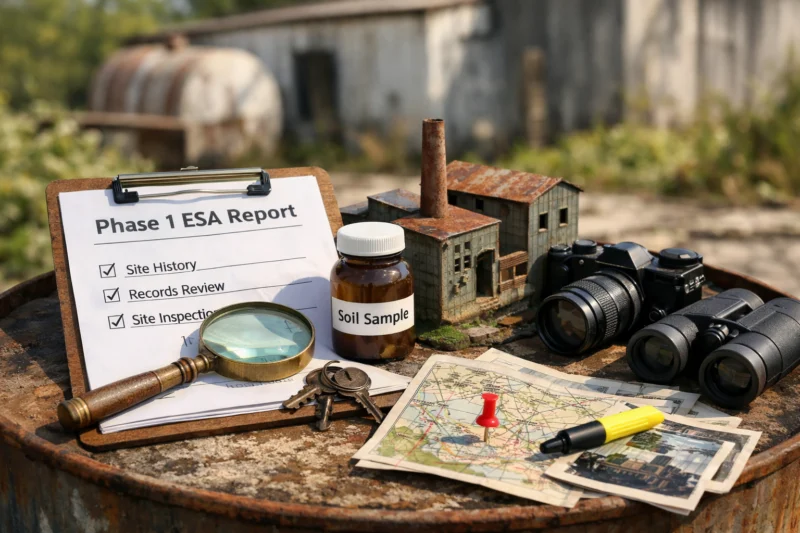
Which standards and regulations govern the key components of a Phase 1 ESA?
ASTM E1527-21 is the primary standard that governs how a Phase 1 ESA is structured, including data review, interviews, and site reconnaissance components. For regulatory alignment of inquiry documentation, the ASTM framework is commonly paired with the AAI concept under 40 CFR Part 312.
Why this matters: “key components” are not arbitrary. ASTM E1527-21 organizes the inquiry into specific pathways—document review, interviews, and a site reconnaissance—then ties those inputs to REC determinations. When a consultant follows those expectations consistently, the report tends to be easier to defend because the reasoning aligns with recognized professional practice.
AAI under 40 CFR Part 312 is a regulatory context that influences what documentation should show. While Phase 1 reports are not the same thing as an environmental compliance permit, the inquiry documentation needs to support the idea that environmental due diligence was performed appropriately. In practice, consultants often reference how their process fits inquiry expectations and ensure the evidence trail is clearly described: what was reviewed, who provided information, and what observations were made.
Misunderstandings happen when teams confuse “following ASTM” with “meeting AAI documentation expectations.” A report can cite ASTM E1527-21 and still be weak if it omits required inquiry elements (for example, insufficient interview coverage, inadequate evaluation of records, or poorly documented reconnaissance limitations). Another common problem is using outdated workflows. In 2026, reputable firms make sure they’re using the current ASTM version and not relying on older templates that may omit elements or phrase opinions differently than the current standard expects.
For 2026 readers, a practical tradeoff is that “more pages” is not automatically “more compliance.” The key is that each component adds decision value: history review creates hypotheses, interviews test those hypotheses with human knowledge, and phase 1 ESA site reconnaissance verifies what is visibly observable and how apparent conditions can be interpreted. When the components don’t interlock, the report becomes harder to defend even if it appears polished.
To ground your expectations, see ASTM E1527-21’s role in professional practice via ASTM E1527-21 and the federal AAI concept in 40 CFR Part 312. For background on what environmental assessment frameworks aim to support, the EPA’s broader due diligence context can be found in EPA Brownfields and Environmental Assessment Resources.
How do document review components build the environmental “story” before the site walk?
Document review is the Phase 1 component that builds the property’s likely environmental history before anyone walks the land. It creates a chronology of land use, operational clues, and reference points that guide what the consultant should look for during reconnaissance.
Document review typically covers historical land use records, maps and plats, regulatory and government databases, aerial imagery, previous environmental reports, and ownership/occupancy history. The “how it works” part is about aligning timeframes: what was happening when, where potential chemical activities occurred, and what changes in use may create new or different environmental risks. Chronology matters because plausible RECs are usually connected to specific practices (storage of solvents, fuel handling, waste disposal, equipment maintenance) and often tied to particular areas.
Practically, a good document review also identifies gaps. Records can be missing, contradictory, or ambiguous—especially on older properties, parcels with multiple owners, or sites with partial demolition and later re-use. The report should show how gaps were handled: whether additional records were requested, how inconsistencies were flagged for interview follow-up, and what limitations were accepted due to available information. If a consultant simply assumes “nothing happened” because the record is incomplete, the report loses decision value and can become difficult to defend.
Another deeper detail involves boundary and background-area sensitivity. Phase 1 often considers whether adjacent or off-site conditions could influence the property’s environmental context without asserting causation. Document review can help the consultant understand nearby land uses, utilities, or historic features that may explain environmental signals—or help frame why a signal likely is not attributable to the property.
Tradeoffs exist. Thorough history review takes time and can increase cost, but it can reduce uncertainty later by narrowing hypotheses for interviews and reconnaissance. A real scenario: a redevelopment team might discover that a property was historically used as a machine shop and later converted to light office use. Even without sampling, the historical record can direct interview questions about waste disposal practices and inform the reconnaissance to focus on likely storage or loading areas. If the document review is weak, the reconnaissance can become aimless, and REC determinations become more speculative.
How do interviews and information-gathering support RECs in a Phase 1?
Interviews are how Phase 1 turns human knowledge into structured, auditable evidence that supports or refutes potential environmental conditions. They help connect the document-reviewed history to what people remember about chemical handling, maintenance practices, and releases.
Interview targets commonly include current owners/operators, past owners/operators, and occupants/tenants, plus local contacts when relevant. How it works is straightforward: the consultant asks questions aligned with likely RECs suggested by document review—then summarizes what was learned, when it occurred, and what evidence supports the statements. The output should clearly indicate uncertainty and not treat recollection as an infallible fact.
Why it matters: interviews often provide context for conditions visible during reconnaissance. For example, a person may recall that a basement area once held drums of cleaning solvents or that a boiler room had specific waste disposal practices. Alternatively, an interview may contradict a record: a historical map might suggest industrial use, but an interview could explain that the area was storage-only and that certain chemicals were never used there. The report should show how those statements were reconciled.
Practical application includes documenting who was interviewed, the date of interviews, and how summaries were recorded. A strong report also deals with incomplete memory and bias. People may remember the “general” activity but not specific dates, volumes, or disposal methods. The consultant’s job is to translate that into a professional judgment statement: what is supported, what is uncertain, and what might warrant further inquiry if there is conflicting evidence.
Deep insight: what most guides get wrong is treating interviews as a checkbox. If interviews are not designed to test the document-driven hypotheses, you may collect irrelevant details that do not meaningfully contribute to REC determinations. Conversely, if an interview suggests a release or unusual handling but reconnaissance could not access relevant areas (locked doors, restricted roofs, limited ground access), the report must state those limitations and avoid overclaiming.
Tradeoff: expanding interview scope can sometimes be difficult when past personnel are unavailable or when confidentiality limits access. Still, high-quality Phase 1 reports typically demonstrate that interview targets were chosen with reasoning and that the evidence trail shows how uncertainty was handled.
How is Phase 1 ESA site reconnaissance planned, performed, and documented?
Phase 1 ESA site reconnaissance is the on-site observation component conducted to identify observable signs of environmental conditions and apparent releases. It is planned to maximize information within reasonable access and safety constraints and then documented so it ties back to the document review and interviews.
How it works begins before the walk. Consultants plan reconnaissance with safety, weather considerations, site access permissions, and the ability to observe representative conditions. Then they follow an observation approach that is typically organized by categories such as structures, ground conditions, staining or odors, waste handling areas, utilities, and evidence of past releases. Path-of-travel logic matters: the walk should be structured so the consultant can describe how observations relate to site layout, not just provide random snapshots.
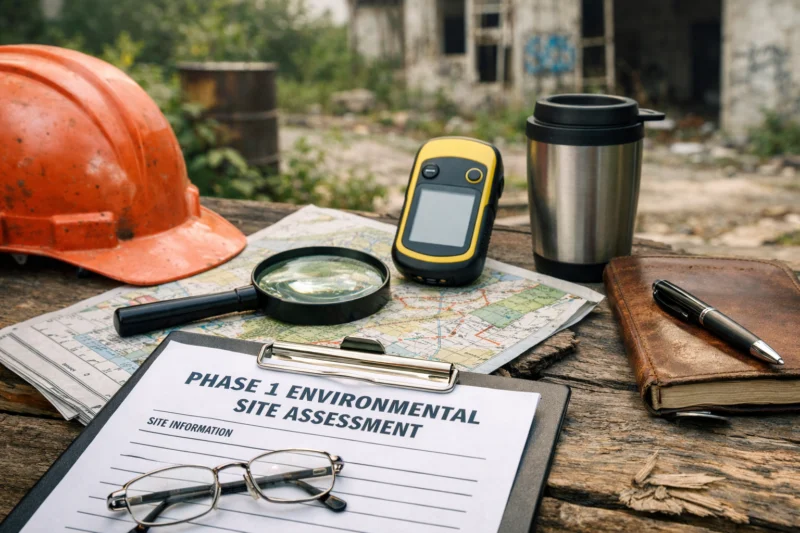
During the walk, the consultant documents photographs, location descriptors, and narratives describing apparent conditions. If the consultant sees what might be an environmental release (for example, stained soil, stressed vegetation, pooled liquids, chemical containers, or damaged storage infrastructure), the report should describe the condition in detail and explain plausible interpretations. The “recon-to-report linkage” is critical: each notable observation should connect back to the evidence chain, such as the relevant historical use and interview statements.
Tradeoffs and limitations must be documented carefully. Real-world constraints include locked buildings, inaccessible basements or attics, vegetation cover, weather that prevents full ground observation, seasonal conditions, and restricted access to adjacent boundaries. In these situations, the report should not imply certainty about areas it did not observe. Instead, it should state what was limited and how that limitation affects confidence in conclusions.
Edge case: limited access can be common for large parcels or multi-tenant buildings. A consultant might be able to observe only perimeter areas, while interior mechanical rooms remain off-limits. A well-documented reconnaissance will specify what was observed externally, what was inaccessible, and what assumptions—if any—were not made. The report should also reflect that “inaccessible” is not the same as “no problem,” so REC determinations are framed accordingly.
Another deep nuance involves how reconnaissance observations influence REC determinations. Some observations may support an environmental interpretation and become part of a REC or potential REC rationale. Others may be explained as non-environmental (e.g., landscaping treatments, benign staining from building materials) with plausible support. When that interpretation is weak or undocumented, stakeholders lose defensibility—even if the overall conclusion could have been favorable.
How are RECs and report outputs determined without overclaiming?
RECs are determinations that arise from the combination of historical evidence, interview information, and site reconnaissance observations. A Phase 1 report structures these outputs clearly—so decision-makers can understand what conditions are recognized, which ones are potential, and where uncertainty remains.
In practical terms, the report may identify RECs, potential RECs, and sometimes controlled RECs where applicable, then provide bases for each. The consultant decides whether an observed condition is “environmental” (or plausibly environmental) versus “non-environmental” based on the total evidence. This is where overclaiming can occur if the consultant treats visible clues as confirmation of contamination. A Phase 1 is not designed to prove the presence of contaminants; it’s designed to identify conditions that warrant concern and further evaluation.
Typical report sections readers rely on include a site description, the historical review chronology, interview documentation and summaries, a reconnaissance narrative, and appendices such as references and supporting materials. The outputs should read like an evidence trail: each conclusion should cite or logically connect to specific supporting information. For example, if a REC is identified based on historical use, the report should explain which activities occurred, where within the property they likely occurred, and how reconnaissance observations or interview statements align.
Deeper insight: uncertainty language must be supported by facts. “We suspect” statements should be limited and explained through the evidence limitations that drive professional judgment. If the consultant did not have access to a key area, that limitation should appear in the reconnaissance section and again in how it affects REC determinations. Good reports also avoid conflating probability with proof—so they can responsibly recommend next steps without implying that contamination exists.
What happens next is part of the component purpose. Buyers and lenders commonly use Phase 1 findings to determine whether to proceed and with what risk mitigations. Attorneys may evaluate how the report would hold up if questions arise later. In many cases, Phase 1 findings lead to targeted follow-on investigation where specific uncertainty is highest—rather than broad intrusive work across the entire property.
A common mistake is treating the “no REC” outcome as a guarantee. Another is treating a single observation as the sole driver of a REC determination. Both mistakes can be avoided when the report’s outputs clearly reflect the full component chain: document review → interviews → phase 1 ESA site reconnaissance → REC reasoning.
What common mistakes and misconceptions undermine Phase 1 quality and AAI defensibility?
Phase 1 reports fail when they are treated like “sampling-lite,” when history and limitations are handled casually, or when documentation is not built to be auditable. These issues can undermine AAI defensibility even if the report cites ASTM E1527-21.
One misconception is that Phase 1’s lack of sampling means the process is casual. In reality, Phase 1 relies on a structured inquiry and professional judgment supported by evidence. Overinterpreting visible conditions without adequate context is another failure mode. For example, a stained patch might be interpreted as chemical release without considering whether it aligns with landscaping practices, building materials, or known spills that are documented differently.
Skipping or under-scoping history is frequently problematic. Without a strong chronology, interviews may become unfocused and reconnaissance may not target plausible risk areas. That results in REC decisions that either overreach or appear arbitrary. Similarly, mishandling access limitations can weaken defensibility: if locked areas, seasonal constraints, or unclear boundaries are not documented in detail, later reviewers may question what was truly known.
Deeper issues involve boundaries and off-site causation. Phase 1 often includes context about adjacent areas, but it should avoid claiming causation beyond what evidence supports. A report can recognize that adjacent land uses may affect environmental context without asserting that off-site sources are responsible for on-site conditions. Misstatements here can trigger legal or technical objections.
Finally, relying on older standards or generic templates is a subtle but serious issue. If a consultant uses outdated ASTM expectations or fails to conduct the regulatory inquiry search in a current and documented manner, the report may not align with 2026 expectations of professional practice. The remedy is not just updating forms—it’s ensuring the process reflects current requirements for inquiry structure and documentation.
Real-world scenario: a transaction team signs a Phase 1 quickly, focusing on the conclusion line. Later, a new buyer’s counsel requests detail about interview coverage and limitations. If the report does not clearly show who was interviewed, what documents were searched, and what areas were not observed, the inquiry record may be less usable for risk allocation discussions.
What options exist besides a Phase 1 when real projects need different investigation depth?
Phase 1 is often the starting point, but it is not the only due diligence option. When Phase 1 flags RECs or high uncertainty, teams can choose next steps such as targeted limited-scope investigation, confirmatory sampling, or broader intrusive phases.
How decisions are made starts with REC determinations and the reasons behind them. A REC driven by a specific suspected release area might justify targeted work focusing on that area, rather than sampling everywhere. Conversely, if the uncertainty is broad (for example, undocumented fill across much of the property), the team may choose a more comprehensive characterization plan. The key is logic: Phase 1 informs what uncertainty exists and where it is most plausible.
Tradeoffs matter. Targeted investigation can be faster and cheaper, but it depends on well-defined hypotheses created during Phase 1. If Phase 1 is weak—unclear reconnaissance notes, incomplete chronology, or untested interview statements—then the targeted plan may miss the most relevant areas. Broader intrusive investigation can reduce uncertainty but increases cost and time, and it may introduce operational disruptions.
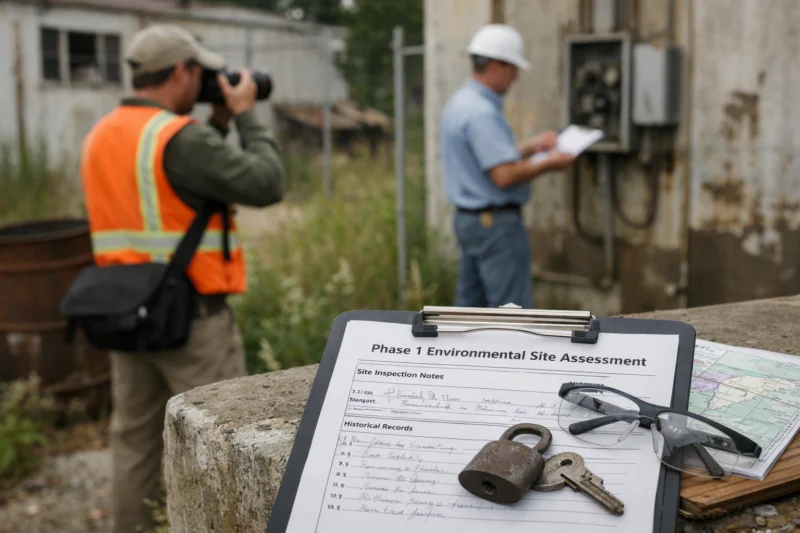
Alternative due diligence formats can also exist as long as they remain standards-based and evidence-driven. However, if a process is positioned as “equivalent” without fulfilling comparable inquiry elements, it may not satisfy the same decision and defensibility expectations. In other words, alternatives should not replace the component chain without showing comparable rigor in documentation.
Edge case: redevelopment projects sometimes require earlier investigation when physical design depends on subsurface conditions (for example, new foundations, cap design, or utility trenching). Even then, teams generally still benefit from Phase 1 because it helps scope intrusive investigation intelligently. Phase 1 is the foundation for selecting the right next category, not a substitute for intrusive confirmation when conditions are suspected.
If you’re working through this planning logic, a useful checklist approach is to compare what Phase 1 identified (RECs and evidence gaps) versus what follow-on work intends to confirm (presence, extent, or risk drivers). That alignment reduces the chance of “sampling without a question.”
[Advanced] How do modern work reduce uncertainty for gray-area objections—without creating compliance gaps?
Modern work reduces uncertainty by improving documentation traceability and selectively applying screening tools, but it must remain consistent with ASTM E1527-21 and the inquiry/documentation expectations of AAI. The goal is to answer objections with evidence and clearer linkage—not to present unapproved screening as compliance-equivalent to intrusive confirmation.
Edge cases include properties with undocumented fill, mixed-use buildings, industrial-adjacent parcels, historic redevelopments with unknown buried utilities, and sites with evidence that conflicts across documents, interviews, and observations. When objections arise (“Why wasn’t X followed up?” “Why weren’t areas opened?” “Why is this condition not a REC?”), the best response is the report’s internal audit trail: evidence sources, rationale, limitations, and consistent reasoning across components.
In 2026 practice, innovation categories can strengthen traceability when used appropriately. GIS and spatial mapping workflows can help consultants layer historical uses over current parcel boundaries, improving context checks while still documenting the basis for any conclusions. GPR (Ground Penetrating Radar) may be used selectively as screening support in limited scenarios where it is appropriate and properly documented; however, it does not replace the inquiry structure and cannot replace confirmatory sampling if contamination is suspected. Drones or ortho-imagery can support certain reconnaissance tasks where roofs, large lots, or inaccessible views need better documentation, again with clear limitations and without overstating what imagery can prove.
Digital workflows and data platforms also matter: they can link photo IDs → observation descriptions → supporting records, making it easier to demonstrate recon-to-report linkage. The tradeoff is “innovation risk.” If a consultant uses new technology, they must still meet the same core reporting expectations. Technology cannot be presented as a substitute for inquiry elements, and it should not convert Phase 1 into something it is not—especially regarding confirmation of contamination.
Common objection themes can be addressed with a disciplined component response. For example, if a condition is argued as a REC but the evidence is weak, the report should explain why the observed condition is interpreted as non-environmental (with plausible alternative explanations) and how limitations were documented. If additional inquiry wasn’t performed, the report should show access constraints or evidence insufficiency rather than silence.
What most guides get wrong is implying that technology alone improves defensibility. It only does so when it strengthens the component chain: it must improve how document review, interview summaries, and phase 1 ESA site reconnaissance are connected and how uncertainties are accurately stated.
Frequently Asked Questions About Unlocking the Secrets: Key Components of a Phase 1 Environmental Site Assessment
What exactly qualifies as a “site reconnaissance” component in a Phase 1?
Site reconnaissance is the on-site observation portion of the Phase 1 inquiry, where the consultant documents apparent conditions relevant to environmental risk. It includes structured walking or observation methods, photographs, location descriptors, and a written narrative of what was seen and how it was interpreted. It also requires careful documentation of limitations such as locked areas, seasonal constraints, or inaccessible surfaces.
How do ASTM E1527-21 and 40 CFR Part 312 (AAI) affect what must be included?
ASTM E1527-21 guides how the inquiry is structured into components like document review, interviews, and site reconnaissance, and it shapes how the report should be organized and supported. 40 CFR Part 312 provides the regulatory AAI framework, which emphasizes documented, reasonable inquiry. Together, they influence what evidence should be gathered and how uncertainty and limitations should be recorded in the report.
What should a buyer look for in the Phase 1 report sections before signing?
A buyer should review not only the conclusion, but also the evidence trail that supports it: the chronology from document review, the scope and results of interviews, the reconnaissance narrative, and the statement of limitations. Look for clear REC determinations tied to specific observations and supporting records, plus an explanation of why areas were not fully accessed. The strongest reports make it easy to see how the consultant arrived at professional judgment.
How are interviews used to support or refute possible environmental conditions?
Interviews are used to gather information about how chemicals and materials were stored, used, maintained, or disposed of and whether any spills or unusual events occurred. A well-written Phase 1 summarizes what was said, identifies the interviewee’s relationship to the property, and links statements to the documented history and reconnaissance observations. If recollections conflict with records or observations, the report should show how uncertainty was handled.
What happens when historical records are incomplete or contradictory?
When records are missing or conflict, a consultant should document the gap, reconcile inconsistencies as much as possible, and explain what additional inquiry—if any—was pursued. The report should avoid overconfident conclusions based on assumptions not supported by evidence. Uncertainty should be expressed through professional judgment that reflects both what was learned and what could not be verified.
Can Phase 1 findings ever be used to confirm contamination?
No—Phase 1 is not designed to confirm contamination, and it does not provide the type of results that sampling provides. Phase 1 can identify RECs and conditions that warrant further investigation, but it cannot confirm the presence, type, or concentration of contaminants. Any language implying confirmation should be treated as a red flag unless supported by appropriate intrusive testing.
In practice, what are common “limitations” and how should they be described?
Common limitations include restricted access (locked areas, inaccessible interior spaces), weather or seasonal conditions that reduce visibility of ground surfaces, and constraints that prevent full observation of certain structures. Good reports describe exactly what was limited, what areas or conditions were affected, and how that influences confidence in the conclusions. Limitations should be stated clearly rather than implied.
When is it reasonable to consider sampling or a limited-scope intrusive investigation after Phase 1?
It can be reasonable when Phase 1 identifies RECs, potential RECs, or evidence gaps that make it unlikely that the risk can be responsibly characterized without additional work. A typical trigger is a specific suspected release area or a credible history of chemical handling coupled with insufficient confirmation. Next steps should follow the uncertainty drivers identified in Phase 1 rather than sampling the entire site without a defined rationale.
How should a consultant handle off-site conditions that might influence the property?
A consultant should use off-site evidence to provide context, such as nearby historical land uses, but avoid asserting causation without support. The report should differentiate between environmental context and property responsibility and should explain how off-site information was evaluated relative to on-site observations and boundaries. Unsupported statements about causation are a common weakness in lower-quality reports.
phase 1 ESA site reconnaissance: what level of access and observation is expected?
Phase 1 site reconnaissance is expected to be planned and performed using reasonable access opportunities while respecting safety and legal constraints. Inaccessible areas should not be assumed “clear”; instead, limitations should be documented and considered in REC reasoning. Typically, consultants aim to observe representative areas, structures, and visible ground conditions that are relevant to likely environmental concerns.
How do modern digital tools (GIS, data platforms) change the quality of Phase 1 documentation?
Modern digital tools can improve traceability by linking photos, observation notes, maps, and supporting records into a consistent evidence trail. GIS workflows can also help layer historical land uses over current parcel boundaries, which supports context evaluation. However, digital tools do not replace inquiry components; the underlying document review, interviews, and phase 1 ESA site reconnaissance still need to meet ASTM E1527-21 and AAI documentation expectations.
Conclusion
Unlocking the secrets of a Phase 1 ESA comes down to the component chain: document review builds the environmental story, interviews convert people’s knowledge into auditable evidence, phase 1 ESA site reconnaissance captures what is observable, and the report then translates that evidence into REC determinations with clearly stated limitations. When those components connect coherently, the output becomes decision-ready for buyers, lenders, and attorneys.
In 2026, the quality signals are consistent: an evidence trail you can audit, limitations described with specificity, reconciliation of conflicting information, and alignment with recognized inquiry structure under ASTM E1527-21 and AAI documentation expectations in 40 CFR Part 312. Phase 1 isn’t a substitute for sampling when confirmation is needed, but it is the foundation for choosing the right next-step category logically and defensibly.
If you’re selecting a consultant or relying on a report for a transaction decision, use a component checklist mindset: review the sections that build the case (history, interviews, reconnaissance, and limitations), not only the final conclusion line. The most actionable reports help stakeholders understand what to do next, whether that’s proceeding, negotiating based on recognized risk, or requesting targeted follow-on investigation where uncertainty is highest.
Updated August 2026