
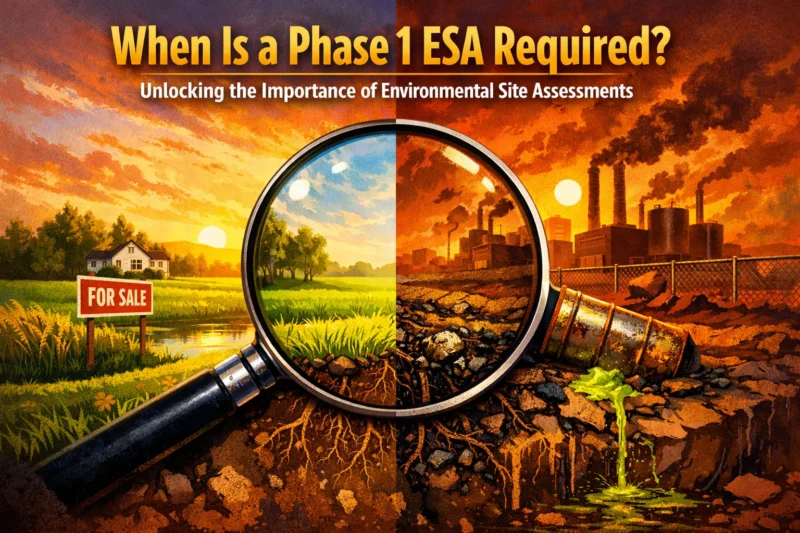
In most real estate and lending transactions, a Phase 1 ESA is required when the deal structure, contract language, lender or investor underwriting policies, or applicable regulations call for baseline environmental due diligence. But “when is a phase 1 ESA required” can’t be answered with a single universal rule because it depends on jurisdiction, property history, and who is asking for protection. This is exactly why environmental site assessments matter: they establish a defensible “starting point” for decision-making, especially when contamination risk is uncertain and timing is tight. In 2026, the expectations behind “baseline” due diligence commonly mirror ASTM E1527-21 practices and the federal environmental liability protection concept tied to 40 CFR Part 312 (AAI), though exact requirements vary by state and transaction.
In this guide, you’ll learn the real-world triggers that make Phase 1 ESA ordering effectively mandatory, how lenders and counterparties interpret report adequacy, what the Phase 1 process actually does (and what it does not do), and which misconceptions most often derail closings. You’ll also get a practical decision path you can use early in underwriting, including recency considerations and what to do if you’re unsure whether a full Phase 1 is necessary.
For context, many U.S. due diligence workflows use ASTM E1527-21 as the practical framework for professional documentation. If your transaction is aimed at liability protection outcomes, federal concepts under 40 CFR Part 312 (AAI) focus on appropriate investigation and follow-up actions when conditions are identified. For regulatory background on environmental cleanup programs and obligations, the U.S. EPA’s Brownfields and liability information can help frame why “baseline” due diligence often appears in deal documents: EPA Brownfields. For the ASTM standard itself, consult ASTM E1527-21 information (access may require membership or purchase depending on ASTM policy).
What “required” really means for a Phase 1 ESA in real transactions (not just regulations)
A Phase 1 ESA is considered “required” in practice when the transaction requires a baseline environmental assessment that can be relied upon for financing, risk allocation, or liability protection planning. Even if no law directly mandates a Phase 1 for a specific address, lenders, investors, and sellers’ counsel often treat it as a non-negotiable condition to move forward without unacceptable uncertainty.
It helps to think of “requiredness” in three layers. First are legal or program triggers: some jurisdictions and cleanup frameworks require certain assessments for specific redevelopment activities or when a party is seeking participation in a program. Second are financing and risk policy requirements: many underwriting policies call for a Phase 1 to control the possibility of undisclosed contamination affecting collateral value. Third are contract and closing conditions: parties may include representations, warranties, and conditions precedent that require an ESA baseline before closing or before proceeds are released.
In the 2026 environment, Phase 1 expectations often align with ASTM E1527-21 elements because it provides a widely understood professional structure for identifying “Recognized Environmental Conditions” and documenting the basis for the findings. Where transactions are connected to the federal liability protection concept known as All Appropriate Inquiry, the “due diligence baseline” emphasis becomes even more important. At a high level, 40 CFR Part 312 (AAI) is about demonstrating that the buyer undertook appropriate investigation and acted appropriately based on what was found—meaning a Phase 1 that is incomplete, stale, or mis-scoped can undermine the practical defensibility of the diligence record.
Who orders the ESA matters just as much as whether an ESA exists. Buyers typically commission Phase 1 ESAs for their own planning and negotiation leverage, while lenders may require that the buyer provide a report that meets their criteria. Sellers sometimes provide an ESA to limit their disclosure exposure, but they may seek limits on reliance or add conditions that affect how the report can be used. In real deals, the “requiredness” question is often really a reliance question: who can rely on the documentation and under what scope boundaries.
Real-world scenario: imagine purchasing a mixed-use property where ground-level retail is new, but historical records show a prior dry-cleaning business in one portion of the building decades ago. Today the site “looks clean,” but the transaction terms may still require a Phase 1 because solvents and disposal practices can leave risks even after operations stop. In that scenario, “required” usually reflects lender comfort and decision governance rather than visible evidence.
Deeper insight (edge case): a Phase 1 can be “required” yet still be inadequate for the transaction’s specific protection goal if the report’s scope assumptions don’t match what the parties needed. For example, if the Phase 1 is based on limited site access or fails to document key records searches for the property’s historic land uses, a counterparty may accept it for general underwriting but push for an addendum or additional investigation planning.
Common mistake: assuming that “no Phase 1 in the law” means “optional in the deal.” Many closings fail not because the law was ignored, but because a lender policy or contract condition precedent was not satisfied.
When is a Phase 1 ESA typically needed for a deal to move forward?
A Phase 1 ESA is typically needed when transaction risk cannot be underwritten without a baseline environmental due diligence record. The most common triggers are not abstract “environmental requirements,” but very specific deal moments—new financing, new ownership, redevelopment decisions, and collateral protection needs—that make environmental uncertainty unacceptable.
The most frequent transaction triggers include purchase and sale of real property, refinancing or new lending, and certain forms of redevelopment or ground-leasing with substantial obligations. Foreclosure risk and workouts are also common triggers because lenders’ collateral decisions often shift from “paper underwriting” to “real risk ownership.” Another common scenario is when intended use changes: converting a historically commercial site into offices, housing, or sensitive occupancy can create new concerns even if the building has been renovated.
Property history signals strongly influence whether a Phase 1 becomes “required.” Examples include prior industrial operations, properties with underground storage tanks (USTs) or aboveground storage tanks (ASTs), dry cleaners, bulk chemical storage, electrical substations, rail-adjacent operations, or sites near landfills or documented releases. Importantly, a property may not appear risky today; the “need” often comes from what was done there before, what was disposed of, and what records show about past practices. Adjacent impacts matter too: an area that hosted manufacturing can have off-site pathways that still influence what is prudent for baseline due diligence.
“New information” can also trigger ordering (or re-ordering) a Phase 1. Title amendments, updated ownership history, newly discovered leases or documents, or changes to the intended footprint can shift the risk picture. If a Phase 1 was done early in the process but the deal later learns of a relevant historic operation, lenders and counsel often want the Phase 1 updated or supplemented.
How the ESA supports decision-making: a Phase 1 doesn’t just label risk; it structures how risks are treated. When it identifies Recognized Environmental Conditions (RECs), it typically informs whether Phase 2 sampling or targeted investigation is likely, which affects both budget and schedule. Even when RECs are not identified, the report’s documentation of data gaps and limitations influences how counterparties judge the certainty of the conclusions.
Tradeoff to understand: delaying the Phase 1 until late in the process can force costly renegotiations at closing. If the lender or contract expects a report with certain scope and recency, ordering too late can lead to either a rushed addendum or a refusal to accept the record as meeting the requirement.
What most guides get wrong: they list generic “regulated items” and stop there. In real deals, the trigger is the combination of (1) transaction timing, (2) collateral significance, and (3) historic uncertainty, which then determines how quickly and how defensibly the team needs a baseline report.
A practical decision path: how to determine when a Phase 1 ESA is required (criteria + process)
To determine when a Phase 1 ESA is required, you need a decision path that matches deal milestones to environmental risk baseline needs. Start by collecting property history and deal requirements early, then align the Phase 1 scope and recency to what lenders and counsel can accept.
A practical “intake → records review → site reconnaissance → screening → reporting” sequence is usually how a Phase 1 is structured. The records review identifies what relevant agencies, historical sources, and property documentation say about past uses and potential regulated activities. Site reconnaissance (typically limited to what an environmental professional can observe safely and appropriately) checks for visible indicators and confirms context. The reporting then screens for Recognized Environmental Conditions and documents the basis for whether RECs are identified or whether data gaps and limitations exist.
The moment “required” gets decided often happens before the environmental professional begins. A transaction team can use pre-screening questions to triage whether a full Phase 1 is prudent or likely to be required anyway. For example: What is the address and how long has the property been in the current configuration? Were there known industrial operations, USTs, or dry-cleaning uses? Are there adjacent operations that could reasonably affect the site? If you can’t answer these clearly—or your lenders ask for baseline due diligence—then commissioning a Phase 1 early is often the safest path to avoid closing surprises.
In terms of documentation defensibility, many teams expect Phase 1 work to follow ASTM E1527-21 practices at least in the sense of including the relevant conceptual elements: appropriate records review, reasonable site reconnaissance, interviews where applicable, and a structured reporting of RECs and data gaps. That does not mean every report looks identical, but it does mean counterparties expect a professional basis rather than a casual review.
Recency matters: an “old” Phase 1 can be treated differently depending on deal timing and whether known conditions or uses have changed. If the Phase 1 is several years old, redevelopment plans changed, access was limited, or new records suggest prior industrial operations that were not addressed, counterparties may require an update or addendum. Conversely, if the property history is stable and the report is recent enough for the deal and lender policy, a re-use may be acceptable—sometimes with limited supplemental documentation.
Edge cases: inherited properties, parcels with unclear legal descriptions, tenant-only knowledge gaps, and partially demolished structures can constrain what a Phase 1 can observe. In those cases, a “required” Phase 1 may still be needed, but the report will likely include limitations. The right response is not to ignore the limitations; it is to plan defensible next steps if the limitations increase uncertainty.
Tradeoff: commissioning a full Phase 1 may feel like extra process if the property appears low-risk. However, the alternative is often greater uncertainty at closing, where lenders may either deny reliance or require additional investigation planning that could have been structured earlier.
When lenders, investors, or landlords demand a Phase 1 ESA (AAI and risk management context)
Lenders, investors, and sometimes landlords demand a Phase 1 ESA when they need a defensible baseline to control underwriting uncertainty and to allocate liability risk before money moves. Even if the property seems benign, financial institutions often treat environmental due diligence documentation as part of prudent risk management.
Under the federal environmental liability framework concept tied to 40 CFR Part 312 (AAI), the idea is that a buyer should undertake appropriate inquiry and then respond appropriately if it later learns of conditions that indicate contamination risk. Phase 1 documentation can support that narrative because it records what was investigated, what sources were consulted, whether RECs were identified, and what follow-up actions are suggested when conditions are identified. That said, AAI does not “automatically” result in protection simply because a Phase 1 exists. The practical question is whether the Phase 1 is appropriate to the transaction, sufficiently scoped, and supported by reliable documentation consistent with professional expectations.
Investors and lenders also focus on scope boundaries and reliance. A report might be technically acceptable as a general environmental assessment but not meet a lender’s required scope for reliance. If the report included limited access areas, relied on assumptions that the lender does not accept, or was prepared for a different party without the right reliance language, the lender may request an updated report or addendum before underwriting approval is finalized.
Deal timing is a major driver. If Phase 1 is delayed until after letter of intent or financing underwriting, the transaction team may discover—at the worst moment—that the report is stale or missing required information. In that scenario, “required” becomes a logistical emergency rather than a planned due diligence step.
Practical application: bring legal counsel, the environmental consultant, and the transaction team into the conversation before work begins. Align on what the lender expects (recency, reliance, scope, and reporting elements), and confirm whether an addendum/update logic is already acceptable if new information emerges. This early alignment reduces the risk of rework.
Common mistake: treating lender conditions as paperwork only. In practice, lenders use Phase 1 findings to guide underwriting questions such as whether collateral value could be impaired, whether additional investigation is likely, and whether additional mitigation should be planned.
How to respond: if a lender demands a Phase 1, ask for the specific acceptance criteria (recency, reliance, standards alignment). Then ensure the Phase 1 deliverable is built to that acceptance standard rather than assuming all Phase 1 reports are interchangeable.
Common mistakes and misconceptions about when a Phase 1 ESA is required
The biggest misconceptions about when a Phase 1 ESA is required lead teams to underestimate how “history” and “documentation quality” affect deal readiness. The most frequent failures are not about obvious contamination; they’re about unseen risk and incomplete due diligence records.
Misconception: “If there’s no smell or visible staining, an ESA isn’t needed.” Many contaminants do not create immediate visible signs, and historic use can create risk long after operations stop. Dry-cleaning solvents, certain industrial wastes, and petroleum releases can leave effects that are not detectable visually. Even if the property appears pristine, lender underwriting may still treat baseline due diligence as necessary because it establishes whether risks are unknown versus known.
Misconception: “A Phase 1 is always a one-and-done.” In real deals, Phase 1 reporting recency and changes to the intended use can force updates or addenda. If a new tenant lease is signed, if redevelopment changes the footprint, or if records searches reveal a relevant historic operation, counterparties may demand supplemental documentation. A Phase 1 can remain useful, but the “required” question changes as facts evolve.
Mistake: relying on incomplete or non-standard reports. Many counterparties expect work that is consistent with ASTM E1527-21 practices in both substance and documentation. “Consistent” means you can trace the basis for conclusions, understand limitations, and see how the consultant addressed relevant records and reconnaissance observations.
Deeper insight: confusion often arises between “no RECs identified” and “no further investigation needed.” A Phase 1 might identify no RECs but still document data gaps and uncertainties, especially for older records or constrained access areas. In such cases, a lender may still require a risk-informed planning step for Phase 2 if the project’s intended use is sensitive or if the cost of uncertainty is high.
Procurement pitfall: ordering too late. If the Phase 1 is not ordered until after underwriting relies on it, scope limitations might surface after closing timelines have tightened. That can reduce negotiating leverage and increase the chance that you’ll need costly supplemental work on short notice.
What most guides get wrong: they focus on “what triggers RECs” and ignore what triggers “acceptance.” Requiredness is frequently a function of what the lender or contract will accept as sufficient proof of baseline inquiry—not just what the property seems to be.
Alternatives and options: what to do if you’re wondering whether a Phase 1 ESA is necessary
If you’re unsure whether a Phase 1 ESA is necessary, you still need a defensible decision path that aligns with how lenders and counsel evaluate risk. In many cases, the safest alternative is not skipping environmental due diligence—it’s choosing the right starting level and documenting the recommendation.
Approach category 1: proceed with a Phase 1 ESA when triggers are uncertain or when financing and contractual requirements may apply. This is often the correct choice if you can’t quickly confirm historic land use, the property has a complex tenancy profile, or you anticipate lender questions about baseline due diligence. The tradeoff is cost and time, but it reduces uncertainty at closing.
Approach category 2: targeted pre-screening or records-only review as early triage. This can help identify whether a full Phase 1 is likely warranted by highlighting known historic uses and potential data gaps. The limitation is that records-only work typically cannot replace the “reconnaissance + professional evaluation” component that counterparties expect for a defensible Phase 1 baseline.
Approach category 3: commission an expanded or scoped Phase 1 when site history suggests likely data gaps or higher risk. For example, if historic records suggest possible regulated activities but site access is constrained, the environmental professional may recommend additional targeted steps within the Phase 1 framework or supplemental procedures. The tradeoff is that you may still end up planning Phase 2 if RECs or uncertainties are elevated.
Approach category 4: plan Phase 2 preparation earlier when records and reconnaissance strongly suggest likely releases. If the evidence points toward significant potential contamination, you may not want to “wait for Phase 1 to clear” because it can delay action. Still, Phase 1 principles matter: you must document what was known, what was investigated, and why the next steps are reasonable.
| Alternative approach | Best use case | Limitations | When it likely won’t satisfy lenders/AAI expectations |
|---|---|---|---|
| Records-only pre-screen | Early triage when deal facts are incomplete | Typically lacks site reconnaissance and structured professional screening | When the lender requires a full Phase 1 baseline deliverable for underwriting |
| Scoped “expanded Phase 1” | Complex history, access constraints, or sensitive intended use | May increase cost and still requires careful reporting of limitations | When the lender demands strict reliance language or specific Phase 1 elements |
| Phase 2 planning early | Evidence suggests likely release that needs sampling strategy | May not replace baseline due diligence documentation | When the deal requires a Phase 1 record to establish the investigation narrative |
Deeper insight: decision governance matters. If you choose an alternative, ensure your consultant provides a documented recommendation that explains why the alternative is sufficient for the current decision point and what would trigger moving to a full Phase 1. That documentation is what helps lenders and counsel accept your logic.
What to ask your consultant: “What would make a lender refuse this approach?” If you can identify the failure modes upfront, you can pick the right baseline work before deadlines compress.
Advanced considerations: complex sites, objections, and edge cases that change the “required” answer
On complex sites, the answer to when a Phase 1 ESA is required can change because the expected confidence level—and the documentation burden—rises with uncertainty. Multi-parcel properties, brownfield-like redevelopment, rail-adjacent contexts, and constrained access can turn a “maybe” into a “required for closure.”
Complex sites include multi-parcel acquisitions where not all parcels have equal history, former industrial campuses with many former buildings, and properties that have undergone extensive historic alterations. Brownfields with phased redevelopment are another challenge: even if one phase looks finished, the next phase may uncover historic disposal pathways. Rail-adjacent properties may require careful evaluation of off-site impacts and historic land use patterns. In each case, counterparties may require a Phase 1 that is more detailed in record gathering and reconnaissance than a standard “single parcel, single building” scenario.
Data quality and limitations also change requiredness. City directory gaps, missing archives, demolished structures removing evidence, or constrained access areas (fences, occupied units, utility work) can increase uncertainty. A strong Phase 1 does not ignore uncertainty; it documents limitations and indicates whether those limitations reduce the reliability of conclusions and whether additional investigation planning is prudent.
Objections are common and often revolve around “we already have an older Phase 1” or “we have certifications.” If an existing Phase 1 is stale, the consultant must evaluate whether an update/addendum is needed. If environmental certifications exist, they may address certain compliance programs but not necessarily the baseline “investigation narrative” a lender needs. If only leasing knowledge is available (tenant-only records without a full property view), a Phase 1 may still be required to create a property-wide baseline.
Deeper insight (edge case): RECs versus atypical conditions. Sometimes the site history suggests a certain risk pattern, but actual conditions (or lack thereof) lead to unusual documentation outcomes. Consultants may still identify data gaps or discuss uncertain pathways. The transaction team must understand that uncertainty itself can trigger additional planning because lenders do not finance “unknown” risk easily.
Common mistake: assuming that a report with “no RECs” ends the discussion. For sensitive intended uses (or where access limits are high), counterparties may still require Phase 2 planning if the limitations prevent meaningful exclusion of risk.
To address these issues, align objections early with documentation goals. Ask counsel and the lender what they need to accept and how they treat limitations. Then select the appropriate scope for Phase 1 (or scoped alternatives) so the requiredness question stays consistent across the transaction timeline.
Innovation in Environmental Site Assessments: how modern data tools influence practical requirements
In 2026, modern data tools influence how Phase 1 ESAs are executed and documented, but they rarely replace the need for a Phase 1 baseline when the deal requires it. Instead, innovation can improve defensibility, reduce uncertainty, and strengthen the professional record that lenders and counsel rely upon.
Innovation categories relevant to Phase 1 outcomes include GIS mapping for property and adjacent land use context, analysis of historical aerial imagery, and enhanced digital record management that improves traceability of sources. Some projects also use drone-assisted reconnaissance where permitted and safe, especially for large sites or to supplement limited viewpoints. While tools like GPR (ground-penetrating radar) may be used in certain contexts, they do not automatically convert a Phase 1 into a Phase 2 sampling program; the key is that they support professional judgment and reconnaissance-level understanding without replacing ASTM-style conceptual elements of Phase 1 deliverables.
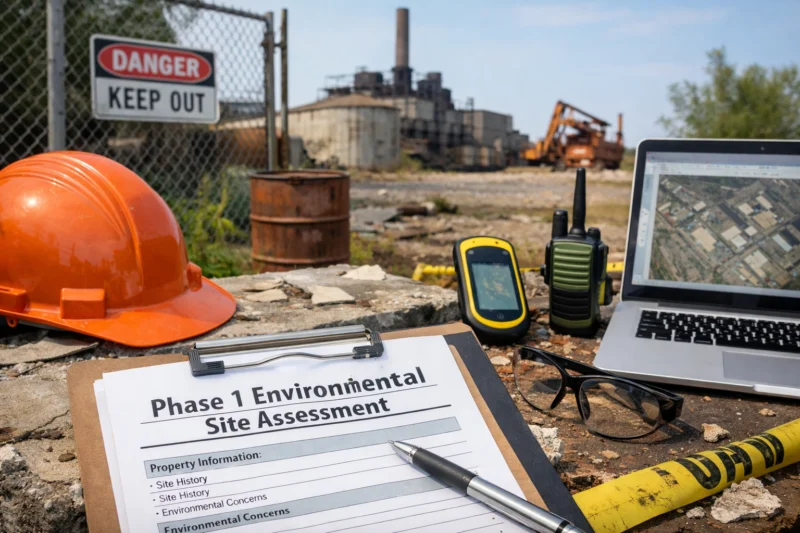
Digital workflows support better decision-making by making it easier to integrate records, map sources to findings, and maintain chain-of-custody for evidence like scanned maps, historical documentation, and interview notes. They also improve reproducibility: if counterparties question a source, the consultant can show where it came from and how it was used. This matters because requiredness is often driven by acceptance—lenders want to understand not just the outcome, but the basis for the outcome.
Practical application: when you interview environmental consultants, ask how they present data sources, how QA/QC is handled for geospatial layers or historical map interpretations, and whether the report clearly documents limitations. You can also ask how the consultant handles “new information” scenarios—whether they have a structured method for producing addenda when a new historic use is discovered.
Tradeoff and boundary: tools supplement judgment; they don’t eliminate the need for professional judgment and reporting structure. If a transaction contract requires a Phase 1 baseline deliverable, innovation typically helps you meet the requirement more confidently, not avoid it.
Common mistake: assuming that “more technology” means lenders will waive a baseline report. Most lenders still require the Phase 1 deliverable because it creates a standardized due diligence narrative consistent with accepted professional expectations.
Geography and jurisdiction: state and local factors that shape when a Phase 1 ESA is required
“Requiredness” is shaped by jurisdictional rules and local context, so the right answer depends on where the property is and how the transaction is structured. Even when federal concepts like AAI are relevant, state programs and local land use history can determine which documentation is expected and when.
In general, federal environmental due diligence concepts do not automatically translate into a single property-level mandate across all states. Many states have their own cleanup frameworks, brownfields programs, reporting triggers, and documentation requirements tied to redevelopment or changes in ownership. That means a Phase 1 ESA might be optional under a narrow reading of law in one state, but still required by a lender policy or contract clause elsewhere.
Local land use context can also influence the outcome. For example, zoning history may suggest long-standing industrial operations, and municipal records may reveal prior permits, enforcement, or reported releases even if visible conditions appear normal today. Record availability varies by location, so you may need a more robust records approach if local archives are incomplete or require more time to retrieve.
Deeper insight: lender and investor policies often override jurisdictional variability. A lender with conservative environmental risk management may require the Phase 1 regardless of state-level rules, because their goal is to standardize underwriting. So jurisdiction is not the only determinant; it’s one input to the requiredness calculation.
Practical next step: use a scoped checklist method for your state and property type. Decide which records sources to pull, how to document the search, and when to escalate questions to counsel or to a consultant. If you are working under tight deadlines, ask the environmental consultant to confirm anticipated records availability so you can plan around delays.
For background on how environmental liability and cleanup programs interact with redevelopment decisions, you may find EPA Brownfields helpful as a starting point for understanding why baseline due diligence often matters in redevelopment contexts.
Frequently Asked Questions About Environmental Site Assessments in Phase 1 Context (Required timing + decision drivers)
Is a Phase 1 ESA required by law for every property purchase?
No—there is not always a nationwide “Phase 1 is required by law for every property purchase” rule. Instead, requiredness usually depends on the state, the property’s history and classification, and how the transaction is structured (for example, whether it is tied to a specific cleanup program). Many Phase 1 ESAs are required because lenders and contract terms demand baseline due diligence, even when the law itself does not.
How do I know when is a phase 1 ESA required for my transaction?
Start by checking deal triggers: purchase/sale, refinancing, new lending, redevelopment, and any lender or investor policy conditions. Then review property history signals such as prior industrial operations, USTs, dry-cleaning use, bulk chemical storage, and landfill proximity. If you cannot confidently rule out relevant historic uses—or a lender requires baseline due diligence—you should plan for a Phase 1 early and align scope and reliance expectations with counsel.
Does refinancing require a Phase 1 ESA?
Often, yes—lenders commonly require a Phase 1 ESA for refinancing because it supports collateral risk underwriting and documentation of due diligence. The report’s “recency” becomes critical: if the existing Phase 1 is older than the lender’s acceptance window or if land uses changed, an update or addendum may be required. Some lenders may have exceptions for clearly low-risk properties, but those are usually policy-based rather than universal.
Can I reuse an existing Phase 1 ESA report from a previous transaction?
Sometimes, but it depends on recency, changed conditions, and whether the report’s scope matches the current deal assumptions. If the intended use has changed, access constraints changed, or new information suggests a historic operation not addressed previously, an addendum is likely needed. You also need to ensure reliance language and lender acceptance criteria match the current transaction.
What standards should my Phase 1 ESA follow in 2026?
In 2026, many Phase 1 ESAs are expected to follow ASTM E1527-21 practices as the professional documentation framework. That typically means the report includes a structured records review, reasonable site reconnaissance, screening for Recognized Environmental Conditions, and clear documentation of limitations and data gaps. While the standard name matters, what really matters for acceptance is whether the deliverable is defensible and consistent with professional expectations for baseline due diligence.
What is the connection between Phase 1 ESAs and 40 CFR Part 312 (AAI)?
Phase 1 ESAs are often connected to AAI because they help document what a buyer investigated before or during acquisition and what they did based on the findings. 40 CFR Part 312 (AAI) is about appropriate inquiry and follow-up when conditions are identified; Phase 1 documentation can support that due diligence narrative. However, AAI outcomes depend on the overall investigation approach and whether appropriate responses occur when risk is identified.
What happens if Phase 1 identifies a Recognized Environmental Condition (REC)?
If RECs are identified, counterparties typically consider whether additional investigation planning is warranted (often Phase 2), because RECs indicate that contamination may be present or that further characterization is needed. The underwriting and negotiation impact can be significant: it may affect cost, schedule, and risk allocation language in the deal. The exact response depends on the nature of the REC, the property’s intended use, and the lender’s policy.
Are there situations where a Phase 1 ESA might not be necessary?
There are rare situations where a full Phase 1 might not be required by the lender or contract—such as narrowly defined low-risk scenarios with strong supporting documentation. However, pre-screening or records-only reviews usually cannot fully replace a baseline Phase 1 deliverable when lenders expect reconnaissance and a structured screening narrative. If you are uncertain, it is safer to treat the Phase 1 as required from a practical standpoint until a consultant and counsel confirm otherwise.
What are the biggest red flags that suggest I should require a Phase 1 ESA even if records look clean?
Big red flags include historic industrial uses you discover midstream, adjacent operations that could affect the site, and meaningful data gaps where records are incomplete or inconsistent. Another red flag is a change in intended use that increases sensitivity, such as converting commercial space to residential or adding new subsurface work. Finally, limited site access or demolition that prevents meaningful reconnaissance can also increase uncertainty, making baseline documentation more important.
Do leases require Phase 1 ESAs, and who pays for them?
Leases may require Phase 1 ESAs depending on the lease terms, lender requirements for financing the landlord or tenant improvements, and whether the deal includes environmental representations and risk allocation. Who pays depends on negotiation and responsibility allocation: the party seeking baseline due diligence usually commissions the report, but landlords may require it as a condition of the lease. The requiredness often becomes clear through the lease’s conditions precedent and notice/review provisions.
How long does the Phase 1 ESA process take, and can timing affect whether it’s “required”?
The process timing varies based on record retrieval needs, site access logistics, and consultant workload, but timing can strongly affect whether the Phase 1 becomes practically “required” to meet underwriting or closing deadlines. If you order late, you may end up needing addenda due to new information, which can delay closing. Many teams avoid this by commissioning early enough that any limitations or update needs can be addressed before the lender’s decision point.
Conclusion: using the requiredness decision framework to prevent costly surprises
A Phase 1 ESA is typically “required” when the transaction needs baseline environmental due diligence to satisfy lender or investor underwriting, contract closing conditions, or liability protection planning expectations. In 2026, those expectations commonly mirror ASTM E1527-21 documentation practices and may relate to federal AAI concepts under 40 CFR Part 312 (AAI), but the actual requiredness depends on jurisdiction, property context, and deal structure.
The practical takeaway is simple: if there is meaningful historic use risk, underwriting uncertainty, or a lender/contract condition that depends on baseline inquiry, treat the Phase 1 as required from a planning standpoint and align scope, recency, and reliance early. Avoid the common mistakes of assuming “no visible issues” means “no need,” or assuming a Phase 1 is always one-and-done. Instead, make the requiredness decision based on deal triggers, documented limitations, and how counterparties accept the deliverable.
Call to action: confirm requirements with your lender and counsel early, then engage an environmental professional to determine whether a Phase 1—or an appropriately scoped alternative—fits your specific transaction. A strong next step is to start with a property history intake checklist and ask for a documented recommendation for Phase 1 vs. alternatives before key milestones. If you want a repeatable governance approach, begin with a property history/intake checklist and request a documented recommendation for Phase 1 vs. alternatives before key milestones.
If the report identifies Recognized Environmental Conditions, use the result to plan defensible next steps rather than reacting at closing. For readers building ongoing transaction readiness, the same kind of structured planning also supports better documentation workflows for related due diligence tasks across projects, including records management and decision-ready reporting.
Updated August 2026