
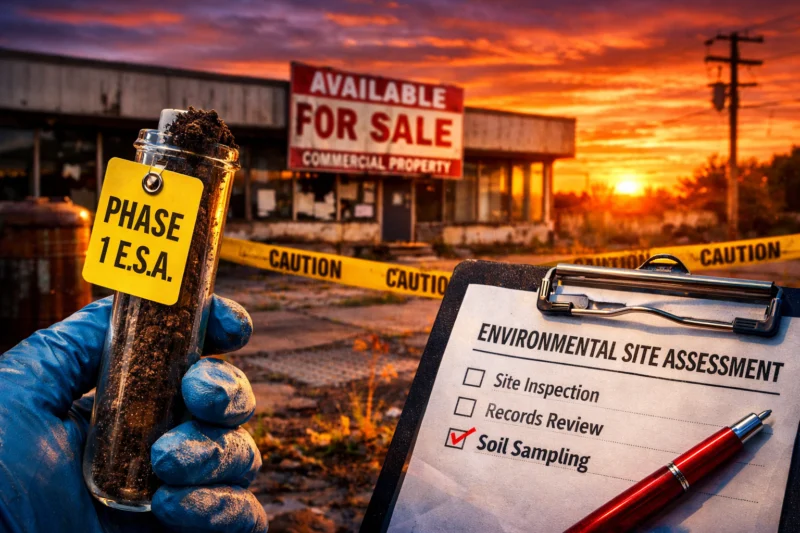
A Phase 1 assessment in commercial real estate is a structured environmental due diligence review designed to document a property’s history and current observations so parties can identify recognized environmental conditions (RECs) and decide what to do next. In many deals, especially where lenders, investors, or regulators expect defensible documentation, it becomes non-negotiable because it helps prevent “surprise” liabilities, supports risk allocation, and reduces the odds of avoidable transaction delays. In practice, you’ll often see Phase 1 reports referenced alongside a commercial real estate phase 1 ESA request in financing and investment checklists—yet the core value remains the same: evidence-based clarity before money changes hands. Importantly, Phase 1 is not a cleanup plan, and it is not invasive sampling; it is about disciplined records review, interviews, and site reconnaissance.
This article explains what Phase 1 assessments do, how the workflow typically unfolds from records to site recon, and how results translate into decision pathways like proceeding, ordering Phase 2, or re-scoping. You’ll also see why standards alignment matters in 2026—particularly with ASTM E1527-21—and how Phase 1 relates to 40 CFR Part 312 (AAI) expectations. Finally, we cover common misconceptions that derail deals and highlight modern innovations such as GIS-based history mapping, targeted geophysics support (including GPR), and digital workflows that improve consistency and audit trails.
What a Phase 1 assessment does (and why commercial deals treat it as critical)
A Phase 1 assessment is a non-invasive environmental due diligence process that documents the property’s prior uses and current conditions to assess recognized environmental conditions (RECs) and related concerns. For commercial transactions, its critical role is less about predicting exact contamination levels and more about establishing a defensible baseline—what was known, what was observed, what records indicated, and what the scope allowed the environmental professional to conclude.
Why it matters in commercial real estate is straightforward: the “environmental” risk profile can affect everything from purchase price and lease negotiations to lender underwriting and exit financing. A well-scoped Phase 1 report helps parties allocate risk with fewer surprises by identifying potential environmental pathways (for example, former on-site fuel dispensing areas, industrial storage, or solvent use indicated by records or aerial imagery) and by documenting the investigative footprint that led to those conclusions. In contrast, weak documentation can create uncertainty even when a report finds “no RECs,” because buyers and lenders may question whether the scope was adequate for the property’s plausible history.
How it works in the real world typically includes site reconnaissance, review of historical records, interviews with relevant parties, and a structured site history analysis to identify RECs and “conditions indicative of releases.” Many Phase 1 deliverables also include a gap analysis describing missing or limited records, plus a clear conclusions section that explains why specific RECs were or were not identified. Practical application looks like: a buyer evaluating an older industrial building uses the Phase 1 to understand whether recognized conditions exist near current operations, loading areas, or adjacent lots; the lender uses the report to understand what environmental risk was considered before funding.
A key tradeoff—and a common limitation—is that Phase 1 is observational and records-based. It can’t “prove absence” of contamination, and it can’t replace sampling when evidence indicates uncertainty that sampling could resolve. For example, a retail site with “no RECs” may still face Phase 2 consideration if the records are incomplete regarding underground storage tank presence, or if historic aerial imagery suggests frequent fuel-related operations without clear documentation. What many guides get wrong is implying that Phase 1 results are simply a pass/fail statement; in commercial deals, defensibility hinges on scope adequacy, data quality, and the quality of the professional’s reasoning.
The Phase 1 assessment workflow for commercial real estate: from records to site recon
A Phase 1 assessment workflow is a disciplined sequence that moves from planning and records review to interviews and on-site reconnaissance, culminating in report drafting and conclusions. In commercial real estate, the process must be flexible enough to address property-specific factors—like adjacent uses, shared utilities, and redevelopment footprints—while staying consistent with prevailing standards expected by lenders and investors.
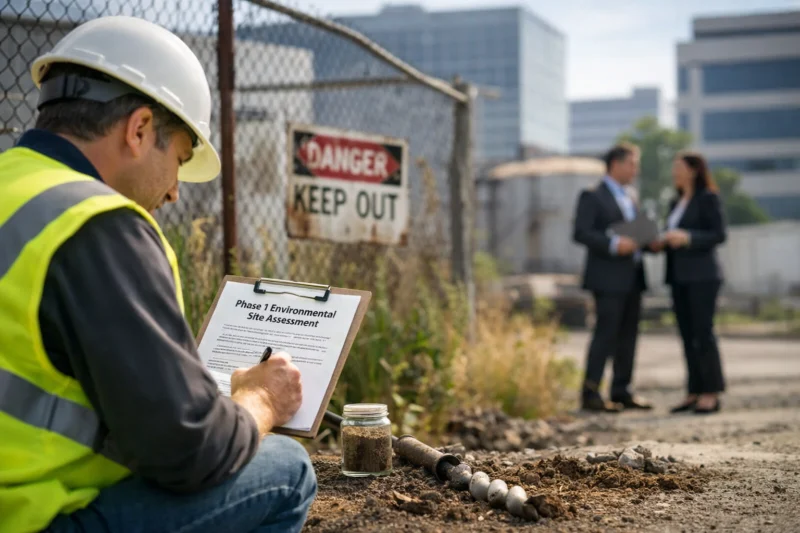
Step-by-step, most Phase 1 workflows begin with scoping and planning: the environmental professional reviews the transaction context (asset sale, refinance, lease/ground lease, or development), identifies likely historical uses, and determines what site observations and records would be most relevant. Next is records review and documentation gathering, which typically includes historical directories, regulatory databases (where accessible), historical aerial imagery, and chain-of-title information. Interviews follow, often with current and past property occupants or owners, and the professional then develops a property history narrative and conceptual site model that connects plausible pathways with evidence.
Site reconnaissance is where many commercial stakeholders expect “real world” clarity: the professional walks the property, observes current conditions (including evidence of staining, odors, stressed vegetation, or signs of past equipment), and notes exposure routes like surface drainage patterns and proximity to potential contamination sources on adjacent parcels. During reporting, the professional evaluates whether conditions rise to REC status and documents uncertainties and assumptions. This is also where standards alignment matters: ASTM E1527-21 provides the prevailing framework for Phase 1 elements such as the records review scope, interview expectations, and site reconnaissance approach.
In practice, scoping decisions can materially affect results. A redevelopment project may require deeper attention to fill/grade changes and demolition history because those can move contaminants vertically; a multi-tenant industrial park may require extra focus on shared infrastructure and off-site adjacencies. If records are missing or access is limited, the professional documents the gap and explains how it influences conclusions. The limitation is that incomplete archives or restricted access can lead to uncertainty that stakeholders may address with targeted Phase 2 investigations rather than relying on a conclusion that “appears compliant.”
How to use Phase 1 assessment results: decision pathways after the report
After a Phase 1 assessment, commercial teams typically convert findings into a decision pathway: proceed, proceed with conditions, order Phase 2, adjust terms, or re-scope for clearer evidence. The most important job of the report is to reduce uncertainty in a way the deal can act on—by translating environmental evidence into underwriting, contract language, and risk management steps.
How results influence underwriting depends on the property’s context. For example, a “No RECs” outcome often supports smoother financing and fewer contingencies, but it still needs careful review of assumptions and record gaps. If the Phase 1 identifies RECs, parties may plan conditions such as escrow arrangements, enhanced representations, or covenants that require further evaluation before closing or before certain construction activities. Lease negotiations can also be impacted: tenant estoppels, operating covenants, and “who pays if” provisions frequently hinge on what the baseline Phase 1 indicates regarding plausible subsurface or surface concerns.
Escalation from Phase 1 to Phase 2 usually occurs when severity indicators and uncertainty align. Practical triggers include: RECs with plausible pathways to soil or groundwater impacts; a historic use inconsistent with present development footprint; or limitations that prevent a confident conclusion (such as inaccessible underground areas, missing records for prior tank systems, or insufficient documentation of adjacent releases). In mixed-use and multi-tenant properties, boundaries complicate interpretation because environmental conditions can migrate across parcels through drainage, utility corridors, or shared parking and loading zones. Phase 1 conclusions should reflect those realities, and teams should align the next steps with how the risk could manifest.
A deeper nuance is that two Phase 1 reports can both be “compliant” with standards yet produce different business outcomes due to differing assumptions or interpretive choices. One report may document a particular historic-use hypothesis with stronger evidentiary support; another may describe the same uncertainty as a gap requiring further work. A common mistake is treating the REC label alone as the entire story while ignoring limitations and observational constraints. The better approach is to examine the report’s conceptual site reasoning, the adequacy of the records, and whether the scope matches the property’s plausible environmental pathways.
Standards and regulatory context in 2026: ASTM E1527-21 and AAI expectations
In 2026, ASTM E1527-21 remains the cornerstone framework for how most Phase 1 assessments are structured and defended, and its purpose is consistency in records review, interviews, and reporting. Separately, 40 CFR Part 312’s All Appropriate Inquiries (AAI) concepts connect Phase 1 elements to qualifying protections—where the transaction and party situation support that goal.
Standards matter in commercial transactions because they create a shared language for what “good” looks like and what the report should include. ASTM E1527-21 guides the environmental professional’s responsibilities and the elements typically expected by lenders, investors, and counsel: how far back records are researched, how interviews are conducted and documented, what site reconnaissance seeks to observe, and how conclusions must be supported by evidence. For practical application, commercial stakeholders should ensure the Phase 1 scope and report structure match the standard level expected by their financing terms and diligence checklists, because report incompleteness can drive renegotiation or delays even when surface observations appear benign.
AAI context under 40 CFR Part 312 is also important, but it is often misunderstood. The regulation ties to qualifying protections and the relationship of the parties and inquiry. Phase 1 assessment work supports the intent of AAI when it is properly scoped and documented as an inquiry that meets expectations; it does not guarantee legal protection by itself. Roles matter: the environmental professional must exercise professional judgment, while clients provide access, chain-of-title documents, and truthful information about known site history and occupancy. If the client influences scope or suppresses information, the defensibility of AAI-related goals can be undermined.
Edge cases can require careful reconciliation. For instance, a lender’s internal checklist might emphasize certain records sources that are not available due to local archive practices, while the legal concept of AAI expects an inquiry that is reasonable and documented. The way to reconcile this without overpromising is to insist that the report clearly describes what was available, what was not, and how that limitation affects the conclusions. ASTM E1527-21 guidance reference points can help stakeholders understand the broader AAI landscape, while 40 CFR Part 312 provides the formal AAI framework. In 2026, the most defensible approach is to align report scope, documentation, and transaction timing with the standard of inquiry expected by the deal and the parties’ diligence obligations.
Common mistakes and misconceptions in commercial real estate Phase 1s (what fails deals)
Many deal delays trace back to misconceptions about what a Phase 1 assessment can confirm and what “no findings” actually means. The most common failure pattern is not that contamination exists or doesn’t exist—it is that the Phase 1 scope and documentation do not match the property’s plausible history, access realities, and lender expectations.
The first misconception is “no RECs means no risk.” A Phase 1 conclusion of “no RECs” is conditional on what records and site observations allowed the professional to determine. If there were records gaps, limited access, or unobserved areas that could conceal relevant evidence, then uncertainty may remain even if RECs were not identified. Another misconception is “surface-only is enough,” especially for commercial properties with older subsurface utilities, abandoned equipment, or historic tanks. Phase 1 includes targeted observational elements, but it does not replace intrusive sampling where evidence indicates subsurface concerns.
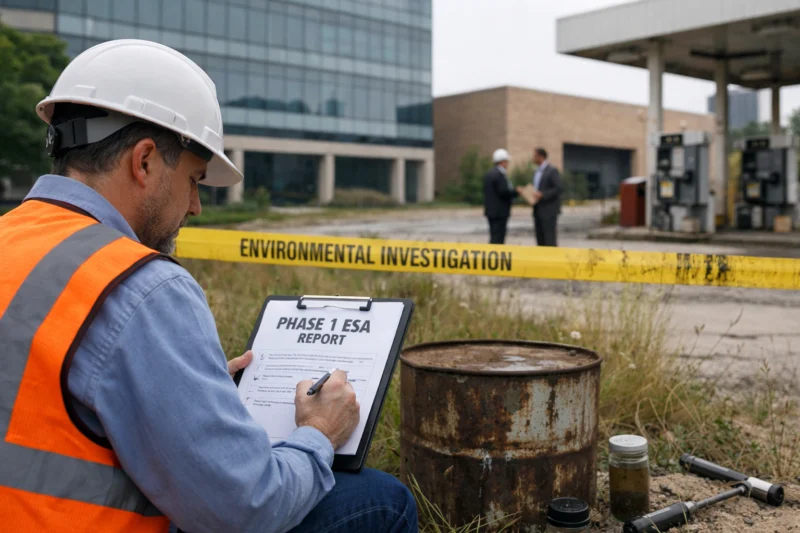
Under-scoping is a frequent real-world cause of defensibility problems. Examples include failing to cover relevant adjacent properties that may have plausible releases, not addressing historic uses that fit the property footprint (such as former manufacturing that changed grades or introduced fill), or ignoring shared infrastructure where environmental conditions could migrate across boundaries. In multi-parcel asset sales, common mistakes include ambiguity in easements, incomplete mapping of utility corridors, and failure to document how property boundaries were interpreted during reconnaissance.
What most guides get wrong is treating REC classifications as the only decision variable. In commercial contexts, “uncertainty” and “limitation” language can be just as important because it can change what Phase 2 is needed and when it must happen. Stale site observations can also create problems: if the property undergoes new construction, demolition, or cover removal after the reconnaissance date, the site conditions may change and require updated documentation prior to closing or refinancing. A typical mitigation is to align Phase 1 timing with deal milestones and to confirm that access assumptions remain valid through underwriting.
Alternatives and options: choosing the right environmental diligence path
Commercial teams usually choose among Phase 1 only, Phase 1 plus targeted Phase 2, phased diligence during development, or supplemental investigations when access or archives are limited. The “right” choice balances cost, decision defensibility, and the level of uncertainty that could affect underwriting or closing terms.
When “Phase 1 only” works best is when risk indicators appear low and documentation is robust: the property’s historic use is consistent with its current condition, records and aerial evidence align, and no plausible pathways emerge from adjacent uses. When uncertainty remains—because evidence suggests potential releases, the records are incomplete, or physical constraints prevent adequate reconnaissance—teams often move to “Phase 1 + targeted Phase 2.” Targeted Phase 2 can be designed to answer specific questions (for example, confirming whether a former fuel area is associated with soil or groundwater impacts) rather than conducting broad intrusive work.
Phased environmental due diligence during development is another option, especially when sequencing matters for budgeting and land-use operations. A buyer or developer might start with a Phase 1 to validate historic-use assumptions and plan site design, then conduct targeted studies for segments where construction will penetrate deeper or where fill movement changes exposure routes. Supplemental investigations can also include limited intrusive work or non-invasive methods that support decision-making, such as targeted subsurface utility mapping or geophysical surveys, when they are used appropriately to address uncertainty described in the Phase 1.
The tradeoffs are significant. Doing “extra” can backfire by creating obligations, expanding the definition of diligence expectations, or generating new findings that require regulatory engagement. For leasing scenarios, the option depends heavily on who is responsible for tenant improvements and how subsurface liabilities are allocated contractually. A practical buyer/lender selection criteria set includes confirming the professional uses the expected standard (typically ASTM E1527-21), provides clear scope transparency, documents assumptions and limitations, and produces a report that counsel can interpret without ambiguity. A common mistake is selecting an “equivalent report” vendor approach without verifying that the report’s elements and evidentiary support meet the financing party’s expectations.
Innovation beyond the basics: GIS, drones, GPR, digital workflows, and data platforms in Phase 1s
Modern tools can strengthen the evidence base in a Phase 1 assessment by improving history mapping, boundary understanding, and documentation quality—while still keeping the report’s conclusions aligned with Phase 1 elements. In 2026, innovations like GIS, drones, GPR, digital workflows, and data platforms are most valuable when they support the investigation described in the ASTM E1527-21 framework rather than replacing it.
GIS and improved aerial imagery help commercial professionals build clearer property and adjacency histories. For example, geospatial overlays can assist in interpreting what was built, where fill may have been introduced, and whether apparent industrial operations likely existed on specific parts of the parcel over time. Drones can enhance evidence gathering in certain commercial settings by providing high-resolution views of rooftops, equipment placement, and surface conditions when conventional reconnaissance is limited. The practical use case is often an industrial warehouse with complex roof equipment and multiple roof levels, where ground-level visibility is insufficient to observe certain potential release indicators.
Geophysics such as GPR is typically treated as supplemental support rather than a substitute for Phase 1’s records review, interviews, and site recon process. In a commercial context, GPR may help confirm the presence of utilities, abandoned conduits, or shallow subsurface anomalies in limited areas identified as uncertain during Phase 1. However, data interpretation must be documented and validated with professional judgment; overreliance on automated outputs can create false confidence. Digital workflows—cloud collaboration, version control for records and interview notes, and audit trails—reduce human error and can improve defensibility when parties challenge report scope or conclusions.
The deeper nuance is how to document innovative methods so the final conclusions remain consistent with standards. A data platform can flag “anomalies,” but the environmental professional must explain what the tool contributed, what it could not confirm, and how it influenced the conceptual site model. A common mistake is failing to record the limitations of innovative evidence, then assuming the report should carry the same weight as intrusive sampling. Done well, innovations improve clarity; done poorly, they can shift the burden of uncertainty into the report without actually resolving it.
Region-specific reality check: how U.S. property conditions affect Phase 1 assessments
Even when a Phase 1 report follows ASTM E1527-21 expectations, region-specific property conditions can meaningfully affect what the environmental professional can determine. Differences in state and local record retention, availability of environmental databases, and accessibility of archives can change whether the inquiry is comprehensive or limited.
In practical terms, property history varies widely across regions. Industrial corridors with dense historic manufacturing may require more attention to legacy materials and operational patterns, while coastal areas may require additional consideration of fill and grading that changed the subsurface environment over time. Agricultural-to-commercial conversions can present different records and aerial-evidence challenges, especially when old land-use practices were not well documented in commercial property files. These realities influence scoping hypotheses: a professional must tailor what “plausible historical uses” means for that geography and for the asset’s building footprint.
Jurisdictional constraints also influence execution. Permitting processes, access to local records, and utility locate response times can vary by area. If a site contains multiple access points, easements, or shared utility corridors, the practical ability to observe surface indicators may depend on local norms for scheduling and access approval. Underwriting patterns may also reflect market maturity: lenders in areas with frequent redevelopment may have more standardized expectations, while other regions may rely on counsel-driven interpretations of whether records gaps are acceptable.
The deeper insight is that “standard-compliant” reporting still needs tailored historic-use hypotheses. Regional history can determine whether the professional’s pathway reasoning was adequate for the property’s plausible releases. For additional context on federal AAI concepts that interact with how inquiry is documented, you can review EPA All Appropriate Inquiries. The takeaway is simple: a defensible Phase 1 is not copy-paste work; it is evidence-based inquiry adapted to what the property’s region likely means.
Advanced considerations: access constraints, boundary disputes, and “controlled” conditions
Access constraints and boundary complexity can elevate the importance of a well-documented Phase 1 assessment because they directly affect what the environmental professional can observe and how conclusions should be interpreted. In addition, when “controlled” conditions or institutional controls are relevant, the report must clearly describe current compliance status and what that means for risk.
Practical blockers show up frequently in commercial transactions: locked gates, refusal of access to specific structures, restricted roof access due to safety conditions, or demolition debris covering evidence that would otherwise be visible. When those limitations occur, Phase 1 conclusions should reflect them. A common mistake is expecting a report to “discover” what it could not observe without acknowledging observational limits. The professional should document exactly what areas were inaccessible, what alternative evidence was reviewed, and how those limitations influence uncertainty and the presence or absence of RECs.
Boundary and easement issues are another commercial reality. Multi-parcel sites, shared parking/loading zones, and utility corridors can blur the practical meaning of “adjacent property” observations. If boundary disputes exist—especially around where historic operations likely occurred or where drainage flows—then the report needs clear assumptions about parcel mapping and adjacency. Tradeoffs include the possibility that a buyer may need a follow-up scope adjustment or targeted Phase 2 to resolve boundary-driven uncertainty before closing.
“Controlled” conditions require careful handling because they can affect how risks are managed rather than eliminating them. If the report references institutional controls conceptually, it should align with what is known about the current compliance status and how it relates to plausible exposure pathways. In multi-party transactions, such as an asset sale where the seller retains certain liabilities or an SPE/LLC structure that splits obligations, diligence scope must match the transaction reality. Disputes also arise: parties may challenge methodology, interpretation, or missing data. High-quality documentation reduces friction by making the scope, assumptions, and evidence chain explicit and reviewable.
Frequently Asked Questions About The Critical Role of Phase 1 Assessments in Commercial Real Estate Transactions
What is the purpose of a Phase 1 assessment in a commercial property transaction?
The purpose is to identify and document recognized environmental conditions (RECs) by reviewing property history, records, and current observations without intrusive sampling. In commercial transactions, it establishes a defensible baseline that helps parties decide whether to proceed, ask for conditions, or commission Phase 2. A Phase 1 report also documents scope limitations so lenders and counsel can evaluate the level of uncertainty remaining.
What’s the difference between RECs and actual contamination found during Phase 2?
RECs are potential environmental conditions recognized through evidence in records, interviews, and site observations, not confirmed sampling results. Phase 2 typically involves targeted sampling, testing, and analyses designed to confirm whether contamination is actually present and to delineate it. Even when a Phase 1 identifies RECs, Phase 2 can reveal that impacts are absent, limited, or confined to specific areas.
When do lenders or investors typically require a Phase 1 assessment?
Lenders and investors commonly require Phase 1 when financing or refinancing involves commercial assets with plausible historic industrial or hazardous-material uses, or when deal documentation demands standardized environmental diligence. Typical triggers include acquisition loans, construction/bridge financing, and major tenant changes that affect site operations. Even in “modern” commercial buildings, stakeholders may require Phase 1 due to historic fill, prior occupants, or adjacent uses.
How long is a Phase 1 assessment “valid” for commercial transactions?
There is no single universal validity period because “freshness” depends on deal timing, property changes, and how much uncertainty remains. In practice, if major site changes occur after the reconnaissance date—such as demolition, cover removal, grading changes, or new tenant improvements—parties often require updates or supplemental work. Many lenders set internal expectations for how recently the report was completed for underwriting review.
What happens if access to the site is limited or refused?
Limited or refused access should be documented explicitly, including which areas were inaccessible and how that restriction affected conclusions. The report may identify uncertainty or limitations that can trigger additional diligence, such as targeted Phase 2 or supplemental observations where feasible. If access is refused, the safest expectation is not “Phase 1 still guarantees the same conclusion,” but rather “the uncertainty must be addressed transparently.”
How do you decide whether Phase 2 investigations are warranted after Phase 1?
Phase 2 is typically warranted when Phase 1 identifies RECs with plausible exposure pathways, when evidence is strongly suggestive but incomplete, or when limitations prevent confident conclusions. Decision-makers also consider proximity to sensitive areas (for example, outdoor employee spaces or stormwater features) and whether the property’s planned use increases exposure. Another factor is whether Phase 2 can resolve a discrete question rather than expanding scope unnecessarily.
In many situations, properly scoped and documented Phase 1 assessment work can support All Appropriate Inquiries (AAI) related expectations because it addresses key elements like records review, interviews, and site reconnaissance. However, AAI-related protection depends on multiple factors, including the parties’ relationship and how the inquiry is conducted and documented. It is important not to treat Phase 1 as automatic legal protection without aligning the diligence narrative to AAI concepts.
What does ASTM E1527-21 require, and how does it affect reporting quality?
ASTM E1527-21 guides how the environmental professional conducts the Phase 1 elements and how the report should present findings, assumptions, and limitations. Reporting quality is affected because the standard expects a structured narrative supported by evidence rather than an informal summary. Commercial lenders often prefer reports that clearly show records sources, interview summaries, and why conclusions were reached.
What are common Phase 1 misconceptions that cause deal delays?
Three frequent misconceptions are that “no RECs equals no risk,” that surface observation is enough for all scenarios, and that any vendor’s report is automatically equivalent. Deal delays often occur when scope gaps or boundary misunderstandings appear late in underwriting. Another common issue is failing to update conclusions when the site changes between reconnaissance and closing.
How do GIS, aerial imagery, and GPR fit into a Phase 1 process?
GIS and high-resolution aerial imagery support evidence gathering by improving property history interpretation and adjacency mapping. GPR is generally used as supplemental information when uncertainties identified in Phase 1 merit additional non-invasive insight, but it should not replace Phase 1’s records review, interviews, and reconnaissance framework. Any use of these tools should be documented with limitations and how the professional interpreted the findings.
What should a buyer look for in a Phase 1 report before closing on a commercial asset?
A buyer should look for clear scope transparency, detailed records and interview documentation, and a site reconnaissance narrative that reflects the actual property conditions observed. The report should clearly state assumptions, explain any gap or uncertainty, and present conclusions in a way counsel and lenders can evaluate. Buyers should also verify that adjacent uses and plausible historic pathways were addressed appropriately for the property and its geography.
Conclusion
Phase 1 assessments are critical in commercial real estate transactions because they establish a defensible baseline, guide decisions, and reduce transaction risk before the deal reaches closing. In 2026, the strongest Phase 1 outcomes come from quality over paperwork: a properly scoped investigation, alignment with ASTM E1527-21 expectations, and careful documentation of evidence, assumptions, and limitations. That combination helps parties avoid surprises, negotiate with confidence, and decide intelligently whether Phase 2 is needed.
If you are planning a purchase, refinance, or redevelopment, treat the Phase 1 as a decision tool—not a formality. Engage qualified environmental professionals early, review the Phase 1 report with lending and transaction stakeholders, and align report timing with closing milestones so access and site conditions reflect the scope described in the final deliverable.
Next steps are best handled proactively: confirm the scope during early underwriting, clarify how any innovative data sources (GIS, drones, geophysics) were validated and documented, and plan for updates if site conditions change. Those actions support a smoother diligence flow and help you move forward with a risk picture that is explainable, evidence-based, and commercially workable.
Updated August 2026