
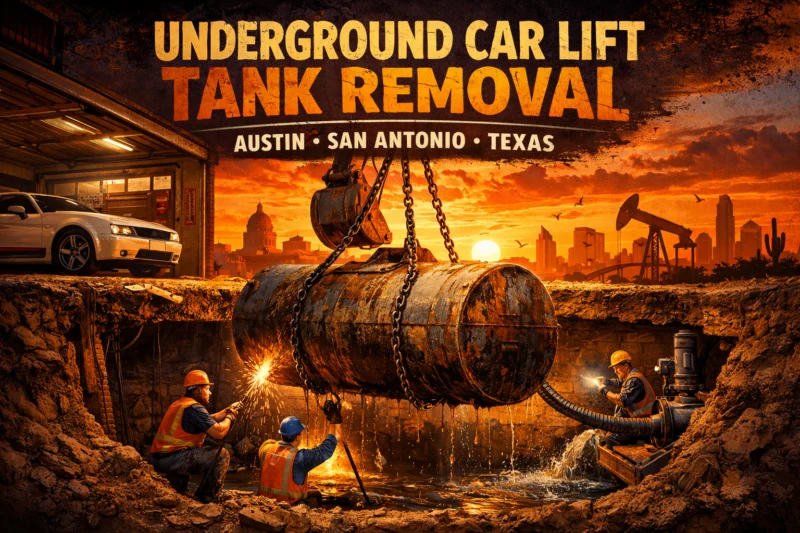
If you’re dealing with an underground car lift tank—typically at an auto service facility—removal in Austin or San Antonio usually means confirming what’s underground, de-fueling and excavating the tank, verifying whether any release occurred, then documenting closure in a way lenders and buyers can rely on. For many transactions, this starts with environmental due diligence and then becomes a removal-and-verification workflow, not just digging and hauling. If you’re searching for underground car lift tank removal texas, you’re probably trying to make the next decision for a sale, refinance, or site change: what to remove, what to test, what to document, and how to avoid delays when underwriting reviews the paperwork. In 2026, timelines vary based on soil conditions, tank age/material, site access, and how much information exists already, so the “plan” matters as much as the field work. This guide walks through how underground car lift tank removal is typically planned and delivered in the Austin/San Antonio market—what to request, which standards lenders expect, and the common pitfalls that stall closings.
What “Underground Car Lift Tank Removal” Usually Means in Austin & San Antonio
Underground car lift tank removal in Austin or San Antonio generally refers to identifying and removing (or properly closing) an underground storage tank associated with a car lift system and the facility’s historical operations, then verifying site conditions well enough to support transaction and liability needs. In practice, “removal” includes a sequence: vacate/secure, excavate and remove or render it non-operational, transport and dispose of the tank properly, and document verification/closure. That documentation is what most buyers, lenders, and real estate attorneys actually need to feel comfortable.
Environmental due diligence and lift tank work are intertwined because decisions about excavation scope and closure standards depend on what’s known (or unknown) about releases. Many properties already have a Phase 1 ESA report, but that doesn’t automatically answer whether contamination exists. When records show the lift-related tank was used for regulated substances, or when historical usage raises flags, a targeted follow-up may be necessary before (or immediately during) removal so verification is credible rather than speculative.
For investors and lenders, expectations are usually documentation-driven: a report package that ties back to the Phase 1 ESA findings and explains what was concluded after physical work. The reporting benchmark commonly referenced for Phase 1 ESA quality is ASTM E1527-21, which supports the “all appropriate inquiries” concept used for transaction due diligence. You can have the tank physically removed and still struggle at closing if the verification data, historic interviews, or scope language doesn’t align with what the file requires.
Texas site realities also shape removal planning: tight access around slabs and drive pads, nearby utilities, and operational constraints at occupied commercial properties. A lift tank might be located under or near infrastructure that must be protected, which affects excavation logistics, dewatering planning, and how confirmation sampling is performed. And a key nuance: tank removal isn’t automatically the same as environmental remediation—if contamination is present, the end deliverable must match the actual risk picture, not just the fact that the tank is gone.
For many facilities in Austin and San Antonio, the best “removal” outcome is the one that makes your transaction paperwork straightforward: correct scope, verified conditions, and a closure narrative that matches the decision path in your lender’s review. That’s exactly where Phase 1 Enviro Pros fits, since the firm focuses on Phase 1 and Phase 2 Environmental Site Assessments, remediation support, SWPPP compliance, and desktop reports built to keep investor workflows moving.
How to Plan the Removal Process (Decision Path From Assessment to Closure)
The smoothest way to approach underground car lift tank removal is to plan it as a decision path: review existing records, complete an ASTM E1527-21 compliant Phase 1 ESA when needed, perform targeted investigation if indicators exist, then remove and verify/close based on the findings. If you skip steps, you can end up with removal work that doesn’t match what was concluded in your due diligence file—leading to rework, additional sampling, or lender questions that delay closing.
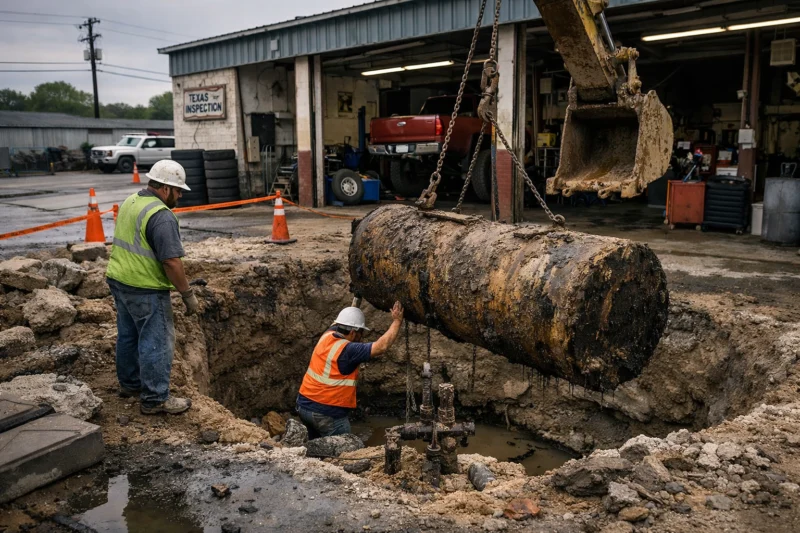
In a typical sequence, the first stage is initial records review and site history gathering. If a Phase 1 ESA already exists, it still needs to be reviewed for relevance to the specific lift system tank location, operational timeline, and prior recommendations. If it doesn’t exist or is outdated for the transaction timeline, a Phase 1 ESA becomes the baseline before any disturbance—especially in 2026, when lenders are more frequently asking for a clean audit trail.
Next comes the “decision point” stage: if Phase 1 indicates recognized environmental conditions or if the property history suggests a higher likelihood of release, a targeted Phase 2 investigation may be required. This is where real-world criteria matter—previous spills, suspicious odors or staining, unusual tank fill/disposal records, or physical evidence near the lift pad. The practical outcome is a work plan that defines excavation boundaries, verification sampling approach, and what constitutes closure for your transaction needs.
Then removal happens: the tank is secured, excavated, removed/transported, and the site is restored. After that, verification/confirmation testing and closure documentation complete the loop. A common mistake is to treat “removal” as an end in itself; in lender and underwriting review, what matters is what was learned and what the results support. Real-world scenarios include an occupied facility where operations must remain active—your sequencing must protect the business while still allowing confirmation testing and report finalization before funding decisions.
When calling for next steps, have day-one information ready: address, lift/tank area photos, any installation/use history you have, prior environmental reports, and whether the site is occupied. Even basic details affect excavation planning and the probability of encountering unknown underground structures or utility conflicts. Fast turnaround is valuable, but sequencing still matters—doing field work without aligned investigation can invalidate the removal verification narrative and force additional steps later.
Underground Tank Removal Requirements & Documentation Lenders Expect (2026 Perspective)
Lenders typically don’t just want proof that a tank was removed; they want a documentation package showing what was known before work, what was done during work, and what the verification results concluded afterward. In many Austin/San Antonio deals, this means connecting your tank removal documentation to the ASTM E1527-21 Phase 1 ESA record and any necessary targeted follow-up so the transaction file supports reliance.
At a minimum, underwriting files commonly include the Phase 1 ESA report (or a defensible alternative pathway when appropriate), any Phase 2 or targeted investigation reports triggered by findings, and removal/closure confirmation materials. The reason is simple: “all appropriate inquiries” expectations under 40 CFR Part 312 (AAI) focus on the quality of due diligence and the transparency of conclusions—not merely on what was physically removed after the fact.
Under 40 CFR Part 312 (AAI), the lender-oriented issue is whether the file demonstrates due diligence and supports reliance. While you may not control every underwriting policy, you can control how the environmental story is documented: clear historic interviews (as applicable), consistent site information, and explicit findings tied to the locations impacted by removal. That’s where “scope alignment” becomes the difference between a file that closes and one that stalls.
Practical concerns lenders have include audit-trail clarity and uncertainty management. They want to see what was concluded as “no further action” (when justified) versus what remains unknown or requires additional investigation. A “paperwork trap” happens when a tank removal is physically completed, but documentation language, verification testing, or the scope described in the report package does not match what the transaction reviewer requested.
Phase 1 Enviro Pros supports the reporting workflow for commercial real estate investors and lenders by producing ASTM E1527-21 compliant Phase 1 assessments and coordinating the documentation trail that removal contractors can reference. The firm also provides remediation and SWPPP compliance support where it’s relevant to the larger property risk picture, while staying clear about boundaries—environmental assessment and removal documentation are connected, but they are not a single step.
Common Mistakes Property Owners Make Before They Hire a Tank Removal Contractor
A frequent reason underground car lift tank removal projects stall isn’t excavation cost—it’s misalignment between what the property needs for its due diligence file and what the contractor plans to do on site. Property owners often make preventable mistakes like choosing purely on price, assuming “removed” equals “no risk,” or failing to confirm what type of tank is actually present and where it sits relative to the lift and utilities.
One common pitfall is selecting a scope that doesn’t reflect earlier findings. If a Phase 1 ESA indicated a potential concern, the removal plan must incorporate appropriate verification and documentation. Otherwise, you end up with a removal that “finishes the dig,” but doesn’t produce the verification dataset lenders expect. Another mistake is proceeding without capturing existing records and site history details—missing documentation can weaken how due diligence conclusions are supported, even when the physical tank is gone.
Access and utility mapping problems can also cause delay and expense. Many lift/tank areas sit beneath slabs, drive pads, or near service lines; if the owner and contractor haven’t mapped those constraints, excavation can hit unforeseen obstructions, requiring change orders and extending the field schedule. Another misconception to correct is that site cleanup always ends after tank extraction. If a release is found or suspected, you still need confirmation/verification work and appropriate closure steps, which can include additional sampling or remedial actions.
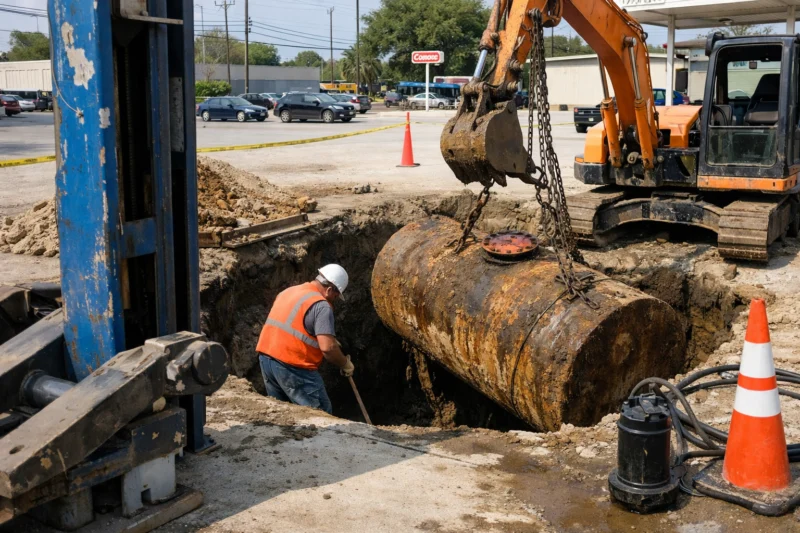
Real-world scenario: a customer at an occupied auto service facility in the Austin area planned removal to support a lease assignment, but only shared limited information about what the tank served and where it was located. Field crews uncovered an unexpected conduit run and delayed access for verification sampling; the documentation later required an additional supplemental investigation to satisfy lender questions. The lesson is that “what you know before mobilizing” determines how smoothly documentation and verification can match the transaction timeline.
What most guides get wrong is focusing too narrowly on tank removal logistics while under-emphasizing the file requirements lenders request. In a transaction, the deliverable is the report package and closure narrative—not only the removed tank. Owners who insist that contractors coordinate documentation outputs with the assessment findings usually reduce the likelihood of second mobilizations or re-scoping.
Removal Options and Alternatives: What You Can Choose Besides One-Size-Fits-All Excavation
Not every underground lift-associated tank situation requires the same level of disturbance, and the best approach depends on site conditions, what investigations reveal, and what documentation your buyer or lender will accept. Your choices typically fall into categories like full removal with excavation, partial removal with engineered closure, and investigate-first strategies when historical data is insufficient to proceed safely and confidently.
Full removal (excavate and remove the tank, then verify conditions) is often the most straightforward story for transactions because it reduces uncertainty about what remains underground. However, it can be disruptive—especially when lift bases, slabs, or utilities are directly above or adjacent to the tank area. That disruption can affect business operations if the site is occupied and can extend schedules if access is limited or deeper excavation is required due to tank placement.
Engineered closure options (where allowed and justified) can reduce disturbance while still addressing the tank’s fate through an approved closure pathway. Even then, documentation and verification remain essential: lenders generally expect clear reasoning, supporting investigation results, and a closure report that explains what was done and what was verified. In-situ management can sometimes be appropriate in certain scenarios, but it is not a “no documentation” choice; you still need a defensible basis and closure reporting for underwriting review.
When selecting among these options, ask what the contractor will provide as deliverables for transaction closeout: the verification approach, how results are documented, and whether the scope ties back to the earlier Phase 1 ESA conclusions. Desk-based work—like reviewing lift area layouts, old work orders, or previous sampling—can reduce field uncertainty before you mobilize excavation crews. The tradeoff is that “alternatives” don’t mean “no risk”; they mean the risk story must be supported by investigation and results.
During lender review, the differentiator is whether the chosen approach produces consistent documentation that matches what the due diligence file represents. If you want fewer underwriting questions, the most valuable step is ensuring scope alignment between assessment findings and what the removal/closure contractor will verify and report.
Advanced Considerations for Complex Sites (Edge Cases That Change the Plan)
Complex sites can turn a straightforward tank removal into a staged workflow, especially when older tanks, multiple underground elements, or unknown contents introduce uncertainty. If your Phase 1 ESA flags concern or your records are thin, the “edge cases” are what change the plan: how deep excavation goes, whether dewatering or utility protection is needed, and whether additional sampling must occur to support closure.
Older tanks may have material degradation, and that can influence how safely the tank can be removed without creating additional disturbance. Multiple underground elements—like conduits, sumps, or lift hydraulics—can restrict excavation pathways and complicate verification sampling. Groundwater sensitivity in parts of Texas and site-specific drainage patterns may also influence how you plan disturbance controls and what closure criteria are appropriate. These complexities don’t just affect field work; they affect the documentation story that lenders rely on.
If the Phase 1 ESA indicates concern but the owner wants to move quickly, the solution is not to skip investigation—it’s to structure a targeted follow-up that prevents rework. For example, rather than broad, generic sampling, you can focus on the likely impact pathway tied to the tank’s location and historical usage evidence. That targeted approach helps reduce uncertainty and produces results that can support removal verification and closeout more efficiently.
Digital workflows matter here because documentation consistency is essential. Using secure document storage and version control for ESA and removal reports helps lenders access consistent files throughout due diligence and financing. Data platforms and mapping workflows can also reduce “unknowns” before excavation, improving coordination between environmental and construction teams. This is where technologies like GIS overlays, GPR, drones, and digital mapping can help with decision support—identifying lift-related infrastructure patterns, potential tank locations, and excavation constraints—without replacing the need for required compliance steps.
A common mistake at complex sites is treating advanced tools as substitutes for proper scope. Tools can reduce guesswork, but verification testing and compliant reporting still matter. When you do need supplemental investigation, coordinating it early prevents late-stage report gaps that can force another round of review.
Austin & San Antonio Texas Logistics: What to Expect When Scheduling Underground Tank Removal
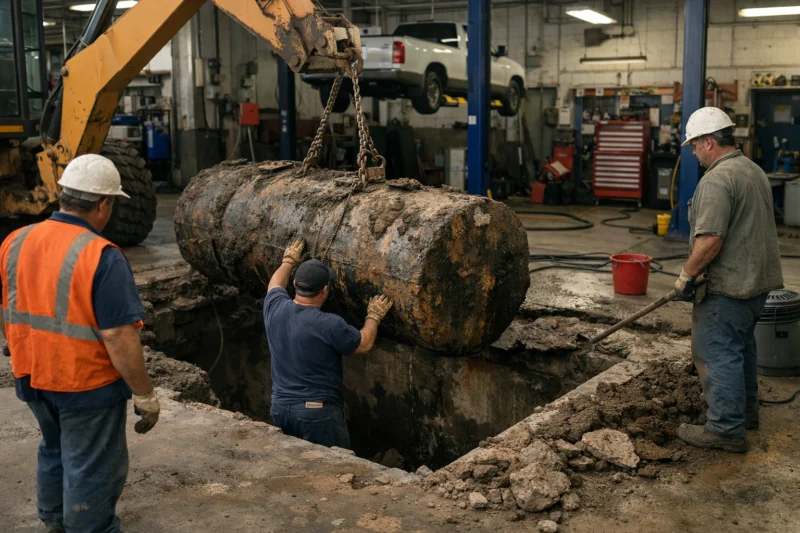
Scheduling underground lift tank removal around Austin or San Antonio usually depends less on the “date you want” and more on access conditions, lift/tank layout, and coordination windows for commercial properties. Whether the site is occupied, how the lift area is arranged, and how utilities run near the excavation zone can all change when field crews can safely mobilize and when verification sampling can be completed.
Commercial real estate investors and lenders often require a predictable documentation workflow that supports underwriting milestones. Property managers may be handling due diligence during underwriting while tenants continue operations, which means contractors must schedule work windows that protect safety, allow equipment access, and maintain compliance with site controls. The more information you can provide upfront (photos, prior reports, and lift/tank history), the fewer scheduling surprises you’ll face.
Phase 1 Enviro Pros is positioned to support local investor and lender workflows by providing ASTM E1527-21 compliant reporting and faster assessment turnaround in the industry, while still building the documentation trail required for SBA-compliant and lender review contexts. That doesn’t mean every project is instantaneous; rather, it means the paperwork and compliance steps are planned so the field work and reporting can fit transaction timing.
When you call to schedule, prep a checklist: the property address in Austin, TX or the San Antonio area, any existing Phase 1 ESA documents, photos showing the lift and tank area, and any known installation/use history. Also confirm whether the facility is operational and what hours access is available. For best results, share your transaction timeline too—closing dates or financing deadlines help coordinate how quickly reports must be finalized.
A key deeper nuance is that “fast turnaround” should be balanced with correct sequencing. Ask what must be completed before excavation can begin, what confirmation testing is required after removal, and how report finalization fits into the schedule. If you only ask “when can you dig,” you can miss steps that extend the project later.
Frequently Asked Questions About Underground Car Lift Tank Removal Austin San Antonio Texas
What happens to an underground car lift tank after removal—does the site always need more testing?
After the tank is removed, the site typically still needs confirmation or verification testing to support closure. Whether additional investigation is required depends on what was indicated by prior assessments, what was found during excavation, and whether there are signs of release. If the Phase 1 ESA and/or field observations suggest concern, targeted sampling results are often needed to document what conditions remain (if any).
How do ASTM E1527-21 Phase 1 ESA results affect whether a tank removal plan changes?
ASTM E1527-21 Phase 1 ESA results guide the risk story and can trigger targeted follow-up if conditions are flagged. If recognized environmental conditions are identified or if historic usage creates suspicion, removal scope and verification sampling may need adjustment. For transactions, lenders often want the removal verification to align with what the Phase 1 ESA concluded.
Can Phase 1 Enviro Pros help with both the environmental site assessment and the removal workflow?
Phase 1 Enviro Pros provides Phase 1 and Phase 2 Environmental Site Assessments and can support remediation-related documentation and reporting workflow where it connects to due diligence. The removal itself is typically executed by specialized tank removal contractors, but the assessment deliverables and scope alignment are critical for lender review. This approach helps keep the file consistent from assessment through closure documentation.
What should I send when I call to schedule underground car lift tank removal in Texas?
Send the property address, any existing Phase 1 ESA or related environmental reports, photos of the lift/tank area, and any known installation or use history. Also note whether the site is occupied and what access hours are available. If you have records showing prior tank service, fill/disposal practices, or any prior spills, include those details too.
Is underground car lift tank removal texas the same process in Austin as in San Antonio?
The core workflow is similar in both Austin and San Antonio: assess, plan scope, remove/close as appropriate, verify conditions, and document for transaction review. Differences usually come from site-specific factors like layout, access constraints, and how the property’s infrastructure affects excavation scheduling. The lender documentation expectations generally remain consistent, even if the field logistics differ.
How do lenders use the report package for property transactions and SBA-compliant requirements?
Lenders use the package to evaluate due diligence quality, understand what was concluded, and determine whether any further risk management is needed. In many cases, they expect ASTM E1527-21 compliant Phase 1 documentation and any subsequent targeted reports that connect to removal and closure. Completeness matters because underwriting often cannot “fill gaps” with assumptions.
What are 40 CFR Part 312 (AAI) considerations that property owners should not ignore?
40 CFR Part 312 (AAI) focuses on the quality of environmental due diligence and the basis for conclusions in property transactions. Property owners should ensure that historic information and site observations are documented clearly and that the inquiry approach is consistent with the transaction timeline. When tank removal happens, the verification/closure documentation should align with the due diligence conclusions rather than contradict them.
What are common causes of project delays during underground tank excavation?
Delays commonly come from limited access to the lift/tank area, unexpected utilities or underground structures, incomplete historical records, and the need for supplemental investigation when conditions differ from assumptions. Weather and soil conditions can also influence excavation logistics and verification sampling planning. Another frequent cause is documentation rework when the removal scope does not match what the lender expects in the report package.
How long does the assessment/reporting phase take before physical removal can begin?
The assessment/reporting duration depends on whether a current Phase 1 ESA already exists, how quickly records can be gathered, and whether targeted Phase 2 follow-up is required. If the Phase 1 ESA indicates potential concern, you may need additional field investigation before removal verification can be finalized. Site access and scheduling for field work can further affect timelines, so the safest plan is to build flexibility into your transaction schedule.
Will the contractor handle SWPPP compliance and site controls during the work?
SWPPP compliance and site controls are typically planned and implemented to manage erosion and stormwater impacts during land disturbance. Whether a given contractor directly handles SWPPP tasks depends on scope and roles, but owners should ensure responsibilities are clear before mobilization. In many workflows, environmental documentation teams coordinate the assessment and compliance narrative while construction teams execute the controls in the field.
Long after tank removal, what documentation proves the work was completed correctly?
Documentation typically includes removal/closure confirmation reports, verification testing results, and a closure narrative that explains what was removed, what was found, and what was concluded. If additional investigation or remedial actions were required, those reports should be part of the final package. Lenders generally rely on these documents to confirm the site’s risk status for underwriting.
If the tank was abandoned years ago, do we still need a full Phase 1 ESA?
Even if a tank was abandoned years ago, historical due diligence still matters because it informs what risk pathways may exist and what documentation is expected for transactions. A full Phase 1 ESA may be required depending on the property’s transaction timeline and whether prior assessments meet current needs. The conclusions from historic due diligence influence whether removal plans should include verification sampling or targeted follow-up.
Conclusion
Underground car lift tank removal in Austin and San Antonio works best when you treat it as a connected workflow: ASTM E1527-21 compliant Phase 1 ESA (and Phase 2 targeted follow-up when needed) leads into a removal plan that is verified with confirmation testing, then closed with documentation lenders can rely on. If you select contractors based on whether their scope aligns with assessment findings—and whether they will produce transaction-ready closure reporting—you reduce the chance of rework and late-stage underwriting delays.
To choose a safer path, insist on scope alignment, confirmation/verification deliverables, and a consistent report package that doesn’t leave lenders guessing. Avoid the common pitfalls: choosing only on price, assuming removal automatically equals full risk resolution, and proceeding without confirming site conditions. When the environmental story and removal verification data match, transaction files move forward more predictably.
If you’re preparing for a property transfer or financing decision in the Austin/San Antonio area, contact Phase 1 Enviro Pros at (855) 445-9625 to discuss your property, timeline, and what documents you already have—so next steps can be mapped quickly. Phase 1 Enviro Pros supports the assessment and documentation workflow that underwriters expect, including ASTM E1527-21 compliant reporting and lender-oriented deliverables.
Updated August 2026