
A Phase 1 Environmental Site Assessment (Phase 1 ESA) is a non-invasive investigation that helps buyers, lenders, and sellers understand whether a property may have environmental contamination concerns based on historical research, interviews, and a visual site walk. In practice, a complete guide to phase 1 environmental site assessments should clarify what the assessment can and cannot determine, how it supports risk-based decisions, and what triggers a follow-up Phase 2 investigation. For 2026 transaction work, it’s also important that the report be defensible—typically by aligning with ASTM E1527-21 and (in the liability-protection context) the framework under 40 CFR Part 312 (often referenced as the AAI framework). This article delivers everything you need to know about Phase 1 Environmental Site Assessments: scope, standards, what investigators look for, common deliverables, realistic decision outcomes, pitfalls, and modern innovations that are shaping how Phase 1 work is documented.
Most readers want a straightforward answer first: Phase 1 is usually records and interview driven, plus site reconnaissance—meaning it generally does not involve drilling, excavation, or laboratory sampling. That limitation is by design, but it’s not a “guarantee” that the site is clean. Instead, Phase 1 is meant to identify potential or existing environmental concerns and translate them into report findings such as recognized environmental conditions (RECs) or controlled conditions. When evidence points to a likely release or a condition that needs verification, the Phase 1 report commonly recommends Phase 2 sampling/testing or targeted follow-up.
Finally, expectations can vary by property type, local cleanup programs, and stakeholder requirements. A strong Phase 1 should clearly document sources, assumptions, limitations, and how the evidence supports the conclusions. The goal is not merely to “meet the checklist,” but to reach a decision that a third party can understand—especially when uncertainty (data gaps) must be handled responsibly. This guidance is informational and not legal advice; for transaction-specific decisions and liability strategy, consult qualified environmental professionals and counsel.
What a Phase 1 Environmental Site Assessment actually covers (and what it doesn’t)
A Phase 1 Environmental Site Assessment is designed to identify potential or existing contamination concerns using records research, interviews, and a visual site reconnaissance—not intrusive sampling. The output is a structured report that translates historical land use and current observations into findings that can drive underwriting, due diligence, and next-step planning.
Phase 1 work typically starts with a mission statement: identify recognized environmental conditions (and, where applicable, controlled conditions) that may indicate releases of hazardous substances or petroleum products. Investigators review property and adjoining histories, talk with parties knowledgeable about site operations, and conduct a site walk to document conditions that can be seen from public ways or observed during the reconnaissance. The key is that Phase 1 is evidence-based: it doesn’t just collect information, it evaluates it for relevance and reliability.
What it doesn’t do is equally important. Phase 1 generally excludes intrusive sampling, drilling, excavation, or laboratory testing. Even if a site shows signs that raise questions—such as staining, chemical containers, buried drums (visible evidence), odors, or discontinued tank infrastructure—Phase 1’s role is still primarily to document and interpret those observations without confirming soil or groundwater chemistry. In many cases, the report will recommend Phase 2 if a likely release needs verification.
Why this matters for real estate decisions: Phase 1 often becomes the foundation for risk screening. If the report identifies RECs, lenders and buyers may require Phase 2 or additional documentation to support financing, sale terms, or redevelopment plans. If the report identifies controlled conditions—managed contamination with controls in place—the decision may shift from “is there contamination?” to “how is it managed, and what are the obligations?” Either way, Phase 1 is about reducing surprises.
Deeper nuance: two Phase 1 ESAs can both “meet the standard” yet lead to different recommendations. One report may do a thorough chain-of-evidence review (including high-quality interviews and careful scoping), while another may rely on limited access to records or incomplete historical reconstruction. The difference often appears in how the investigator treats uncertainty: one may classify issues as RECs with a clear rationale, while another may document data gaps and recommend targeted verification. Common mistake: treating “no RECs” as equivalent to “no risk.” Phase 1 is not a clean bill of health; it is a defensible screening-level determination.
Related topic connections are common in practice. Many teams also need guidance on environmental due diligence for redevelopment projects, especially when Phase 1 findings interact with redevelopment design and permitting. Likewise, an important parallel is understanding how ASTM standards influence environmental reporting so stakeholders know what “defensible” looks like in audits and underwriting packets.
Standards and regulatory frameworks you should expect the report to align with
A defensible Phase 1 ESA in 2026 should align with ASTM E1527-21 for the assessment process and documentation expectations, and it may be used alongside the AAI-related framework under 40 CFR Part 312 for liability protection in qualifying circumstances. That alignment affects how inquiries are made, how evidence is documented, and how conclusions are supported.
ASTM E1527-21 primarily governs the scope and conduct of Phase 1 work: the inquiry elements, how to document sources, the treatment of data gaps, and the manner in which findings are presented in the report. In practical terms, this standard provides a common “language” so stakeholders can interpret whether the work was performed with appropriate care and completeness for a screening-level assessment.
AAI and 40 CFR Part 312 matter because they are tied to liability considerations for certain scenarios. The core idea is that a party’s “appropriate inquiry” and reasonable steps can influence their risk posture if contamination is later discovered. Even when counsel is involved, the environmental professional’s documentation is critical: it shows which inquiries were made, what information was identified, and how the next steps were determined when questions remained.
In 2026 practice, most reputable ESA providers document compliance in the report by explicitly listing search efforts, interview sources, property-use timelines, and the basis for findings. Common gaps that undermine defensibility include missing interviews where knowledgeable parties were available, incomplete review of regulatory and historical records, and unclear documentation of scoping assumptions or limitations on site access.
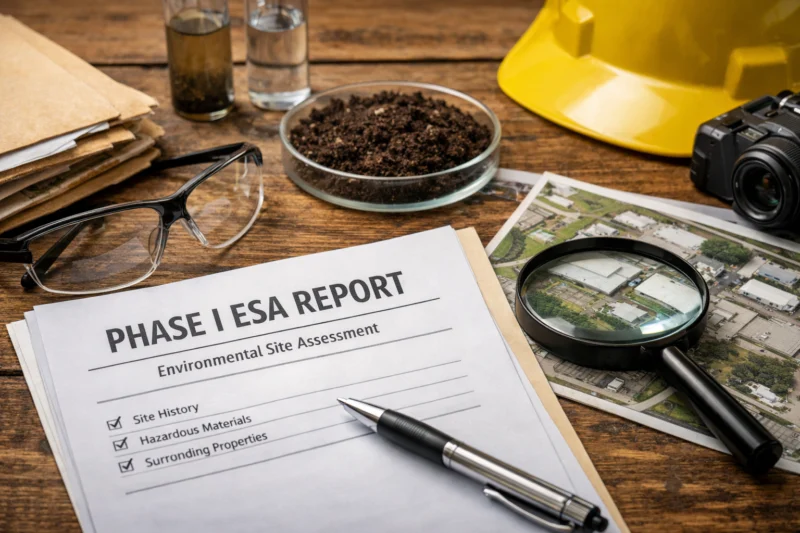
Deliverables you should expect under these frameworks generally include: a site description; a history of operations and land uses; identification of sources reviewed; a summary of interviews; maps/figures or boundary representations; discussion of data gaps; and the findings language for RECs and controlled conditions. The report should also include conclusions and recommendations for further action when warranted.
Deeper insight: compliance is not only about following steps—it’s about how unknowns are handled. If records conflict (e.g., aerial imagery indicates a former industrial use but interviews are vague or map layers disagree), the investigator must explain how the evidence was weighted and whether uncertainty rises to the level of a REC, controlled condition, or data gap. Many guides oversimplify by focusing only on whether the work was “done.” The higher bar is whether it was documented in a way that allows a third party to follow the reasoning.
For baseline references, see ASTM E1527-21 guidance summaries, 40 CFR Part 312 (AAI) and the EPA’s land recycling and appropriate inquiry resources. These provide context for how frameworks influence expectations.
The Phase 1 ESA workflow: from scoping to a defensible conclusion
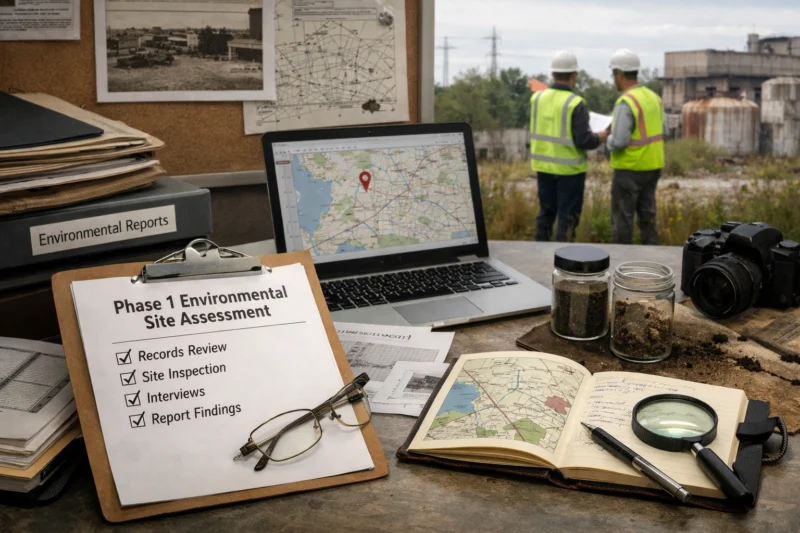
A Phase 1 ESA workflow is a structured sequence: scoping, records review, interviews, site reconnaissance, and reporting that ties evidence to findings. When done well, the process creates a defensible conclusion that stakeholders can rely on for underwriting and due diligence decisions.
Step one is scoping. The investigator defines property boundaries, establishes assumptions about timeframes for historical inquiry, and typically considers the surrounding area based on proximity logic relevant to potential contamination pathways and likely sources. For mixed-use sites or parcels with shared infrastructure, scoping determines what “counts” as the relevant search area and which adjoining properties may require attention.
Step two is records and review. The investigator pulls documents from historical sources and regulatory/regulatory-adjacent databases used to identify past releases, permits, spills, cleanup activities, underground storage tank records, waste-handling indicators, and land-use evolution. Crucially, strong Phase 1 work does not treat this as a “document grab.” It evaluates each source: who created it, how old it is, whether it’s consistent with other evidence, and what it means in relation to site operations.
Step three is interviews. Who gets interviewed matters: building owners/managers, current tenants, long-term employees, local contacts, or knowledgeable parties who can describe operating practices or known incidents. The investigator should ask questions that connect land use to potential chemical use, storage, handling, and waste disposal practices. When accounts conflict, the report should explain how conflicting information was handled and whether additional research was used to resolve discrepancies.
Step four is site reconnaissance. Observations focus on visible evidence: staining or odors, drums/containers, waste-like materials, current and historical equipment, utility corridors that may connect to storage areas, stormwater flow characteristics, and signs of tanks or abandoned piping. The investigator records what can be seen and documents limitations such as locked areas or limited access where relevant.
Step five is reporting and decision logic. The findings section should clearly map evidence to RECs, controlled conditions, and data gaps. Deeper insight: a “decision path” isn’t just “REC vs no REC.” It’s how the report explains whether uncertainty is low enough to support a finding, or high enough to recommend Phase 2. In real-world scenarios, a Phase 1 may recommend targeted Phase 2 when there’s a plausible pathway (e.g., former chemical storage near subsurface features) or when evidence is strong but incomplete.
What most guides get wrong is skipping over how scoping and evidence evaluation affect conclusions. Two properties can have similar histories but different boundaries or different quality of interviews; the Phase 1 outcome can differ because the report’s reasoning differs. If you’re preparing for due diligence, you’ll want to understand how to prepare documents for environmental due diligence so the investigator can test assumptions rather than guess.
What qualifies as a recognized environmental condition (and controlled conditions)
Recognized Environmental Conditions (RECs) are findings from the evidence review that indicate a release or likely release of hazardous substances or petroleum products that could be present on the property, while controlled conditions reflect contamination that is addressed through controls or management measures. In both cases, the Phase 1 report’s language tells stakeholders what level of follow-up may be necessary.
RECs are typically triggered by specific categories of evidence such as documented spills, historical storage and handling practices, underground storage tanks, landfills or waste disposal, leaking drums or evidence of former releases, and industrial operations that reasonably suggest chemicals could have been released. Importantly, RECs are not simply “someone said there was contamination.” They are evidence-weighted conclusions: the investigator links site history and/or observations to plausible releases.
Controlled conditions are different. They generally involve contamination that is known and managed through institutional or engineering controls, remediation plans, or other measures that limit exposure or manage risk. The Phase 1 report may identify controlled conditions when cleanup is underway or completed under regulatory programs but still requires ongoing obligations, documentation, or access restrictions.
Proximity logic matters because Phase 1 can recommend follow-up even when there is little direct on-site evidence. If adjoining properties used chemicals in ways that could affect groundwater flow, surface water transport, or shared utilities, the report may identify RECs or at least recommend verifying off-site sources. A common real scenario is older industrial corridors in which multiple parcels historically hosted manufacturing, waste storage, or rail-adjacent operations.
Data quality thresholds separate “REC,” “data gap,” and “no REC.” A strong data set can support a REC, while weaker or ambiguous evidence may lead to a data gap recommendation instead of asserting a REC. Deeper nuance: false positives can occur when investigators rely on outdated maps, confusing signage, or discontinued operations without verifying what actually happened. A good Phase 1 counters this by verifying through multiple sources, corroborating interviews, and documenting why uncertain information was treated as uncertain rather than decisive.
Tradeoffs and limitations: even when the investigator is careful, Phase 1 remains screening-level. If the evidence suggests likely subsurface impact but there is no confirmatory sampling, the report may stop short of defining the nature and extent. That’s when Phase 2 becomes the mechanism for verification.
Misstep to avoid: treating controlled conditions as “nothing to worry about.” Controlled conditions require due diligence on what controls are in place, who monitors them, and whether future redevelopment could disturb them. If you’re also planning environmental permitting for redevelopment, the Phase 1 recommendations help determine what documents and design constraints you’ll need next.
Common mistakes and misconceptions that derail a “complete” Phase 1 ESA
The most common Phase 1 ESA mistake is misunderstanding what the assessment is meant to do: Phase 1 screens for potential concerns and evidence-based conditions, not guarantees of cleanliness. Misconceptions about scope, data gaps, and interpretation can lead buyers or lenders to make the wrong decision based on the report.
One misconception is “Phase 1 will tell us if the site is clean.” In reality, Phase 1 generally cannot confirm absence of contamination in soil or groundwater because it does not involve intrusive sampling. Instead, it identifies conditions that may indicate contamination and then recommends additional investigation when warranted. If a team expects laboratory confirmation during Phase 1, they may underestimate the likelihood of a Phase 2 trigger.
Another pitfall is the incomplete or unverifiable historical chain. Examples include unclear tenant histories, missing lease documentation, or inability to confirm which parties used which chemicals or equipment. When historical records are fragmented, the Phase 1 report should document data gaps and limitations clearly; if it does not, defensibility suffers. This is particularly important when multiple tenant turnovers occur in a building and chemical use happened in shared spaces like loading docks or maintenance bays.
Poor scoping can also derail a “complete” assessment. Wrong boundaries, an inappropriate historical timeframe, or failure to account for features that connect adjoining and on-site areas can bias the evidence set. For instance, a parcel with a former tank location outside the current footprint may require scoping that captures historical infrastructure location patterns—not just today’s parcel line.
Misstep in reporting interpretation is also common: treating “no RECs” as equivalent to “no risk.” A Phase 1 may conclude no RECs but still identify data gaps, limited access areas, or controlled conditions. Those items can matter for redevelopment plans, financing covenants, or insurance underwriting decisions. Another mistake is ignoring controlled conditions and focusing only on whether RECs exist.
Deeper insight: documentation survival affects how Phase 1 performs later. If the report lacks attachments, fails to list sources, or provides weak interview notes, it becomes hard to defend during underwriting or during disputes about what was known. What most guides get wrong is emphasizing “getting the report” rather than “getting the defensible reasoning and evidence.” A good Phase 1 is the combination of scope plus transparent evidence handling.
Comparisons and realistic alternatives to Phase 1 (and when each is appropriate)
Phase 1 ESA is a screening-level, non-invasive assessment; realistic alternatives include Phase 2 testing, limited-scope evaluations, remedial history reviews, or early document-only screening. Which option is appropriate depends on what decisions you must make and how much uncertainty stakeholders can tolerate.
Phase 2 vs Phase 1 is the most important comparison. Phase 2 involves intrusive work—typically soil and/or groundwater sampling, laboratory analyses, and interpretation to confirm the presence, nature, and extent of contamination. Where Phase 1 identifies RECs or raises plausible pathways, Phase 2 provides verification so parties can plan risk management, remedial design, or redevelopment constraints.
Limited-scope assessments can sometimes be reasonable when time and budget are constrained and the property meets certain conditions. For example, if a property has a very clear modern history with minimal industrial use and documentation is robust, a team may choose targeted verification rather than a broader scope. However, limited-scope work can fail lender or buyer expectations if it is not aligned with the level of inquiry commonly expected under ASTM E1527-21 and (where applicable) AAI-related expectations.
Remedial history-focused reviews are another alternative for sites with known cleanup projects. Instead of repeating broad screening, the environmental professional may focus on what remediation occurred, what residual contamination remains, and what regulatory documentation supports site status. This can be efficient, but it still needs careful integration with the property’s current use and any changes since closure.
Document-only screening tools can help early-stage triage, but they typically do not replace ASTM/AAI-aligned Phase 1 ESAs for transactions where third parties require defensible inquiry and a site reconnaissance. Tradeoff: document-only approaches can miss on-site observations like current staining, tank remnants, or waste-like materials that may require additional follow-up.
Deeper nuance: “same intent, different depth.” Two approaches can both identify potential concerns, but only one may be likely to satisfy third parties because the depth of inquiry and the transparency of data-gap handling differ. If you’re navigating financing requirements, this is where understanding environmental due diligence requirements for lenders becomes practical: stakeholders often need a report that they can rely on across underwriting reviews and audits.
| Approach | Typical scope | Best for | Limitations |
|---|---|---|---|
| Phase 1 ESA | Records review, interviews, visual reconnaissance | Screening and transaction due diligence | No intrusive sampling; cannot confirm absence |
| Phase 2 | Sampling/testing and lab analysis | Confirm RECs and define extent | Intrusive; higher cost and schedule impact |
| Limited-scope assessment | Restricted inquiry based on known facts | Early screening or narrow verification | May not meet stakeholder expectations |
| Remedial history review | Cleanup documentation and status review | Sites with known remediation | Still needs context on current conditions |
How to get the outcome you want from a Phase 1 ESA (process + decision criteria)
You get the outcome you want from a Phase 1 ESA by aligning the assessment scope with the decisions stakeholders must make, preparing strong background documentation, and interpreting recommendations in context. The “outcome” is usually clarity: whether RECs or controlled conditions exist, whether data gaps remain, and whether Phase 2 follow-up is justified.
Start with your goal outcomes. Some teams primarily need underwriting acceptance; others need buyer due diligence clarity for purchase agreements; others need an AAI-appropriate inquiry narrative for liability risk posture. These goals affect how stakeholders evaluate the report. If you need financing acceptance, for example, your provider’s track record with lender-facing deliverables and consistent documentation practices becomes essential.
Choosing the right provider matters. Look for investigators with methodical history research, experience handling industrial legacies, and disciplined interview and reconnaissance documentation. Ask how they document assumptions, how they manage conflicting evidence, and how they handle data gaps. A strong provider will treat scoping as a reasoned decision, not a formality.
Prepare for the site visit by assembling practical documentation: prior environmental reports, tank system records, operation manuals, maintenance logs, waste manifests where available, utility maps, historic photographs, tenant history timelines, and any known incidents. Even if you cannot provide everything, providing what you have improves accuracy and reduces the need for investigators to rely on assumptions. When tenant turnover is high, consolidating what each tenant remembers (with dates) helps the interview process and can reduce conflicts in historical accounts.
Then interpret the recommendations. “Further investigation” language often signals that RECs, controlled conditions, or data gaps were identified in a way that merits targeted verification. The decision to proceed with Phase 2 can depend on risk tolerance, lender requirements, and the level of uncertainty in the report. Some follow-up can be targeted to specific suspected areas (for example, a former chemical storage area), which may reduce intrusive work compared to broad Phase 2 everywhere.
Deeper insight: scope negotiations can unintentionally narrow inquiry below what stakeholders expect. For unique site types—mixed-use redevelopments, legacy industrial parcels, or buildings with major tenant turnover—teams may be tempted to reduce scope to “save cost.” That can backfire if the report becomes less defensible due to missing inquiry elements or poorly documented limitations.
Related practice area: if you’re also managing project communications, consider how environmental information management in real estate helps keep assumptions consistent across due diligence, design, and permitting.
Advanced considerations and edge cases most guides skip
Many Phase 1 ESA guides stop at straightforward industrial history and on-site observations, but real properties often include complexities that require careful documentation and evidence weighting. Advanced edge cases—like multi-tenant chemical use, off-site contamination sources, and data conflicts—can change whether the report identifies RECs, controlled conditions, or data gaps.
For multi-tenant buildings, historical chemical use may have occurred elsewhere in the building or in shared loading areas. A tenant may remember using cleaning agents or solvents, but records may show those operations were in a different unit. A skilled Phase 1 accounts for building-wide risks by integrating interview findings with evidence about shared infrastructure, shared utility corridors, and common equipment rooms. Common mistake: assuming that the tenant’s current leased footprint matches historical usage with perfect accuracy.
Off-site sources add another layer. Contamination concerns can stem from adjoining operations, rail corridors, nearby disposal areas, or historic industrial patterns in dense urban areas. In these cases, even limited on-site evidence can still lead to RECs depending on proximity logic and evidence quality. If the report boundaries and adjoining-property research are weak, stakeholders may later question why a concern was or wasn’t identified.
Groundwater vs. soil pathways influence how investigators plan next steps without intrusive sampling. While Phase 1 doesn’t test, it can infer plausible pathways from site features such as former drainage patterns, surface water routes, topography, subsurface utility evidence, and the location of potential releases. Those inferences can drive Phase 2 planning: groundwater-relevant concerns may justify sampling beyond the immediate source area.
Data gap strategies are critical. Investigators should document uncertainties, pursue additional evidence when feasible, and avoid cherry-picking the most favorable sources. Deeper nuance: resolving digital record conflicts—like differences between map revisions, aerial imagery, and interviews—requires a transparent explanation. Conflicts might result in a REC, a controlled condition, or a data gap depending on which evidence is most reliable and how well it connects to site history.
In dense contexts, adjoining-property histories can be harder to reconstruct. A strong Phase 1 doesn’t “give up”; it documents what was searched, what could not be verified, and how those limitations were factored into the findings. If you need a more complete environmental due diligence playbook for complex properties, these edge-case handling principles are often the differentiator.
Innovations in Phase 1 ESA fieldwork and reporting (what’s changing in 2026)
In 2026, Phase 1 ESA work is increasingly supported by GIS-driven research, enhanced digital evidence workflows, and selective use of screening technologies—while remaining non-intrusive by design unless additional sampling is specifically scoped. These innovations improve traceability, consistency, and audit readiness.
GIS-driven research is changing how investigators standardize spatial evidence. Instead of relying only on manual map interpretation, providers use spatial layers—such as historical land-use overlays, parcel boundaries, regulatory zones, and aerial imagery timelines—to improve consistency and reduce boundary-related errors. This can be especially useful in dense urban areas where property lines and shared infrastructure complicate scoping.
Drone imagery and enhanced site recon can support site reconnaissance for large areas, steep access constraints, or rooftops and cover systems where standard observation is limited. However, the limitations still apply: drones do not replace the evidence value of interviews or records review, and they cannot “sample” contamination. The best practice is to document how imagery was used, what could be observed, and whether any areas were still not accessible.
GPR and other screening technologies may appear in contemporary practice, often as optional tools for visualizing subsurface utilities or abandoned tank locations. While they can be helpful, Phase 1 is still defined as non-intrusive; any advanced screening should be handled carefully and documented so it doesn’t blur the line between Phase 1 reconnaissance and Phase 2 verification. A common concern is creating undocumented deviations from ASTM/AAI-aligned expectations.
Digital workflows and data platforms are one of the biggest changes. Providers increasingly use document management systems to preserve evidence linking, audit trails, and version control. This reduces the risk of losing context when maps, interviews, and regulatory findings are updated. Tradeoff: more tools can lead to more output, but the report still needs clear narrative reasoning—stakeholders need conclusions tied to evidence, not just data.
Deeper insight: innovation should not substitute for the fundamentals. A Phase 1 remains defensible because it documents inquiry and reasoning. Tools help investigators find and link evidence; they don’t replace the need to evaluate evidence quality, handle data gaps transparently, and explain why a particular conclusion is reached.
Geography-aware expectations: how Phase 1 ESA may differ by state or region
Phase 1 ESAs generally follow ASTM E1527-21 and AAI-aligned expectations, but what “counts” as relevant state and local context can vary significantly by region. In 2026, a strong Phase 1 for U.S. properties should account for state cleanup programs, reporting terminology, and the availability of records in local databases.
For an anchor region, consider the Northeast U.S., where many redevelopment transactions occur in older industrial corridors. While the federal frameworks apply broadly, states often maintain different databases for spills, tank programs, and cleanup status tracking, and the way closure documentation is labeled can differ. A Phase 1 provider should be explicit about which state resources were searched and how they verified closures or status information relevant to property and adjoining sources.
Local land-use patterns also shape inquiry priorities. In former manufacturing belts, the chemical use and waste handling practices that drive RECs may differ from those common in agricultural regions or logistics-heavy port and rail-adjacent corridors. A practical Phase 1 integrates these local patterns into scoping and the question design for interviews—asking about practices that are historically plausible for that region.
Stakeholder expectations can also vary. Some lenders or buyers may request additional state-specific checks depending on enforcement history, local case law trends, or underwriting norms. What you can ask the provider for includes: which state databases were searched; how they documented results and correspondence; how they confirmed closures; and how they treated sites with incomplete or inconsistent records.
Deeper nuance: adjoining-property complexity can be higher in dense urban areas where shared infrastructure exists. A good Phase 1 reflects property complexity by documenting how adjoining history was reconstructed and how uncertainty was managed when records were unavailable or unclear. Common mistake: treating a “national template” database list as adequate without verifying state-specific databases and local terminology.
If geography matters for your project, it often helps to understand regional environmental compliance differences so the Phase 1 report aligns with how local regulators and underwriters interpret findings.
Frequently Asked Questions About Everything You Need to Know About Phase 1 Environmental Site Assessments
What is the purpose of a Phase 1 Environmental Site Assessment in a real estate transaction?
The purpose of a Phase 1 ESA is to support decision-making by identifying potential or existing contamination concerns through historical research, interviews, and visual site reconnaissance. The outcome helps buyers and lenders understand what risks may exist and whether further investigation (such as Phase 2) is likely needed to support underwriting and due diligence.
How is a Phase 1 ESA different from Phase 2 environmental testing?
Phase 1 focuses on records, interviews, and non-invasive site observations; it generally does not involve intrusive sampling or laboratory testing. Phase 2 is the follow-up that typically includes sampling and lab analysis to confirm whether contamination exists and define its nature and extent where RECs or controlled conditions require verification.
Which standards does a defensible Phase 1 ESA follow in 2026 (ASTM and AAI)?
A defensible Phase 1 ESA commonly aligns with ASTM E1527-21 for the assessment process, scope, and reporting expectations. In the liability-protection context, the assessment may also be used alongside the AAI framework under 40 CFR Part 312, which emphasizes appropriate inquiry and reasonable steps when certain conditions are present.
Can a Phase 1 ESA be “good enough” for liability protection even if the property has data gaps?
It can be, but it depends on how the data gaps are documented and how reasonable steps were taken to address uncertainty based on what was available. A high-quality Phase 1 report clearly explains the nature of the gaps, why they matter, and what conclusions and recommendations are supported by the evidence.
What counts as a recognized environmental condition, and who decides?
RECs are determined based on evidence that indicates a likely release or existing release of hazardous substances or petroleum products on or near the property. The environmental professional decides by evaluating the quality and relevance of historical sources, interviews, and observed conditions and then documenting the reasoning in the report.
What happens if a Phase 1 ESA recommends a Phase 2—do we always have to do it?
Not always, but it depends on lender/buyer requirements, risk tolerance, and the report’s level of uncertainty. Many transactions proceed with Phase 2 (often targeted) when the recommended follow-up is needed to verify RECs or resolve material data gaps for the intended use.
How far back in history should an ESA investigate property use?
Expectations generally relate to ASTM/AAI-aligned inquiry elements and to what evidence is realistically available and relevant to likely sources. In practice, the investigator may focus on a timeframe sufficient to capture relevant historical uses and likely release events, then document the basis for any limitations.
What should I provide to the ESA consultant before the site visit to improve accuracy?
Provide anything that helps build the site’s history and confirm operations, such as tenant history, prior environmental reports, tank records, utility maps, operation manuals, and documentation of known incidents or removals. Even partial records and clear timelines can help improve the quality of interviews and reduce reliance on assumptions.
How do investigators handle conflicting information from interviews, maps, or historical records?
Investigators typically weigh evidence quality, document why some sources were given more weight than others, and may pursue additional research to resolve conflicts. The report then reflects what can be supported confidently versus what remains uncertain, which can affect whether issues become RECs, controlled conditions, or data gaps.
Do I need a Phase 1 ESA for properties that were “always residential” with no industrial history?
Often you still may need a Phase 1 ESA because environmental concerns can come from sources like heating oil tanks, garages with chemical storage, septic-related issues, or historical fill. A good Phase 1 will still check records and make observations that correspond to plausible non-industrial sources and interpret findings in that context.
What are the biggest misconceptions about Phase 1 Environmental Site Assessments?
Common misconceptions include believing Phase 1 guarantees the site is clean, that it samples contamination like a lab-based test, and that “no RECs” means “no risk.” In reality, Phase 1 is a screening-level assessment with clear limitations, and data gaps or controlled conditions can still affect decisions and recommendations.
Conclusion
A Phase 1 Environmental Site Assessment is a structured, non-invasive way to identify potential or existing environmental concerns so stakeholders can make informed decisions about a property. In 2026, the most defensible Phase 1 ESAs align with ASTM E1527-21 for scope and documentation and consider the AAI framework under 40 CFR Part 312 when liability-protection considerations apply. The “complete” part is not just covering the checklist—it’s ensuring the report clearly ties evidence to findings, documents assumptions and limitations, and handles data gaps responsibly.
To achieve the outcome you want, align the scope with the decision you must make, prepare strong documentation before the site , and choose a provider that is disciplined about interviews, reconnaissance, and evidence evaluation. When you receive the report, interpret recommendations in context—especially RECs, controlled conditions, and data gaps—because those items drive whether Phase 2 or targeted follow-up is justified. Defensibility comes from the quality of documentation and reasoning, not from the hope that the report will “prove cleanliness.”
Finally, review the report structure for evidence quality: site description, historical narrative, interviewed parties and limitations, database/search documentation, findings language, and recommendations. If you’re unsure how your specific circumstances affect next steps, consult qualified environmental professionals and legal counsel for transaction-specific guidance.
Next step: review your Phase 1 deliverables by checking evidence lists, assumptions, and findings mapping—so your due diligence packet supports both underwriting and future design decisions.
Updated August 2026