
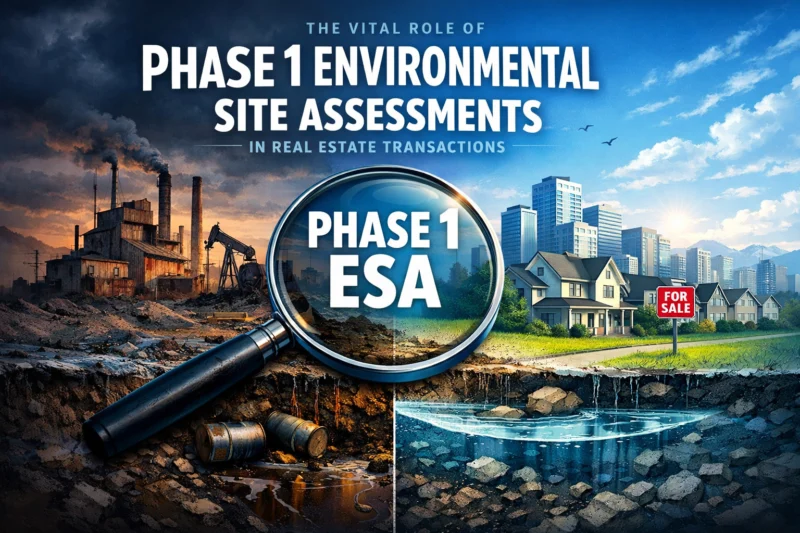
Phase 1 environmental site assessments matter because they turn environmental uncertainty into documented, decision-ready information before you close—or underwriting decisions get made—so buyers, lenders, and attorneys can price risk, allocate responsibilities, and set appropriate contingencies. In practice, that means the phase 1 ESA in real estate transactions becomes a transaction “decision input,” not just a technical report. When done well, Phase 1 helps identify recognized environmental conditions (RECs) and explains how the consultant reached conclusions using evidence that can be defended. Even when a report finds no RECs, the document still protects the deal by showing what was searched, what was observed, and where uncertainty remains.
This article explains what Phase 1 does (and does not do), how it fits into the real estate timeline, and how standards like ASTM E1527-21 and the All Appropriate Inquiries rule under 40 CFR Part 312 shape the defensibility of results. You’ll also learn how to read the report as a non-environmental stakeholder, how data gaps and access limitations can change interpretation, and what to do when Phase 1 flags RECs or unresolved uncertainty. Because you’re planning for 2026, we’ll also cover how modern digital workflows (GIS, enhanced aerial imagery, and data platforms) can improve traceability—without replacing the evidence framework that standards require.
What a Phase 1 environmental site assessment does before closing
A Phase 1 environmental site assessment is an information-gathering exercise designed to identify potential environmental liabilities—especially recognized environmental conditions—before you commit to a property. It matters because many real estate decisions depend on whether environmental risk is “known enough” to price, insure, finance, and allocate contract responsibilities.
At its core, Phase 1 supports informed deal-making. For buyers, it helps avoid surprise contamination claims and reduces the chance that redevelopment plans fail because of pre-existing issues. For lenders, it supports underwriting and collateral risk understanding. For sellers and their counsel, it creates a documented record of what was known and what inquiries were reasonably made—information that can become critical if disputes arise later. This “decision support” function is why Phase 1 is typically ordered early enough to influence LOI terms, purchase agreement language, and lender requirements, rather than after major commitments are already in motion.
How it works is also specific: Phase 1 uses historical research and site observations to determine whether RECs exist, rather than drilling, sampling, or laboratory testing. The consultant typically reviews records from sources that are considered reasonably ascertainable and interviews people with relevant knowledge of the site’s use and condition. Then the consultant conducts a visual inspection to look for signs that might indicate past releases—like stained soil, waste materials, deteriorated tanks/lines, venting, or evidence of former operations.
In real-world terms, you can think of Phase 1 as producing an evidence-based map of environmental facts and uncertainties. If RECs are identified, the report explains why and where the concern is coming from, supporting the next step (such as Phase 2 sampling, targeted supplemental investigation, or risk-based management). If no RECs are identified, it still documents what was searched and observed so stakeholders can make decisions with appropriate confidence—not false certainty.
A key limitation, often misunderstood: Phase 1 does not guarantee that contamination is absent. It addresses the availability of evidence and the likelihood of potential issues based on current and historical information. Data gaps, missing records, and limited access can exist even in a “clean” report, and those factors shape how conservative your decisions should be. For example, if a portion of the property cannot be visually observed because of fencing or locked access, the consultant’s conclusions may still be valid, but uncertainty may remain—and lenders or buyers may respond by adding access rights or requesting supplemental work.
Common mistake: stakeholders sometimes interpret “no RECs identified” as “no environmental liability exists.” What most guides get wrong is separating the finding from the evidence trail. The defensibility of Phase 1 rests on what sources were used, what assumptions were made, and how the consultant handled limitations. If you’re negotiating, the report should be treated like a structured argument supported by documented data—so disagreements can be resolved by pointing to evidence and methodology, not opinion.
How Phase 1 environmental site assessments fit into the real estate deal timeline and decision path
Phase 1 is most valuable when it’s completed early enough to influence contract terms and financing decisions—not after the deal is already locked into a closing date. In the deal timeline, it functions as an information checkpoint that shapes negotiations, contingencies, and the likelihood of moving to Phase 2 testing.
A typical workflow begins before closing, often around the time of LOI or purchase agreement drafting. Many lenders and risk teams request Phase 1 as a condition to proceed. Once the buyer’s team identifies that requirement, they select the ESA consultant and ensure the scope aligns with the property type, historical use, and likely neighboring operations. After the report is delivered, stakeholders review it to understand whether RECs exist, whether uncertainties are significant, and what language should be added to purchase agreements.
Phase 1 outputs are used by multiple parties. Buyers and their attorneys focus on risk allocation: what the seller knew, what is documented, and what contingencies or remediation obligations might be triggered. Lenders and insurers focus on whether the environmental story is consistent with underwriting expectations and whether additional work is needed to reduce uncertainty. Environmental consultants and engineering firms use Phase 1 findings to design Phase 2 or supplemental investigations. Even appraisers may consider how environmental issues affect marketability or assumptions, depending on the transaction structure.
Decision criteria often come down to the type of REC, strength of corroborating evidence, and whether access limitations prevent confirmation. For example, if historical research suggests a former dry-cleaning facility nearby but the site itself shows no indicators and access permits observation of relevant areas, a buyer might accept the “potential risk” framing and request engineering controls rather than immediate intrusive testing. Conversely, if Phase 1 identifies indicators consistent with an onsite release—such as evidence of old tank-related infrastructure or corroborated reports of dumping—many parties treat it as a stronger trigger for Phase 2.
A deeper-than-obvious issue is timing pressure. When Phase 1 is ordered too late—close to closing or after key financing steps—teams may not have enough time to interpret findings, obtain additional access, negotiate contingencies, or schedule Phase 2 if needed. This increases downstream rework and often results in contract amendments under stress. In practice, “late Phase 1” can create avoidable friction: the consultant might deliver a report with actionable issues, but the transaction may lack legal mechanisms and time to respond in a controlled way.
Phase 1 also interacts with other due diligence without replacing it. Title history may reveal transfers that support or contradict historical use narratives. Survey accuracy and boundary conditions help ensure site observations correspond to actual areas of concern. Zoning due diligence can indicate whether a property’s prior use is inconsistent with current development plans. The key is that Phase 1 provides environmental evidence inputs that complement—but do not duplicate—other diligence. That matters because stakeholders sometimes over-rely on one diligence stream: for example, treating zoning inconsistencies as proof of contamination, or treating environmental findings as proof of absence.
ASTM E1527-21 and 40 CFR Part 312 (AAI): the compliance backbone in 2026
Phase 1 reports are not just narratives; they’re expected to follow recognized frameworks—primarily ASTM E1527-21 for the Phase 1 methodology and All Appropriate Inquiries (AAI) under 40 CFR Part 312 for the legal defensibility component. In 2026, the core expectation is that the work is evidence-driven, well documented, and supported by recognized data sources.
ASTM E1527-21 is commonly used to structure the methodology: how the consultant conducts historical research, interviews, and site observations, and how they document findings. The AAI requirement under 40 CFR Part 312 focuses on meeting legal “appropriate inquiry” expectations, emphasizing documentation quality, use of recognized sources, and qualified professional judgment. Together, they form a “purpose-built” relationship: ASTM E1527-21 describes how Phase 1 is typically performed, while AAI provides the broader legal framing that many transactions must satisfy to preserve certain protections.
In practical terms, “compliance” means more than filling in a checklist. It means you should be able to trace conclusions back to documented sources and reasoned interpretation. For example, the report should identify what records were searched and the dates searched, summarize interviews conducted, and explain how observations on the ground were interpreted in light of the historical profile. If the consultant cites limited access or missing records, the report should explain how uncertainty was handled rather than hiding limitations behind reassuring wording.
A nuanced issue clients should ask about: different levels of effort can still produce a report that appears “acceptable” on the surface, even when historical sources vary in availability. Some consultants may rely more heavily on certain record types depending on regional access and their internal methodology. If you want maximum defensibility, it’s reasonable to ask the consultant how they selected data sources, how they handled inconclusive results, and how they documented “reasonably ascertainable” searches. That’s also where modern documentation habits matter: digital workpapers, GIS layers, and traceable source logs can improve transparency—so stakeholders can audit the logic behind conclusions.
Common mistake: confusing “followed the standard name” with “met the standard evidence intent.” Even with ASTM E1527-21 and AAI structure, defensibility depends on documentation quality and the clarity of uncertainty handling. Another limitation: neither ASTM nor AAI transforms Phase 1 into Phase 2. If evidence points to an actual release or high-likelihood conditions, Phase 1 provides the decision pathway, not the final contamination status.
For authoritative context on AAI expectations, consult EPA All Appropriate Inquiries. For the ASTM method reference used in many transaction standards, you can also review information about the ASTM E1527 family via ASTM E1527 standard information. Note that the full text of ASTM standards is typically paywalled, but the public descriptions can help stakeholders understand the standard’s role.
What to look for in a strong Phase 1 ESA report (evidence, uncertainty, and RECs)
A strong Phase 1 environmental site assessment report clearly documents what was searched, what was observed, and how the consultant arrived at conclusions about recognized environmental conditions (RECs), data gaps, and limitations. If you’re reviewing as a buyer, lender, attorney, or insurer, the “quality” of Phase 1 is mostly visible in the evidence trail and the way uncertainty is explained.
Start with the evidence documentation. The report should include the historical research scope (what records/databases were searched and when), interview summaries (who was interviewed and what they said), and the site observations (what was visible, what indicators were noted, and what couldn’t be observed). It should also identify proximity features that could relate to environmental conditions—such as former industrial land uses, waste handling areas, underground storage tank indicators, or patterns of historical fill. This matters because RECs often arise from a combination of historical narrative and present-day indicators; the report should make that connection explicit.
Then look at how the report treats uncertainty. You should expect clear sections addressing RECs, “conditions indicative of RECs,” and “potential RECs.” The language matters, but so does how the consultant explains why. If data gaps exist—like incomplete records, unverified cleanup history, or limited access to a specific portion of the site—the report should explain how those gaps affect interpretation. A “clean” conclusion can still be valid, but it should not imply that uncertainty was eliminated. In real estate decisions, a gap in evidence can change which contingencies you negotiate or whether you request supplemental work.
Practically, you want to verify scope adequacy rather than only reading the final box that says “no RECs identified.” A reviewer should ask whether the consultant’s search accounted for realistic historical patterns for the area, including how long ago relevant uses might have occurred and how boundaries have changed. Many properties have histories that shift due to lot splits, redevelopment, or reconfiguration of parcels; a good report will show how those factors were evaluated. It should also reflect how the consultant treated “reasonably ascertainable” limits, so readers understand where the search stopped and why.
Real-world scenario: imagine a mixed-use redevelopment where an old warehouse was demolished before the Phase 1 inspection. The exterior looks “new,” and the consultant observes no obvious indicators during the site . However, if the historical research cannot verify tank/line status or the prior disposal practices are undocumented, the report may still be defensible—but data gaps may remain. Buyers often need that nuance to negotiate confidently, possibly adding a contingency for access to remaining sub-slab areas or requiring supplemental investigation before specific construction activities.
A common mistake is treating recommendations as guarantees. If the report recommends Phase 2 “if access allows” or “to clarify data gap uncertainty,” stakeholders should understand that the recommendation is evidence-linked, not a promise of contamination status. The correct response is to discuss what evidence would resolve the uncertainty and how it would be documented, so the decision remains defensible.
Common pitfalls and misconceptions that derail Phase 1 in real estate transactions
Many Phase 1 ESA failures come from misconceptions that misunderstand what Phase 1 can and cannot do, or from report quality problems that stem from thin evidence gathering. The result is often avoidable Phase 2 triggers, contract disputes, or lender concerns late in the process.
Misconception #1: “Phase 1 prevents contamination risk.” Phase 1 does not prevent contamination; it identifies environmental conditions and supports better decisions by documenting evidence and uncertainty. If you treat Phase 1 like a contamination “test,” you may underprepare for the reality that RECs and data gaps still require follow-through. Phase 1 is information management—turning unknowns into structured questions that can be answered through Phase 2 testing or targeted supplemental work when necessary.
Misconception #2: “Outdated or incomplete historical research will not matter if the report is clean.” In reality, thin historical research can produce an “acceptable-looking” conclusion that later becomes difficult to defend when facts are uncovered during demolition, redevelopment, or targeted investigations. A common scenario is a redevelopment project where demolition reveals unexpected fill materials or evidence of old infrastructure. If the Phase 1 didn’t adequately document relevant historical records or couldn’t verify tank-related details, stakeholders may end up redoing work and renegotiating terms under time pressure.
Misconception #3: confusion between off-site impacts and on-site evidence. Phase 1 is not meant to prove that contamination has migrated from neighboring properties, but it should evaluate proximity and the relationship between site features and possible migration pathways. When stakeholders treat “off-site contamination exists” as automatically meaning the subject property is impacted, they risk over-escalating. Conversely, when they ignore off-site relevance entirely, they may miss a reason that a REC (or potential REC) should have been identified.
Another deeper-than-obvious pitfall involves misreading land-use history after the fact. For instance, redevelopment may have erased obvious indicators—new roofing, new paving, landscaping that covers disturbed soils—creating a false sense of reassurance. Or, boundaries may have shifted, meaning the “property history” described in a report might not perfectly match what is now on the parcel. The guide error here is not emphasizing how evidence traceability matters as much as the final conclusion.
Finally, contract and lender misunderstandings derail many transactions. A report recommendation may be treated as a guarantee, or environmental “due diligence” definitions might not be aligned with what Phase 1 actually provides. Sellers sometimes believe that a Phase 1 conclusion “covers” all future issues; buyers sometimes believe a recommendation “proves” the risk will exist. The better approach is to make sure the purchase agreement defines the role of Phase 1, how findings can trigger contingencies, and what happens when data gaps or limited access are discovered during the process.
When Phase 1 reveals RECs or data gaps: your realistic options
When Phase 1 identifies RECs or meaningful data gaps, the goal shifts from “information gathering” to “uncertainty resolution” through additional investigation, access, or risk management. The right next step depends on how strong the evidence is, what limitations exist, and what the transaction needs to proceed confidently.
In practice, options usually fall into a few categories. One path is proceeding to Phase 2 intrusive investigation to confirm whether releases have occurred, and to evaluate their extent and potential exposure. Another path is targeted supplemental investigation aimed at specific data gaps—such as verifying a historical tank area, clarifying ambiguous site observations, or confirming what happened in a specific time window where records are missing. In some cases, stakeholders may choose risk-based management and engineering controls (for example, when evidence suggests a low likelihood of impact or when remediation measures can be implemented efficiently). Finally, additional access or updated historical documentation can resolve uncertainty without immediately moving to broad intrusive testing.
Tradeoffs are real. Phase 2 reduces uncertainty but costs money and time, and it may require drilling, sampling, and permitting that can disrupt redevelopment schedules. Targeted supplemental work may be cheaper and faster, but it must be carefully designed so that it resolves the right uncertainty rather than creating new ambiguity. Risk-based management can support deal continuity, but it depends on regulatory context, future use assumptions, and the ability to implement controls and institutional measures if needed.
A deeper-than-obvious nuance: “supplemental” work can sometimes become functionally a Phase 2 if the investigation broadens beyond the original uncertainty. To keep decisions defensible, the documentation should explain what question each additional step is answering and how results will change the risk narrative. For example, if Phase 1 indicates a potential tank-related REC based on limited evidence, a targeted investigation might confirm whether abandoned tanks exist and what conditions they show. If the results suggest releases, the next steps should follow logically and be documented so that stakeholder decisions remain consistent with the evidence.
Insurance and lender requirements can influence which options are available and how stakeholders justify decisions. While not universal, some lenders will require additional work before funding or will impose conditions based on REC type and uncertainty magnitude. A common practical approach is to align the “decision plan” with financing milestones: define what results are required to proceed, and document that plan early so everyone knows what triggers follow-up.
Examples of Phase 1 triggers include corroborated suspect former operations, unverified tank/cleanup history, inconsistent records regarding disposal practices, or inaccessible areas that prevent evaluating potential indicators. When Phase 1 makes those triggers clear, the transaction can respond in a structured way rather than reactively.
If you’re preparing for 2026 workflows, consider how digital recordkeeping can reduce the friction of decisions: an evidence index and traceable workpaper system can make it easier for legal teams and lenders to review uncertainty and understand why supplemental work is necessary.
Edge cases and innovative data workflows that strengthen Phase 1 (without replacing evidence)
Some properties make Phase 1 harder because history, boundaries, and receptors are complex—yet those same edge cases are where a high-quality report can add the most value. Innovative data workflows can help strengthen evidence traceability, but they do not replace the underlying methodology and defensibility expectations.
Edge case 1: “legacy” property changes. Subdivision, lot consolidation, boundary shifts, and redevelopment can complicate historical attribution. For example, a parcel that used to include an on-site industrial yard might now be part of a multi-tenant building site. A careful Phase 1 should explain how the consultant mapped historical sources to the current parcel footprint and how they handled uncertainty where parcel geometry changed over time. Without that analysis, conclusions can become over-generalized.
Edge case 2: off-site complexity and migration pathways. Phase 1 should evaluate adjacent land uses and possible relationships between site features and likely impacts. If a neighboring property had a history of disposal, what matters is whether migration pathways could reasonably connect to the subject site—soil type, proximity features, and site hydrology considerations. A common mistake is to treat off-site facts as automatically conclusive or completely irrelevant. The better standard is “evidence-based relevance,” documented in the report.

Edge case 3: sensitive receptors and exposure pathways. Even at the informational Phase 1 level, stakeholders benefit from understanding how potential human or ecological receptors might be framed. For redevelopment projects near residences, schools, or sensitive environmental areas, the consultant’s narrative should clarify which exposure pathways could matter and how uncertainty was treated.
Innovation categories that can improve Phase 1 evidence quality include GIS-based mapping for consistent overlay of historic aerials, enhanced aerial imagery for visual documentation of past features, GPR as supplementary evidence (only, and not as a substitute for Phase 1 methodology), and drones/photogrammetry for high-resolution site documentation where appropriate and compliant with safety and access constraints. Digital workpaper platforms and data platforms can strengthen traceability by keeping a clear chain from source to conclusion and enabling easier review by attorneys and lenders.
Deeper insight: innovation must not be mistaken for compliance. A consultant can use modern visuals, but the defensibility still depends on documented inquiry and qualified professional judgment consistent with ASTM E1527-21 and AAI expectations. Data provenance, QA/QC, and alignment with recognized data sources matter. If a report includes sophisticated maps but cannot explain what was searched, how interviews were conducted, or how limitations were handled, the innovation won’t fix the underlying evidence weaknesses.
Regional and regulatory context: why Phase 1 expectations can differ by location
Phase 1 environmental site assessment expectations can vary in practice because regional land-use patterns, record availability, and regulatory agency resources affect the quality and completeness of “reasonably ascertainable” searches. While the core standards framework remains evidence-driven, the historical record reality in each region can change how data gaps appear in the report.
In many regions, historical industrial patterns cluster in recognizable ways: former manufacturing corridors, rail yards, dry-cleaner concentrations, small chemical operations, or waste handling areas. Those patterns influence how consultants focus historical research and what proximity features they consider most relevant. For example, a property in an older industrial district may require more careful evaluation of historical uses like machine shops or drum storage, even if current buildings look commercial or residential.
Local regulatory context and database availability can also affect the depth of historical research. Some jurisdictions retain records more completely or provide better online access, while others may require more effort to locate documentation or may have limited record retention for older sites. This difference shows up in Phase 1 as data gaps, missing histories, or reliance on alternative evidence sources. A strong consultant will document what was missing and why, and it will explain whether the missing records materially change conclusions or simply limit detail.
Site access norms can further influence quality. Multi-tenant buildings, shared driveways, locked utility areas, fenced boundary limits, and safety restrictions can reduce what a visual inspection can confirm. Even when the consultant follows methodology, limited access can create uncertainty about areas where indicators would matter most (for example, former tank zones near service areas or loading docks). That uncertainty should be explicitly addressed so stakeholders understand how conservative the decision should be.
Practical guidance for clients: ask your Phase 1 consultant how they adapt to local conditions. Which state or provincial resources are routinely checked? How do they verify that historical searches correspond to the current parcel footprint? If records are incomplete, what strategy do they use to document “reasonably ascertainable” limits? The point is not to demand perfection—records aren’t always available—but to ensure the report is transparent about what it could not confirm and how that affects decisions.
Frequently Asked Questions About Phase 1 Environmental Site Assessments in Real Estate Transactions
What exactly qualifies as “recognized environmental conditions” in a Phase 1 ESA?
Recognized environmental conditions (RECs) are typically site conditions related to current or historical uses that indicate a potential release of hazardous substances or petroleum products. In a Phase 1 ESA, RECs may be based on evidence from historical records, interviews, and on-site observations, and they usually reflect conditions that are likely enough to warrant further attention. If evidence is uncertain or incomplete, the report may instead identify conditions indicative of RECs or potential RECs rather than definitive RECs. The report should also explain how uncertainty and data gaps were handled.
How does ASTM E1527-21 relate to the AAI requirement under 40 CFR Part 312?
ASTM E1527-21 provides a commonly used methodology structure for how Phase 1 inquiries are conducted and documented. The AAI rule under 40 CFR Part 312 sets legal expectations for “All Appropriate Inquiries,” emphasizing documentation, recognized sources, and qualified professional judgment. In many transactions, ASTM E1527-21 is treated as a practical way to meet AAI expectations, but the defensibility ultimately depends on evidence and how the work was performed. A strong report bridges both: it follows the ASTM process while producing documentation consistent with AAI principles.
Can a Phase 1 ESA be relied on for mortgage underwriting requirements?
In many mortgage and commercial lending workflows, lenders request Phase 1 ESA to inform underwriting and collateral risk review. Reliance is strongest when the report is prepared in line with ASTM E1527-21 and documented with clear evidence, assumptions, and limitations. Lenders may request additional work when the report identifies RECs, meaningful data gaps, or limited access that could affect risk. The lender’s own policy and insurer requirements often determine how much further investigation is needed.
What should buyers do if the Phase 1 ESA identifies data gaps or limited access?
Buyers should treat data gaps and limited access as decision-relevant uncertainties, not as minor footnotes. Review the report to identify which conclusions depend on missing records or unobserved areas, and then decide whether to request additional access, obtain supplemental historical documentation, or commission targeted investigation. A good practice is to align the next step with the transaction milestone that requires clarity, such as before major construction or before final funding. Documenting this decision path helps ensure it stays defensible if new information emerges.
If Phase 1 says “no RECs,” does that mean the property is contamination-free?
No RECs identified generally means the consultant did not find evidence strong enough to support recognized environmental conditions based on the Phase 1 inquiry. It does not guarantee contamination is absent, because Phase 1 is not intrusive sampling and may be limited by record gaps or access constraints. The correct interpretation is “information certainty within limits,” not absolute certainty. If the report also describes meaningful data gaps, stakeholders should factor those gaps into their risk decisions even with a “no RECs” outcome.
How far back does the historical research typically go, and what if records don’t exist?
Phase 1 historical research is commonly expected to extend to relevant periods that correspond to the property’s use and the identified risk profile, using evidence that is reasonably ascertainable. The exact depth can vary based on property type and available records, but the key standard is whether sources were searched sufficiently for the current and reasonably anticipated uses. If records don’t exist or cannot be found, the report should document what was missing and how that limitation affects conclusions. When a missing record is tied to a potential indicator, it can increase the importance of follow-up work.
What are the most common reasons Phase 1 leads to Phase 2 testing?
Phase 1 most often leads to Phase 2 when RECs are identified, when conditions indicative of RECs are supported by corroborating evidence, or when data gaps prevent uncertainty from being adequately resolved. Other triggers include suspected former releases, unverified tank or cleanup history, and significant inconsistencies between records and observations. Limited access that blocks evaluation of likely indicator locations can also push stakeholders toward targeted intrusive work. In all cases, the goal is to move from “potential risk” to confirmed condition so negotiations and construction planning can proceed responsibly.
How do attorneys usually use Phase 1 findings during purchase agreement negotiations?
Attorneys typically use Phase 1 findings to support risk allocation and define contingencies in the purchase agreement. They may negotiate language that ties seller obligations or buyer rights to the existence of RECs, the presence of data gaps, or recommendations for further investigation. For example, if Phase 1 identifies RECs, the agreement might include an environmental contingency, a requirement for Phase 2 before closing, or a framework for cost allocation if remediation is needed. The key is translating the report’s evidence-backed conclusions into specific contract terms rather than vague assurances.
What is the best way to evaluate a Phase 1 ESA report as a non-environmental stakeholder?
Start by reviewing the executive summary for RECs, data gaps, limitations, and recommendations, then read the evidence sections for documented sources and dates searched. Look for what the consultant considered most important: interviews, historic uses, proximity features, and site observation findings. Then evaluate whether the report clearly explains uncertainty rather than hiding it behind general language. Finally, ask targeted questions about scope adequacy, search assumptions, and whether any recommended next steps are required to address specific uncertainties.
How does a Phase 1 ESA handle off-site contamination concerns?
Phase 1 generally evaluates off-site conditions in terms of relevance to the subject property, such as proximity, historical land uses, and possible migration or exposure pathways. It should not assume that off-site contamination automatically impacts the property, but it also should not ignore off-site facts that could explain potential concerns. The report’s conclusions should reflect how off-site evidence was weighed alongside on-site observations and historical use records. When off-site facts are significant, the consultant may recommend supplemental investigation to clarify whether impact exists on-site.
Are modern tools like GIS, aerial imagery, and digital workpapers changing Phase 1 quality?
Modern tools can improve Phase 1 reports by strengthening visualization, traceability, and documentation of evidence sources and site observations. GIS overlays and enhanced aerial imagery can help confirm historical land-use patterns and map observations more consistently. Digital workpapers can make it easier for stakeholders to audit sources, limitations, and assumptions. However, these tools do not replace the core inquiry requirements—Phase 1 quality still depends on evidence gathering, transparency about uncertainty, and defensible professional judgment.
Conclusion
Phase 1 environmental site assessments de-risk real estate transactions by turning environmental uncertainty into documented, decision-ready information before closing, underwriting, or contract finalization. When stakeholders treat the Phase 1 report as an evidence-backed decision input—rather than a guarantee—they can price risk more accurately, negotiate the right contingencies, and reduce the chance of disruptive surprises later.
Defensibility in 2026 still centers on the backbone of ASTM E1527-21 methodology and the AAI principles under 40 CFR Part 312. But the defensible value of Phase 1 also depends on the practical details: the quality of source documentation, the clarity of uncertainty and access limitations, and the logic connecting observations to conclusions about RECs and data gaps. That is what enables attorneys, lenders, and consultants to align next steps with what the evidence actually supports.
For the best outcomes, don’t stop at the conclusion section—review the RECs discussion, limitations, and the rationale behind recommendations. Then incorporate the findings into negotiation and contingency planning early in the process, so timing pressure doesn’t force reactive decisions. If you’re working through a deal this year, consult a qualified ESA professional and build your decision plan around the report’s evidence: that’s the practical path to better decisions, even though Phase 1 cannot guarantee a property is contamination-free.
Updated August 2026