
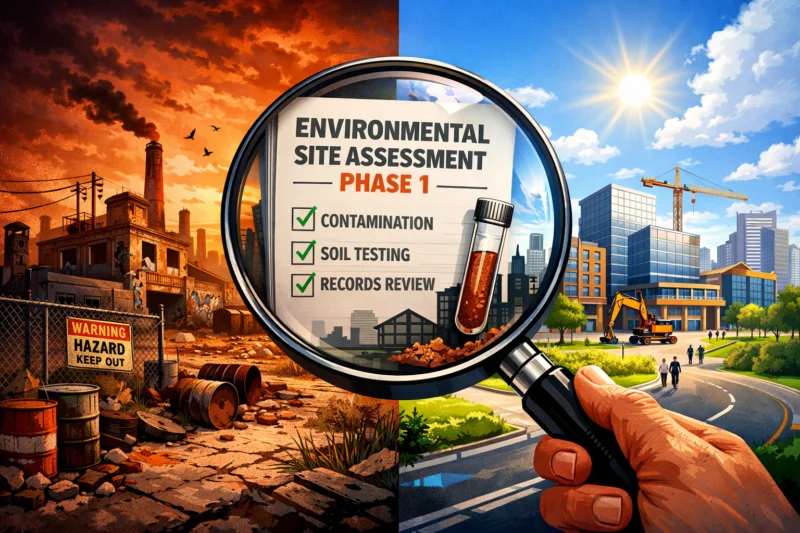
Phase 1 assessments are critical at the start of redevelopment because they reduce uncertainty early, help teams make feasibility decisions with fewer surprises, and support smarter permitting and financing strategies. In practice, a phase 1 ESA for redevelopment projects frames what is known (and what is not) about historical property use so the project can be designed and funded with clear risk boundaries. A “Phase 1 assessment” (often aligned with All Appropriate Inquiry-style expectations) typically combines historical records review, site reconnaissance, and professional conclusions about potential environmental concerns. Because redevelopment compresses schedules—site control, design, entitlement, and lender requirements happen in parallel—an early, well-documented assessment prevents downstream delays caused by late-discovered constraints, contested scope, or missing evidence.
This guide is informational and focuses on how Phase 1 assessments affect real redevelopment decisions: what they evaluate, what outputs look like, how conclusions translate into next steps, and where teams commonly misunderstand limitations. You will also see how standards and defensibility work in 2026, including references to ASTM E1527-21 context and the relationship to 40 CFR Part 312 (AAI). By the end, you should be able to commission (or review) a Phase 1 assessment that is decision-ready for redevelopment milestones rather than “just another report.”
What does a Phase 1 assessment provide for redevelopment decision-making?
A Phase 1 assessment provides a structured, evidence-based picture of a property’s historical use and observed conditions so redevelopment teams can decide how to plan, budget, and de-risk next steps. Instead of jumping into invasive testing, Phase 1 asks a narrower question: “What might have been happening on this site in the past, and what should we pay attention to now?” The result is an organized set of findings, conclusions, and “areas of concern” (if applicable) that can drive redevelopment strategy long before demolition, grading, or construction starts.
In redevelopment planning, the output typically takes the form of a report that documents research sources, interviews or site-knowledge (when available), and site observations. It then synthesizes those inputs into professional judgment: whether the historical and reconnaissance evidence suggests the presence of recognized environmental conditions, controlled recognized environmental conditions, or conditions that warrant additional scrutiny. This structure matters because redevelopment teams rarely make decisions based on one paragraph—they need a defensible trail of how conclusions were formed so that lenders, investors, attorneys, and permitting officials can understand the logic behind proposed next steps.
It also matters how Phase 1 is framed: it is not automatically a cleanup plan, nor is it a sampling program. “No obvious issues” is still a conclusion, but it is a qualified one. For instance, the professional may note limitations such as incomplete records, undocumented fill, restricted access, missing aerial imagery timeframes, or uncertainty about subsurface utility corridors—any of which can justify targeted follow-on investigation later. In real-world redevelopment, this is the difference between a project that proceeds confidently and one that gets stalled after unexpected findings surface during intrusive work.
Finally, Phase 1 affects responsibility and reliance. Developers and property owners want speed, but they also need defensible assumptions. Lenders and attorneys rely on the report’s stated limitations and scope to determine whether further inquiry is required. A common mistake is treating a Phase 1 assessment as a guarantee of “clean” conditions; the more correct mindset is using Phase 1 to define the decision boundary—what you can rely on now, and what you must investigate later if risk signals emerge.
When do redevelopment projects trigger the need for Phase 1 assessments (and who typically requires them)?
Phase 1 assessments are commonly triggered whenever a redevelopment project needs early clarity on environmental risk—especially around property acquisition, financing, or program eligibility. Many projects trigger Phase 1 because redevelopment transforms land use, and new uses can increase exposure pathways (for example, converting commercial space to residential or intensifying occupancy). In those cases, what was “acceptable” for past operations may create new compliance burdens, design constraints, and lender expectations during redevelopment.
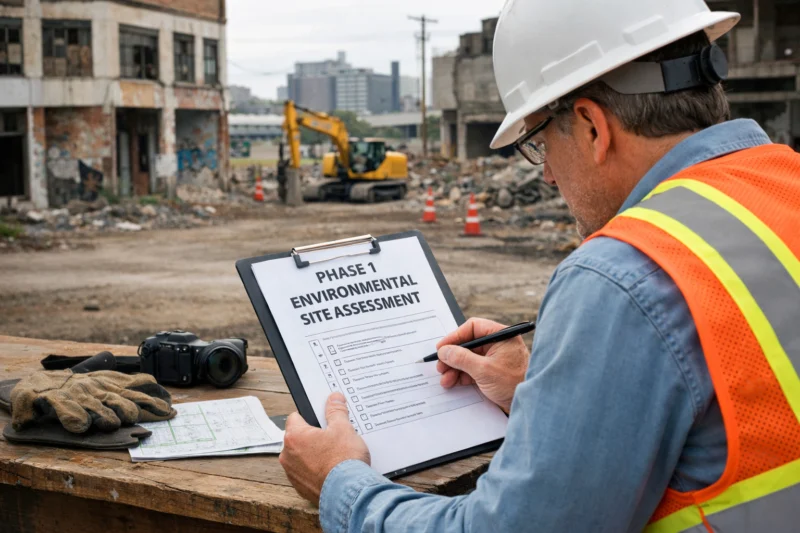
Common triggers include property transfers (sale or lease structures), redevelopment or zoning changes that alter use, brownfield redevelopment programs with eligibility requirements, refinancing, and underwriting for construction or rehabilitation financing. The party that “requires” Phase 1 is often the lender or investor, because their risk models depend on evidence. Municipal programs can indirectly require it as well, because program documentation often expects an inquiry consistent with All Appropriate Inquiry (AAI) concepts or equivalent standards for environmental diligence.
Phase 1 becomes especially critical for redevelopment of former industrial or commercial sites, but also for “not obviously industrial” scenarios. A residential lot near a former utility corridor, a dry-cleaner-impacted area, a former gas station, or a site adjacent to historic rail corridors can still carry legacy chemical releases or fill-related complexity. In multi-parcel redevelopment, even if each parcel looks simple, the project-level reality is that shared infrastructure and adjacent historic uses can create cross-boundary risk, so Phase 1 must cover the defined development footprint consistently.
Geography matters too, mostly in practice variability rather than in changing the fundamental concept. Regulations and program guidance can vary by jurisdiction, and record availability can differ between regions (coastal fill histories, legacy port zones, desert reuse sites, and former rail or manufacturing corridors). The most reliable approach is national-level due diligence anchored to recognized standards, combined with a jurisdiction/program “check your jurisdiction/program” review before you treat a Phase 1 report as sufficient for eligibility or financing conditions.
How do you run a Phase 1 assessment the right way for redevelopment planning (process & decision path)?
To run a Phase 1 assessment correctly for redevelopment planning, you need a decision path: align the scope to the redevelopment footprint, ensure the record review is comprehensive for the relevant timeframe, and use professional judgment to translate findings into “what next” recommendations. The basic process moves from document intake to background research, then site reconnaissance, then synthesis into conclusions about environmental conditions and areas of concern.
Start with document intake that reflects redevelopment reality. Provide the environmental professional with the proposed development footprint, parcel boundaries, planned demolition or grading areas, and any known property boundaries that may differ from legal descriptions (for example, easements, shared driveways, or utility corridors). Then conduct background research that emphasizes historical land use and potential source terms that could matter to redevelopment (for example, historical operations, fuel or chemical storage practices, and known infrastructure such as underground tanks or service lines). Finally, site reconnaissance should be planned with access constraints in mind: restricted gates, partially fenced areas, temporary structures, ongoing construction, or demolition staging can hide evidence if not addressed deliberately.
In the synthesis step, the professional’s conclusions need to be redevelopment-relevant, not just technically correct. For decision criteria, redevelopment teams should look for whether the report identifies potential environmental concerns, areas of concern, and a clear logic for recommendations about next steps. In 2026 reporting workflows, many practitioners will anchor their method to ASTM E1527-21 context when describing what “environmental professional” considerations look like and how reliance on records and observed conditions is handled. You do not need to become an expert in the standard, but you should ask how the team accounted for record sources, limitations, and professional judgment.
Data quality and record reliability are where redevelopment teams can help. Encourage the project team to provide chain-of-title history, relevant aerial imagery timeframes, mapping of utility corridors, and disturbance history (including fill, grading, or construction staging that could complicate “what you see today”). A deeper nuance is that redevelopment plans can change interpretation: if the project proposes significant grading or utilities relocation, areas flagged as “suspect” may become higher priority for follow-on investigation because the redevelopment itself will alter subsurface pathways and disturbance patterns.
How should Phase 1 assessment results shape design, budgeting, and risk allocation?
Phase 1 assessment results should shape design, budgeting, and risk allocation by converting evidence-based findings into actionable redevelopment decisions—refining investigation areas, informing demolition and utility sequencing, and setting realistic contingencies. The key is not to treat the report as a pass/fail score, but to use the conclusions to build a decision-ready plan for what you will do next if areas of concern exist, remain uncertain, or involve limitations.
Practically, Phase 1 outputs can guide where targeted follow-on work should concentrate. If the report identifies an area of concern near a planned foundation footprint, the redevelopment design may adjust building layouts, inform geotechnical planning, or influence the sequence of demolition versus intrusive work. Even when Phase 1 suggests no obvious issues, the “conditions with limitations” can still drive a targeted strategy—for example, clarifying fill boundaries, documenting current ground cover changes, or planning additional confirmatory steps in restricted areas that were not fully visible during reconnaissance.
Budgeting is often where misunderstandings cause pain. Redevelopment teams should anticipate contingencies tied to limited-scope sampling, additional intrusive investigation, or schedule buffers for permitting conversations once follow-on results are available. Risk allocation depends on stakeholder alignment: lenders and insurers may require additional documentation or conditions precedent, investors may adjust diligence timelines, and attorneys may negotiate terms based on which party bears uncertainty. The defensible approach is to map Phase 1 findings to responsibilities early, rather than discovering after underwriting that a limitation was not accounted for.
A common pitfall is the “scope creep” trap. Teams may feel compelled to turn Phase 1 into de facto sampling by demanding intrusive work too early or requesting extensive sampling prematurely. While additional work may be necessary, the better pattern is: use Phase 1 to define decision boundaries, then execute targeted next steps that match the level of uncertainty and redevelopment constraints. For defensibility, keep documentation that supports reliance: assumptions, limitations, the relied-upon source list, and the specific observations that influenced professional judgment.
What are the common pitfalls and misconceptions in Phase 1 assessments for redevelopment?
A major misconception is that Phase 1 tells you whether a site is “clean.” Phase 1 primarily indicates whether there are signs that recognized environmental conditions (or related concerns) may exist based on historical records and site observations; it does not provide the same information as sampling or intrusive investigation. Another frequent issue is treating more records as automatically better, when irrelevant or low-quality records can dilute professional judgment and create confusion in conclusions.
Incomplete site reconnaissance is a practical pitfall. In redevelopment, it is common to have restricted access, ongoing construction, or staged demolition equipment that changes how the property presents. If the reconnaissance does not adequately address current conditions—or if observers cannot verify areas where historic use suggests risk—the report’s limitations may become a problem later, especially when lenders or programs ask why uncertainty exists. Similarly, misreading historical use timelines can cause missed connections: an operation may have started or stopped long before current ownership, or lease turnover may hide intermediate uses that matter to environmental risk.
Edge cases often produce the most disputes because they challenge simplistic interpretations. Redevelopment over former landfills or fill materials is one example: “no obvious staining” today does not resolve questions about what was imported, where it was placed, and whether it contains contaminants. Subsurface utility corridors can also complicate what counts as “observed” versus “unobserved”—and abandoned tanks or lines may be difficult to confirm without targeted investigation. Finally, redevelopment planning itself can generate “unknown unknowns”: if the project changes grade or exposes areas previously undisturbed, Phase 1 may flag limitations that later become urgent only after earthwork begins.
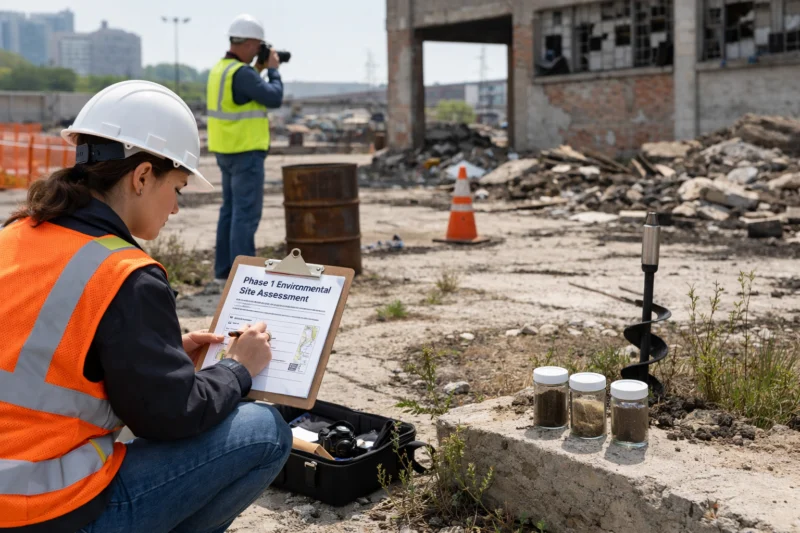
What most guides get wrong is telling readers only what Phase 1 is supposed to do, without emphasizing what “limitations” mean and how they show up in conclusions. In real redevelopment, the limitations section and the professional’s reliance statement are not boilerplate—they determine whether the report can support decisions made for financing and permitting. The best mitigation is to commission Phase 1 with redevelopment inputs from the start and to review the report’s assumptions and limitations as part of your internal go/no-go decision.
What advanced considerations and edge cases can affect Phase 1 outcomes in 2026?
In 2026, advanced considerations in Phase 1 assessments often come down to data quality, boundary conditions, and how well the assessment manages gaps without overreaching. Two Phase 1 reports can look similar on the surface, but the conclusions may carry different levels of confidence because the evidence base and limitations were handled differently.
Gap management is a key advanced topic. When records are missing, inconsistent, or ambiguous, the environmental professional must document what was attempted and what cannot be resolved with existing information. The goal is to communicate uncertainty clearly, not to “fill in blanks” with assumptions. For redevelopment teams, this means your internal review should focus on where uncertainty lives: which areas are based on older aerial evidence, which sources are weak, and which observations could not be confirmed due to access barriers or temporary conditions.
Boundary conditions matter in multi-parcel and shared infrastructure projects. Shared utilities, easements, and adjacent infrastructure can create a situation where one parcel’s history is not isolated from another’s environmental risk. The Phase 1 must therefore define the relevant area of inquiry clearly and ensure the conclusions and areas of concern correspond to the redevelopment footprint and the likely disturbance zones.
Regulatory and eligibility complexity also shows up in 2026 workflows. Teams frequently reference 40 CFR Part 312 (AAI) expectations when discussing eligibility and documentation frameworks, even when Phase 1 is executed under ASTM-oriented practice. A careful approach is to understand that AAI-style inquiry expectations emphasize appropriate investigation and documentation, and that programs may require specific deliverables or timing. Rather than making Part 312 the article’s only focus, treat it as an important context for why documentation quality (sources, reliance, and limitations) can matter in redevelopment eligibility decisions.
Finally, coordinate Phase 1 findings with other studies without assuming Phase 1 covers everything. Vapor intrusion screening and radon considerations may involve building-specific pathways and follow-on steps that are distinct from Phase 1. Likewise, asbestos and lead paint histories are separate scopes for building material assessments. A common mistake is to interpret Phase 1 as covering all environmental concerns; the correct approach is sequential coordination: Phase 1 frames environmental history and potential subsurface concerns, then follow-on work addresses pathway-specific risks.
What alternatives exist to Phase 1 assessments—or for what comes after them?
Alternatives to Phase 1 are usually not a complete replacement when AAI-style inquiry expectations or eligibility frameworks require Phase 1-level investigation; instead, alternatives typically supplement Phase 1 or adjust the due-diligence pathway based on risk. In redevelopment, the practical decision is sequencing: Phase 1 first to define what you need to know, then targeted follow-on work when evidence suggests next steps.
One alternative category is supplemental investigation strategies that follow Phase 1, such as targeted limited sampling or planning for phased intrusive investigation. If Phase 1 identifies areas of concern, those results can justify intrusive work focused on the specific locations and exposure pathways relevant to redevelopment design. Another category is desk-based reviews or “screening tiers” that may help early feasibility, but these generally do not replace Phase 1 when relied-upon standards expect site reconnaissance and professional conclusions based on historical evidence.
Program-aligned redevelopment paths also matter. Some projects may need documentation aligned to specific redevelopment criteria, which can affect what is acceptable for eligibility and how findings must be presented. In those contexts, Phase 1 sequencing still matters, but the deliverables may be tailored to program requirements, especially around limitations, timing, and the decision basis for moving forward.
Professional team alternatives are another area teams consider. The “environmental professional” selection is not just administrative; competency matters for redevelopment contexts such as multi-parcel boundaries, records complexity, and interpretation challenges. Common tradeoffs include under-scoping due to budget pressures or over-scoping due to tool-first thinking rather than decision-based thinking. The most defensible approach remains: Phase 1 → targeted next steps where warranted → decision that is both redevelopment-ready and documentable for stakeholders.
Optional comparison note for planning teams: if you need a decision framework to compare approaches, Phase 1 is the evidence-based inquiry step, targeted supplemental investigation is the evidence-completion step, and desk-based screening tiers are feasibility triage. The right choice depends on whether your project needs eligibility-style documentation, whether your risk signals are strong, and how much uncertainty your financing timeline can tolerate.
Which innovations are shaping modern Phase 1 assessments for redevelopment projects in 2026?
Modern Phase 1 assessments for redevelopment increasingly use GIS, non-intrusive reconnaissance tools, and digital workflows to improve evidence handling, visualization, and defensibility—without replacing professional judgment. In 2026, the best innovation is typically “decision support,” not “replacement,” because Phase 1 conclusions still depend on interpreting historical records and site observations in context.
Innovation categories that are now common include GIS mapping and layered historical aerial imagery, which help professionals visualize land-use changes over time and compare historical footprints to current redevelopment boundaries. Non-intrusive tools such as GPR (where appropriate and permitted by the engagement scope) can provide reconnaissance context for subsurface features that are relevant to redevelopment planning, though it is not a substitute for intrusive investigation when contamination cannot be ruled out. Drones and photogrammetry can improve documentation of site conditions, especially when redevelopment staging limits visibility or when restricted-access areas need clearer visual records.
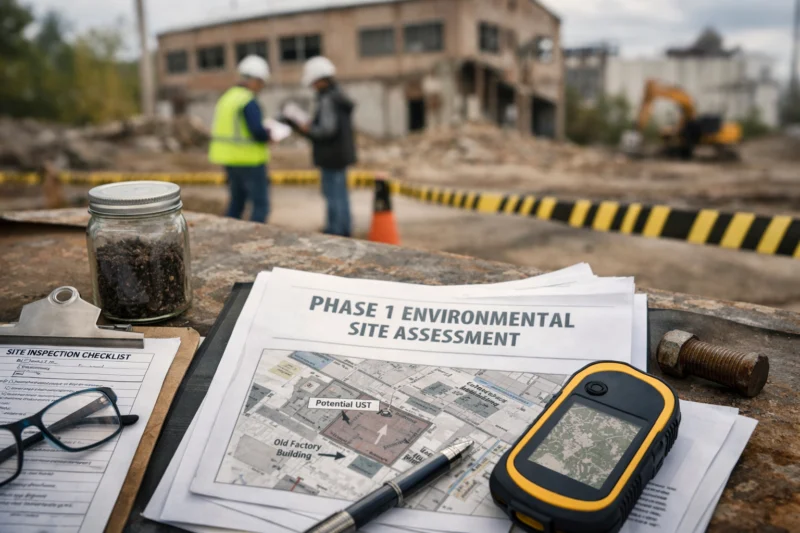
Digital workflows and data platforms can strengthen traceability. In practice, this means structured source tracking, audit trails for how records were obtained, and clear version control for report inputs. These improvements matter for defensibility in disputes because stakeholders can review what sources were relied on, what timeframes were used, and what assumptions were made. A deeper nuance is that innovation can create risk if teams become tool-first: geospatial outputs can be misinterpreted without context, and non-intrusive signals can be over-weighted if professionals treat them as confirmation rather than reconnaissance.
For redevelopment teams, the deliverables should be specified clearly. Ask for georeferenced maps that match redevelopment parcel boundaries, a source list that is decision-ready (not just a long bibliography), and a conclusions section that connects evidence to redevelopment implications. Even in a digitally enhanced workflow, the report must still explain limitations transparently and state how those limitations affect reliance.
How do region and local practice considerations affect Phase 1 assessments for redevelopment?
Region and local practice considerations influence how Phase 1 assessments are documented, what stakeholders expect to , and how redevelopment programs interpret evidence—while the core principles of inquiry and professional judgment remain consistent. Even when the assessment is executed nationally, local redevelopment authorities, permitting offices, and program administrators may have specific documentation norms that affect what is considered “complete enough” for their process.
Property-type history can vary by region and create different record availability challenges. Coastal and river-adjacent areas may have histories of fill and shoreline changes; former rail or port zones may involve complex infrastructure footprints and layered ownership; arid regions may have legacy water reuse and localized industrial activities that appear sparse in records but are present in site conditions. In those cases, the Phase 1 team must reconcile public record gaps with plausible site history, and redevelopment teams should avoid assuming that missing information automatically means missing risk.
Local known site history can also conflict with public records. For example, community accounts may describe past operations that are partially reflected in certain documents but missing in others due to inconsistent chain-of-title records. Professionals typically address this by documenting sources, documenting the level of confidence, and clearly describing how discrepancies were resolved or left as limitations. The practical takeaway is that “reconciliation” must be explicit: redevelopment teams need to understand which parts of the history are corroborated and which parts are uncertain.
Finally, keep communications realistic. Coordinating with municipal redevelopment authorities early can reduce friction, but teams should avoid overpromising regulatory outcomes based on a Phase 1 report alone. The best practice is to align your Phase 1 deliverables with the documentation expectations of the relevant local program, and to treat Phase 1 findings as a foundation for follow-on work and design decisions rather than as a guarantee.
Frequently Asked Questions About Phase 1 Assessments in Redevelopment Projects
How does a Phase 1 assessment influence redevelopment financing decisions?
Phase 1 assessments influence financing because lenders and investors use them to understand environmental risk before they underwrite acquisition or redevelopment. If the report identifies areas of concern or notable limitations, financing may come with conditions precedent, such as completing targeted next-step work or providing supplemental documentation. The report’s clarity on relied-upon sources, limitations, and professional conclusions can also affect how quickly lenders can move from diligence to approval.
What’s the difference between a Phase 1 assessment and environmental sampling?
A Phase 1 assessment primarily evaluates historical records and observed conditions to identify potential environmental concerns, and it results in professional conclusions about whether conditions may exist. Environmental sampling is intrusive testing that measures materials or contaminants in soil, groundwater, or other media. Phase 1 typically determines where sampling may be warranted; it does not replace the evidence that sampling provides when contamination needs to be confirmed or characterized.
When is a phase 1 ESA for redevelopment projects considered “complete” enough to rely on?
“Complete enough” depends on the project’s reliance context and what stakeholders require, but it usually means the assessment scope matches the redevelopment footprint and the report clearly documents sources, observations, and limitations. In 2026 practice, professionals often align methodology to ASTM E1527-21 context and explain how the inquiry meets recognized expectations for an environmental professional’s work. Reliance is strongest when limitations are narrow and well-communicated, and when conclusions are connected to evidence rather than speculation.
Can redevelopment proceed if the Phase 1 assessment identifies areas of concern?
Yes, redevelopment can proceed, but it typically requires a decision plan for next steps. Common pathways include targeted follow-on investigation, redesigning around higher-risk zones, adjusting demolition or grading sequencing, or building in contingencies for additional work. Lenders and municipalities may accept a phased approach if the project team shows how it will resolve uncertainties before sensitive construction or occupancy milestones.
What should developers do if historical records are missing or inconsistent?
Developers should ask the environmental professional to document the record gaps and explain what additional research steps were attempted to resolve them. Gap management often involves expanding the source list, clarifying chain-of-title timeframes, and documenting inconsistent accounts as limitations rather than ignoring them. The project team can also support the process by providing known leases, maps, aerials, or disturbance history that may not appear in public databases.
What are the most common Phase 1 assessment mistakes that cause delays?
Delays often stem from incomplete site reconnaissance, weak or incomplete source documentation, and misinterpreting historical timelines. Another frequent issue is deliverables that do not match what lenders, insurers, or program administrators need—such as unclear definitions of the inquiry area or vague articulation of limitations. When these problems show up late, stakeholders may require supplemental work, extending timelines and creating budget pressure.
How do you ensure the Phase 1 assessment supports ASTM E1527-21 style expectations in 2026?
To support ASTM E1527-21 context, you want a report that documents what an environmental professional reviewed, what was observed during reconnaissance, and what sources were relied upon. The best reports clearly describe limitations and professional judgment, including how uncertainty was handled without overstating conclusions. In redevelopment projects, scope alignment to the planned footprint and a well-defined evidence trail are critical for matching expectations in 2026.
How do Phase 1 assessment findings relate to 40 CFR Part 312 (AAI) eligibility?
Phase 1 findings relate to AAI eligibility because many eligibility frameworks expect an inquiry consistent with All Appropriate Inquiry documentation and intent. While Phase 1 itself is not identical to a formal eligibility determination, the report’s documentation—sources, reliance, and limitations—often becomes central to eligibility reviews. Project teams should coordinate with the relevant program requirements to ensure the inquiry and timing align with what is actually needed for that specific eligibility pathway.
What’s the best next step after Phase 1 flags a potential vapor intrusion concern?
After Phase 1 flags a possible vapor intrusion concern, the next step is typically escalation to appropriate follow-on screening or site-specific evaluation designed for vapor pathways. This often involves coordinating with building design and environmental engineering teams so that future intrusive work targets relevant locations and construction scenarios. Because vapor intrusion assessment can require pathway-specific assumptions, the follow-on scope should be aligned to the redevelopment’s intended use and building envelope design.
Are there edge cases where Phase 1 conclusions are especially likely to be challenged?
Yes. Challenges are more likely when there are conflicting accounts of historical use, restricted access that prevented observation of key areas, or evidence gaps that were not handled transparently. Projects involving fill-heavy areas, subsurface utility corridors, or disputed source documents can also face scrutiny when conclusions depend on uncertain evidence. Preparing the report with clear traceability and well-articulated limitations makes it easier to respond to disputes.
Conclusion
Phase 1 assessments are a critical early step in redevelopment projects because they reduce uncertainty, support better feasibility decisions, and help avoid surprises during permitting and financing. The most valuable Phase 1 outcomes translate into specific decision paths—what you should investigate next, where design constraints may be needed, and how risk can be allocated among stakeholders. Defensibility depends on standards-aligned methodology, transparent limitations, and clear documentation that ties conclusions to evidence rather than assumptions.
For next steps, involve qualified environmental professionals early and align the assessment output with redevelopment milestones such as acquisition, design progression, and lender/investor requirements. Before you move into permitting and investment decisions, review the Phase 1 deliverables for completeness: sources used, scope boundaries, limitations, any areas of concern, and the recommendations that connect to practical redevelopment sequencing. If you build a post-Phase 1 action plan that assigns owners and dates for each follow-on task, you turn the report from a document into an operational roadmap.
If you want a simple workflow check, treat your Phase 1 package as “decision-ready documentation” and confirm it is internally consistent with the proposed site development footprint. That mindset helps keep redevelopment momentum while still meeting evidence expectations that stakeholders in 2026 can rely on.
Updated August 2026