
Yes—Phase 1 ESAs can protect both buyers and sellers by identifying likely environmental risks early, strengthening disclosure, and giving both sides a defensible basis for decisions before closing. In practice, this is the core of phase 1 ESA buyer and seller protection—without making it a guarantee of “no contamination.” Phase 1 Environmental Site Assessments are typically non-invasive record reviews and site reconnaissance, but the real protection comes from how well the scope matches the property’s history, how transparently limitations are stated, and how the findings are used in the contract and disclosures. For 2026 transactions, that means understanding what Phase 1 does detect (and what it cannot), how “recognized environmental conditions” can trigger next steps, and how timing and report reliance can affect outcomes when new information appears between report delivery and closing.
What does a Phase 1 ESA actually do to protect buyers and sellers?
A Phase 1 ESA protects buyers and sellers by converting environmental uncertainty into documented due diligence—so risks can be disclosed and allocated rationally before ownership changes. Instead of relying on assumptions or informal knowledge, the report organizes records, interviews, and site observations into clear conclusions and recommended actions. That structure is what helps prevent “surprise liability” after closing and reduces ambiguity about what each party knew and when they knew it.
Why this matters is simple: environmental issues often carry long timelines, unclear historical facts, and expensive remediation when contamination is discovered later. Phase 1’s main value is not to prove the absence of contamination; it’s to identify whether the property’s past or nearby activities create “recognized environmental conditions” (RECs) that warrant additional investigation. When RECs exist, the buyer gains better decision support (for example, whether to negotiate contingencies or commission a Phase 2). The seller gains a defensible disclosure narrative showing reasonable care based on a standardized, documented process rather than guesswork.
How it works, at a practical level, is that Phase 1 assembles and evaluates information—often including historical land use, regulatory record checks, interviews with people who know property history, and visible site conditions—then summarizes findings and limitations. The report’s recommendations typically map to the type and location of potential release pathways, even if sampling is not part of Phase 1. In negotiations, parties often translate those recommendations into contract terms such as access to additional investigation, price adjustments, or escrow/holdback arrangements when warranted.
Tradeoffs and limitations are critical: because Phase 1 is generally non-invasive, it cannot rule out all contamination, especially where records are missing, where historical activities were poorly documented, or where conditions are below ground. A real-world example is a redevelopment site where old fuel storage practices were undocumented; Phase 1 might identify RECs from prior use indicators, but it still cannot “see” subsurface impacts without targeted sampling. A common mistake most guides get wrong is treating the report like an insurance policy—protection depends on matching scope to the site’s actual use history and using the conclusions appropriately in the transaction.
Practically, this is where readers benefit from understanding adjacent due-diligence topics such as document quality for audits and record retention habits. Those same principles apply if you later explore broader environmental diligence planning, contract disclosure language, or how to organize technical reports for dispute prevention.
What does “protection” mean in Phase 1 ESA results—risk, disclosure, and decision support?
In Phase 1 ESA work, protection means three things: (1) documented risk awareness, (2) improved disclosure clarity, and (3) a defensible decision path for what happens next. That decision support is especially important when one party suspects uncertainty but needs a shared, standardized basis for action before closing. For many deals, this is how phase 1 ESA buyer and seller protection shows up day-to-day: not as a guarantee, but as a structured record of what was investigated and what conclusions were reached.
Risk awareness happens because Phase 1 identifies RECs and other conditions that can indicate potential releases to soil, groundwater, or building materials. When the report flags RECs, it gives both parties a concrete basis to discuss next steps: proceed as-is, negotiate contractual protections, or commission a supplemental investigation. Disclosure clarity follows because the report’s narrative and limitations help translate complex technical work into facts and interpretations that can be shared with reasonable consistency.

Decision support is where many people underappreciate the value. A strong Phase 1 report does not just say “there may be risk”—it shows how the conclusion was reached, which information was considered, and where uncertainty remains. That helps buyers negotiate with specificity (for example, requesting additional access for Phase 2 where RECs suggest a likely release pathway) and helps sellers demonstrate reasonable diligence if questions arise later about what was known or reasonably ascertainable.
Tradeoffs and limitations matter because some risks cannot be resolved at Phase 1 stage. If there is evidence of a past release, if current operations create ongoing risk, or if records are clearly insufficient, the report may recommend Phase 2 or supplemental research. Real-world scenario: a small commercial property previously used as a dry cleaner site may show RECs related to solvent storage or handling; Phase 1 can guide where sampling should occur, but it cannot confirm concentrations without intrusive methods.
Deeper insight comes from recognizing that the “use” of the report affects outcomes. For example, if a buyer receives a Phase 1 report but ignores its limitations or treats recommendations as optional when they are triggered by observed conditions, protection weakens. Similarly, if a seller provides an outdated report without updating for new uses or changes to the property, the disclosure record may no longer reflect the current risk picture.
How does the Phase 1 ESA workflow support buyer and seller protections?
The Phase 1 ESA workflow supports protections by ensuring the investigation is systematic, traceable, and matched to the property’s history—so conclusions are harder to dispute later. From scoping to report synthesis, each step is designed to reduce “surprise” by building a documented understanding of past uses and current conditions. When done well, the workflow turns uncertainty into a structured due-diligence story that both sides can rely on in negotiations and disclosures.
Typically, the workflow starts with defining site boundaries and scoping considerations. This includes identifying the property’s current use, adjacent and historically relevant influences, and the specific “reasonably ascertainable” information needed for the record review. This matters for protection because a narrow scope can miss key historical uses, while an overly broad scope can create confusion about what is within the responsibility of the transaction. Next comes file and records review, including historical aerials, regulatory documents where available, and other sources relevant to potential releases.
Interviews then help fill gaps—especially when records are incomplete. The interview stage is a protection lever: it captures context from people who know operational history, storage practices, or prior tenants. Following that, site reconnaissance documents visible conditions and potential release pathways at the time of the assessment. Finally, the team synthesizes findings into conclusions, identifies RECs, and provides recommendations and limitations so the buyer and seller can interpret the results consistently.
Proper scoping in 2026 practice often means more than “review the parcel and call it done.” It can include understanding ownership and operational history, evaluating relevant property practices (for example, former industrial operations on adjacent lots), and considering how current conditions affect likelihood of a release pathway. Decision-path usage usually maps the outcome to action: proceed, negotiate terms, commission Phase 2, or adopt transaction engineering protections such as escrow and defined allocation of responsibilities.
A deeper nuance is sampling-free methodology and liability arguments. Phase 1 makes certain assumptions and relies on information quality; if those assumptions become unreliable because of observed conditions or missing data, escalation may be needed. A common mistake is to treat “no RECs identified” as a complete absence of risk, rather than as the result of the specific records/information available at the time. Another edge case is inherited or long-held properties where interview completeness varies; careful documentation of what was and was not confirmed becomes a key protection feature.
Which legal and compliance touchpoints matter most in Phase 1—ASTM E1527-21 and 40 CFR Part 312 (AAI)?
ASTM E1527-21 and the All Appropriate Inquiry (AAI) concept under 40 CFR Part 312 shape how Phase 1 ESAs are structured and documented, which is central to buyer and seller protection. In plain English, ASTM provides a widely used framework for how the assessment should be performed and reported, while AAI is a broader diligence concept tied to meeting certain expectations for environmental liability protections in U.S. contexts. When a Phase 1 report aligns with these expectations, it tends to be more defensible in disputes because the method and reporting are consistent and transparent.
ASTM E1527-21 is commonly cited because it governs the Phase 1 approach—what information to gather, how to evaluate it, and how to present conclusions, RECs, and limitations. This matters for protection because a buyer or seller wants a report whose reasoning can be traced back to a recognized method rather than a loosely organized narrative. Practical application: readers should look for clear scope rationale, documentation of research sources, summary of relevant historical use, explicit identification of RECs (when present), and a well-defined limitations section.
40 CFR Part 312 (AAI) matters because in U.S. transactions, buyers often want to demonstrate that they conducted “all appropriate inquiry” into the property’s previous uses and conditions. While AAI involves more than a single document, Phase 1 documentation frequently forms a key part of that diligence picture. It’s important to keep this non-legal: standards help structure the diligence, but “meeting a framework” does not automatically eliminate all future risk if the facts indicate escalation is necessary.
Tradeoffs and limitations show up when the report is “technically compliant” but practically incomplete. If the property has changed significantly after the report, if records are clearly outdated, or if obvious site conditions suggest releases not fully addressed by the scope, then protection is weakened. Deeper insight: meeting standards is not the same as matching the standard to the true property history; a report can be well-written yet still under-scoped for complex legacy operations.
Real-world context: for regulated stakeholders, adherence to recognized frameworks supports credibility and consistent interpretation, a theme reinforced across U.S. environmental diligence guidance such as EPA’s All Appropriate Inquiries information. ASTM content is published by ASTM International and is commonly referenced in practice; if you need the exact text, consult the official standard from ASTM International. For context on environmental liability and diligence expectations, buyers and sellers also often review U.S. EPA material on Brownfields and environmental assessments to understand how diligence documentation is discussed in practice.
How do Phase 1 findings translate into negotiations and closing outcomes?
Phase 1 findings translate into negotiations and closing outcomes by giving parties a factual basis for contract terms—such as contingencies, access provisions for further investigation, and risk allocation tied to RECs and recommendations. Instead of debating environmental issues from scratch after surprises occur, both sides often use the report to define what is known, what is unknown, and what the transaction will do about it before closing. This is where phase 1 ESA buyer and seller protection becomes real in the contract stage: the document supports sharper disclosure and more predictable decision-making.
Common outcomes when Phase 1 identifies RECs include: pricing adjustments, closing contingencies contingent on additional investigation, or seller concessions to address likely follow-up costs. Another frequent outcome is commissioning Phase 2 or targeted supplemental investigation, with contract language spelling out who pays, who controls the scope, and what information must be shared. When Phase 1 recommends further review because it identifies uncertainties in history or visible conditions, parties may negotiate escrow/holdback for remediation if later evidence confirms impacts.

Sellers may use the report to tighten disclosure and show reasonable diligence, especially if they have historically limited knowledge. If a seller provides informal information only (for example, “I don’t think there were chemicals used here”), disputes can arise because the buyer’s expectations may not be documented. A good Phase 1 report becomes a shared reference point: it can distinguish “known conditions” from uncertainties that require further inquiry rather than relying on after-the-fact interpretations.
Timing and report date can matter in 2026 deals because the property can change between assessment completion and closing. If there are new tenants, demolition activity, or operational changes after the report, the disclosed risk picture may be incomplete. A deeper nuance involves REC interpretation: some parties may interpret RECs differently depending on how the report describes the likelihood of releases and recommended next steps. Strong documentation reduces disputes by showing what information drove the conclusion.
Common mistake: treating the recommendations as generic caution when they are actually tied to specific observations or identified historical uses. For example, if the report notes that Phase 2 is warranted due to a likely release pathway from a former storage area, ignoring that recommendation can weaken the defensibility of “reasonable care” in hindsight.
What misconceptions and pitfalls weaken Phase 1 ESA buyer and seller protection?
The biggest misconception is that Phase 1 guarantees there is no contamination; in reality, it documents due diligence and identifies conditions that may require further investigation. Another common pitfall is assuming every Phase 1 report is the same—quality varies dramatically based on scope, record review depth, interview rigor, and how the limitations are handled. These failures can undermine both buyer and seller protection even when the report is formally completed.
Misconception #1: “Phase 1 guarantees there’s no contamination.” Phase 1 is not designed to detect subsurface contamination without sampling; it evaluates information and visible conditions to identify RECs and other features that suggest potential releases. Protection comes from the documented method and the contractual use of findings, not from a promise of “clean” status.
Misconception #2: “Any Phase 1 report is the same.” Reports can differ in how they handle adjacent properties, ownership and operational history, and the completeness of interviews and record sources. A weak report may omit relevant sources, fail to document what was asked in interviews, or provide recommendations that don’t align with the conclusions. In practice, buyers may receive a report that reads confidently but doesn’t provide the evidence trail needed to support decisions.
Pitfall: relying on an old report without updating. If a property undergoes substantial changes—new industrial use, demolition of structures that existed during the assessment, major renovations impacting site features, or evidence that new releases could have occurred—the original findings may no longer reflect the current risk. Another pitfall is treating recommendations as optional when they are triggered by specific observations. For example, visible stressed concrete or stained surfaces can signal conditions that warrant escalation even if history appears uncertain.
Deeper insight: edge cases such as inherited properties, contested site history, and multi-operator industrial sites can produce inconsistent interview accounts or missing archival records. What protects parties in those cases is not simply “having a report,” but clearly documenting uncertainty, explaining how information was evaluated, and stating when and why additional investigation is needed. What most guides get wrong is encouraging a “check-the-box” mindset rather than focusing on report content quality and how it will be used.
When is Phase 1 enough—and when do you need Phase 2 or supplemental research?
Phase 1 is often enough when the historical record and site reconnaissance do not indicate RECs that require intrusive investigation, or when the transaction can manage residual uncertainty through contract protections. You typically need Phase 2 or supplemental research when Phase 1 identifies RECs, meaningful uncertainties in history, or observations suggesting a plausible release pathway that cannot be confirmed without targeted investigation. The right choice depends on report findings, perceived risk, and how the parties handle uncertainty in the contract—not on a one-size-fits-all assumption.
A realistic decision framework commonly looks like this: (1) proceed with Phase 1 only when likelihood of releases appears low and the report limitations are acceptable under the deal structure; (2) upgrade to Phase 2/targeted investigation when RECs and recommendations indicate sampling is needed to confirm or rule out conditions; (3) conduct supplemental research when records are incomplete or contradictory but there is not enough basis for intrusive work yet; and (4) use transaction engineering options alongside diligence when parties want to move forward while allocating known and potential future risks.
Phase 1-only can be appropriate for lower-likelihood scenarios such as a property with long-term consistent residential use and minimal evidence of prior chemical handling. Supplemental research may help when the property’s history is unclear—such as when aerial imagery suggests a different use decades ago but interviews conflict. Phase 2 becomes more likely when Phase 1 identifies likely release areas or when recommendations explicitly call for confirmation through sampling. Tradeoffs include cost, time, invasiveness, and how additional steps affect negotiation leverage.
A deeper nuance: parties sometimes choose “more investigation” when the real problem is scope quality. For example, if Phase 1 failed to consider adjacent property influences or incomplete ownership history, commissioning Phase 2 without first clarifying the scope and assumptions can lead to wasted effort and disputes later. Another limitation: moving straight to Phase 2 may feel definitive, but it may not address record gaps or interpretive uncertainties—so the parties should still align transaction terms to what additional data can and cannot prove.
To apply this decision in real deals, focus on how to “read the recommendations.” Are recommendations triggered by observed conditions? Are they general caution due to typical risk? Does the report explain what specific data would resolve the uncertainty? Those answers guide whether Phase 1 is sufficient or whether escalation is justified.
What advanced scenarios test Phase 1 ESA buyer and seller protection?
Advanced scenarios test protection when property history is complex, boundaries are less straightforward, or new facts emerge that affect what was “reasonably ascertainable” during Phase 1. In these situations, the report’s clarity, documentation, and the transaction’s update/disclosure practices become just as important as the initial findings. Phase 1 buyer and seller protection is strongest when the parties anticipate edge cases and align contract terms with the report’s limitations and next-step triggers.
For redevelopment sites with demolition history, records may be fragmented, and site reconnaissance may encounter conditions altered by demolition. The assessment should account for what structures existed at the time of the historical record and what can be observed today, and it should document how demolition impacts the ability to interpret visible indicators. A common mistake is to treat demolition as “absence of evidence” rather than a change that can obscure release pathways and weaken interpretability unless the report explains the reasoning.
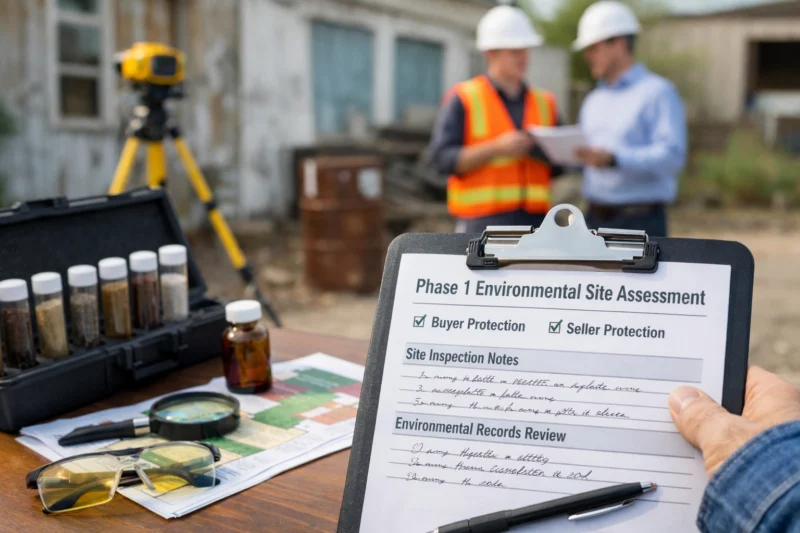
Adjacent properties and cross-boundary influence are another test. A subject property might look clean, but nearby historical industrial operations can create RECs through migration pathways, shared infrastructure, or historical off-site practices. , a well-scoped Phase 1 needs to address adjacent and regional context appropriately. When it doesn’t, parties may later dispute whether RECs should have been identified.
Legacy industrial sites with incomplete records also challenge protection. Interviews may contradict each other, archives may be unavailable, and ownership may change hands multiple times. The deeper protection comes from documenting how uncertainty was evaluated, which sources were used, and why conclusions were reached despite gaps. What most guides get wrong is ignoring how uncertainty documentation affects defensibility when “what was known” becomes a legal and commercial dispute.
Innovation categories can support Phase 1 workflows, but they typically supplement rather than replace the underlying methodology when properly scoped. Common innovation categories include GIS-based historical mapping, GPR or digital reconnaissance tools (where used in supplemental scope), drone or digital site-visual documentation for better reconnaissance, and data platforms that track record sources and update logs. These tools can improve the transparency and reproducibility of findings, but they should not introduce new ambiguity—so the report should explain what was collected, how it was used, and whether it changes conclusions or recommendations.
How do Phase 1 ESA protections vary across property types and regions in the U.S.?
Phase 1 ESA protections generally follow the same standardized logic in the U.S., but outcomes and next steps can vary sharply by property type and the local availability of records. The core standards and diligence concepts—such as ASTM E1527-21 and the AAI framework under 40 CFR Part 312—are widely referenced, but the historical density of industry, the strength of local archives, and permitting practices can influence how confidently a report can evaluate risk. That’s why buyer and seller protection often depends on matching scoping and record strategy to the real-world local environment.
Common property types readers encounter include industrial sites, commercial properties, mixed-use developments, residential parcels with prior nonresidential use, and agricultural or legacy sites. What changes is how file reviews are interpreted and what kinds of RECs are more plausible. For example, industrial and commercial properties often require deeper attention to historical operations, storage practices, and adjacent industrial uses. Residential parcels with past nonresidential use require careful interview work and historical mapping to understand when the change in use occurred.
Geographic variability affects both records and corroboration. Some regions have stronger archives, while others have incomplete documentation, especially for older operations or properties with frequent ownership transfers. Local permitting culture can also increase the likelihood that certain release-related information is available—meaning a well-documented file review might resolve some uncertainties that would remain uncertain elsewhere. Tradeoffs are inevitable: even when a Phase 1 approach is consistent, the quality of protection depends on how well records and interviews can be corroborated in that specific setting.
Deeper insight: despite standard methods, two reports can differ because their scoping choices differ. A site in a region with dense historic industrial activity may justify broader adjacent-property context, while a rural legacy agricultural property may rely more heavily on interviews and land-use chronology. What most guides get wrong is implying that “one standard equals one outcome.” In reality, protections are shaped by local history and documentation realities.
Frequently Asked Questions About Phase 1 ESA Innovations
Does a Phase 1 ESA remove all environmental risk for a buyer?
No. A Phase 1 ESA is designed to identify recognized environmental conditions and document due diligence, not to confirm that contamination is absent beneath the surface. If RECs are present or if information gaps are significant, the buyer may still need Phase 2 sampling or other targeted escalation to reduce uncertainty.
What protects a seller when they provide a Phase 1 ESA before closing?
A seller is typically protected by having a documented, standardized diligence record that clarifies what was investigated and what limitations apply. The seller can use the report’s findings and recommendations to support defensible disclosure, rather than relying on informal knowledge. Contract language and the timing of delivery also matter because the report reflects conditions and information available at the assessment date.
How does a Phase 1 ESA handle “unknowns” in historical property use?
Unknowns are handled by documenting the scope, listing record gaps, and explaining how available information was evaluated. Limitations and assumptions are typically stated in the report’s conclusions so the reader understands where uncertainty remains. If unknowns relate to plausible release pathways, the report may recommend supplemental research or Phase 2 investigation.
If the Phase 1 ESA finds a REC, does that mean contamination is confirmed?
No. A REC generally indicates that conditions exist that could be associated with past releases, not that contamination has been proven. Confirmation usually requires Phase 2 or targeted investigation, depending on what the REC is tied to and what recommendations say.
How current does a Phase 1 ESA need to be in 2026 transactions?
There is no single universal timeline for every deal, but parties typically consider report “freshness” based on when new facts could affect findings. If there have been major changes—such as new operations, demolition, or discovered releases—then updating or supplementing the assessment may be prudent. In practice, contracts often specify how fresh the report must be and whether an update is required if timing slips.
Can a buyer rely on a Phase 1 ESA completed for someone else?
Sometimes, but reliance is not automatic. The report’s scope, date, and the assumptions about transferability matter, and the buyer should confirm whether the report was intended for use in the buyer’s specific transaction and how limitations apply. When the property’s history or circumstances differ, a new Phase 1 may be warranted.
What should I look for in a Phase 1 ESA report to validate buyer and seller protection?
Look for clear scoping and boundary statements, a strong background history summary, explicit identification and explanation of RECs, and a detailed limitations section. Recommendations should be traceable to the conclusions, with enough context to justify next steps. Quality checks should also include evidence of file review depth and transparency around interview completeness.
What’s the difference between ASTM E1527-21 and the AAI expectations under 40 CFR Part 312?
ASTM E1527-21 is a structured methodology for how the Phase 1 assessment is performed and reported. AAI under 40 CFR Part 312 is a broader legal concept about meeting diligence expectations, and it may include more than a single assessment document. In many deals, Phase 1 documentation aligned with ASTM helps demonstrate that the buyer pursued appropriate inquiry.
Is a supplemental Phase 1 or additional research better than moving straight to Phase 2?
It depends on why uncertainty exists. If the report’s main gaps come from missing or conflicting historical data, supplemental research can resolve issues without intrusive work. If RECs indicate plausible release pathways that cannot be confirmed through documents alone, Phase 2 is often the clearer path.
Phase 1 ESA buyer and seller protection: what happens if information changes after the report?
If new information arises—such as new evidence of releases, discoveries during construction, or changes in property use—parties typically need to re-evaluate the report’s conclusions. That may mean updating disclosures, commissioning supplemental inquiry, or revising contractual responsibilities. Many deals address this through disclosure obligations and contract provisions tied to post-report findings.
Conclusion: How to use Phase 1 ESAs to protect both sides
Phase 1 ESAs protect buyers and sellers by turning environmental uncertainty into documented, standardized diligence—supporting disclosure and next-step decisions before closing. In 2026, the strongest protection comes from high-quality scoping, adherence to recognized frameworks like ASTM E1527-21 and AAI concepts under 40 CFR Part 312, and careful contract use of the report’s conclusions, RECs, and limitations. When the report is used properly, it helps prevent surprises, reduces ambiguity about what was known, and supports more predictable outcomes if escalation is warranted.
To put this into action, review the report not just for its headline conclusion, but for how it got there: the scope rationale, the quality of record review and interviews, the clarity of REC identification, and whether recommendations are tied to specific conditions. Then align deal terms to those findings—whether that means negotiating contingencies, defining access for further investigation, or allocating risks transparently for remediation scenarios. This is also a practical moment to ask how recommendations will be used in the contract and what triggers an update if post-report discoveries occur.
Your next step is straightforward: compare report scope and standards against your property’s history, and ask the assessor (or your diligence team) to walk through the RECs and the recommendation logic in plain language. If you need to move forward quickly, request a sample report checklist or schedule a diligence planning call so the buyer and seller can agree early on what “good” looks like and when escalation becomes necessary.
Updated August 2026