
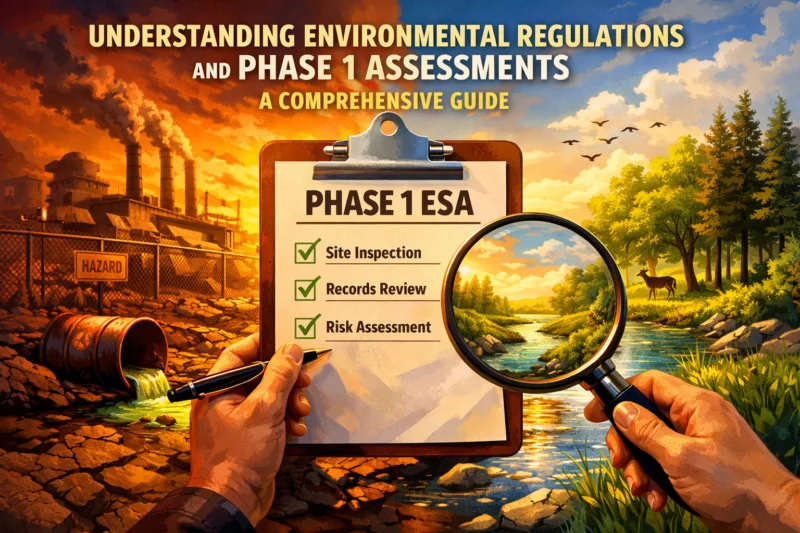
Environmental regulations determine whether a Phase 1 Environmental Site Assessment (ESA) is required for a property transfer, redevelopment, or financing decision—and the Phase 1 is designed to identify potential Recognized Environmental Conditions (RECs), not to prove contamination. In practice, environmental regulations for phase 1 ESA requirements often show up indirectly through lender underwriting rules, insurance expectations, contractual risk allocation, and compliance frameworks that treat “adequate inquiry” as a condition of moving forward with confidence. This comprehensive guide explains what drives Phase 1 timing, what regulatory frameworks matter in 2026, what a defensible Phase 1 deliverable should include, and how outcomes are used to decide whether targeted add-ons or intrusive Phase 2 sampling is warranted.
If you are an owner, investor, lender, or attorney, you should walk away with a practical decision pathway: how environmental regulations shape the “why,” how Phase 1 fits into risk and compliance, what regulators and stakeholders expect to , and which common mistakes undermine defensibility later. We will also cover edge cases where standard assumptions fail, jurisdictional nuances across the U.S., and innovation categories (like GIS, geophysical screening, drones, and digital workflows) that can strengthen the quality and traceability of regulatory-grade work products.
How environmental regulations shape when Phase 1 ESAs are required
A Phase 1 ESA is typically required when environmental regulations—and the compliance expectations surrounding them—make “adequate inquiry” a practical prerequisite for a real estate decision. The trigger is rarely “you must do a Phase 1 today” in a vacuum; instead, it usually emerges from how risk, liability, and permitted use intersect with the property’s history and future plans. Even where no agency order is in place, lenders, insurers, and counterparties frequently treat Phase 1 as the evidentiary starting point to manage environmental uncertainty.
At a high level, Phase 1 is required or strongly expected when property rights change hands, financing is obtained, redevelopment plans involve exposures to legacy industrial conditions, or contractual parties allocate environmental risk based on documented due diligence. These drivers can be statutory, but they also commonly flow from non-statutory sources: lender policies, mortgage insurance requirements, internal underwriting standards, and purchase agreement language. That means “requirements” can be direct (legal obligations) or indirect (commercial requirements that operate like legal conditions).
Conceptually, you can think of the decision pathway in three steps: (1) determine whether the transaction or planned use expects “adequate inquiry,” (2) conduct Phase 1 to gather defensible historical and current-use information, and (3) use the findings to determine whether additional investigation is warranted. Importantly, environmental regulations can be satisfied procedurally even if contamination is ultimately discovered later; what matters is that the inquiry was structured and documented to support the transaction’s compliance expectations.
Tradeoffs and limitations still apply. Phase 1 does not involve intrusive sampling, and it can only conclude what the evidence supports. A well-scoped Phase 1 can reduce uncertainty and narrow options, but it does not eliminate the possibility that a release occurred outside the boundaries of the available records or access limitations. In real-world scenarios, that is exactly why stakeholders care about scope clarity—if an investigator documents limitations and uncertainty appropriately, later disputes have less footing.
One edge case: redevelopment of a property that has been partially demolished or intensively renovated can create a “records vs. reality” mismatch. Even with a strong Phase 1, if key site access is restricted during reconnaissance or if historic land use documentation is inconsistent, the report may recommend targeted follow-up. Another common mistake is treating “regulatory compliance” as a single box to check—when in fact it is a bundle of duties, expectations, and evidentiary elements that can fail if the Phase 1 work is not aligned with the intended use of the report.
Core regulatory frameworks you should recognize (and how they interact)
Several U.S. regulatory frameworks influence Phase 1 workflows, but the key idea is that Phase 1 is usually a methodology-and-evidence bridge to legal “adequate inquiry” expectations, rather than a standalone compliance guarantee. When you understand how hazardous substances and petroleum release authorities, reporting duties, and “All Appropriate Inquiry” (AAI)-type concepts connect, you can better predict why Phase 1 is expected for certain transactions and how regulators or stakeholders evaluate the work.
Phase 1 ESAs typically intersect with regulatory buckets such as (1) hazardous substances and chemicals, (2) petroleum products (including releases associated with storage and handling), and (3) cleanup authority and reporting/response obligations. The Phase 1 deliverable is designed to compile historical land use and current conditions information that can signal whether a release might have occurred. That evidence matters to regulators and counterparties because it informs whether liability risk is plausible, and it helps decide whether confirmatory sampling (Phase 2) should follow.
From a methodology standpoint, a baseline for Phase 1 is often grounded in ASTM E1527-21. ASTM E1527-21 is widely used to define the process and scope elements for conducting a Phase 1 ESA (such as file and record review, interviews, and site reconnaissance). However, ASTM is not the same thing as the legal requirements it may be used to support. A frequent misconception is assuming that “doing ASTM” automatically satisfies regulatory obligations; in reality, legal expectations like AAI are element-based and time-sensitive in their own ways, so the Phase 1 report must also be used correctly within the transaction timeline.
For 2026, it is especially important to understand how 40 CFR Part 312 (AAI) concepts connect to the evidentiary record. In broad terms, AAI focuses on elements of inquiry, reliance on reasonably ascertainable information, and documentation practices. A Phase 1 report is one of the primary sources of that documentation. If an investigator uses an outdated report relative to the intended compliance window, omits critical evidence or fails to support a conclusion with traceable sources, the report may not function as intended—even if the ASTM methodology was generally followed.
Deeper insight: the mismatch between “method” and “legal elements” is where disputes often begin. Most guides stop at “ASTM E1527-21 is the standard,” but what stakeholders actually need is evidence that supports each AAI-related element using the right timing, sources, and documentation. In a real-world transaction, an attorney or lender may question whether the report’s scope matches the property’s history, whether interviews were meaningful, and whether uncertainty was handled in a way that aligns with AAI-style expectations.
Common mistakes include treating regulatory compliance as synonymous with “no contamination found” and assuming that the absence of RECs means no future liability risk can exist. Phase 1 is designed to identify potential conditions; it cannot rule out releases that are undocumented or that occurred beyond the investigator’s ability to confirm. The most defensible approach is to ensure the report’s evidence base and limitations are explicit and consistent with the intended use.
Step-by-step: building a defensible Phase 1 ESA within regulatory expectations
A defensible Phase 1 ESA is built by following a structured inquiry process that gathers reasonably ascertainable information, identifies potential RECs, and documents limitations transparently. Environmental regulations influence not only whether Phase 1 is expected, but also how stakeholders evaluate whether the work was appropriate for the site’s history and the transaction’s decision needs. The goal is not to “guess” at contamination—it is to produce a defensible, evidence-driven narrative that can support compliance and risk decisions downstream.
Step-by-step, the typical Phase 1 building blocks begin with file and records review: historical maps, property records, regulatory databases, recorded documents, and other evidence that can indicate releases, storage practices, or industrial activity. Next, interviews identify knowledge from people with relevant roles (for example, prior owners, long-term employees, or facility operators). Then comes site reconnaissance: observing current conditions, recognizing indicators of past or present operations, and confirming what is visible and accessible during the work window. Search distance considerations (how far back and how wide the search should be) are selected based on site characteristics and land-use context, which helps regulators and stakeholders see that the inquiry was tailored rather than generic.
Investigators also look for regulatory-relevant indicators that can translate into RECs, including evidence of former or current chemical or petroleum storage, waste management practices, stained areas, drums/containers (historical or current), and the potential for underground or aboveground storage systems. Beyond that, neighborhoods matter: nearby industrial uses or transportation corridors can be potential sources of vapor migration or impacts depending on site characteristics. Practical application for owners and lenders is that you should ensure the Phase 1 scope covers the right story for the property—if the property is known to have industrial tenancies over time, the historic research should reflect those layers.
The report structure supports defensibility when it clearly organizes evidence and ties sources to conclusions. A strong Phase 1 narrative typically includes the history of use, agency and record inquiries (as applicable), interview summaries, maps/figures (described conceptually in the report), and a clear discussion of assumptions, limitations, and uncertainty. If RECs are identified, the report should explain what evidence supports those conclusions; if RECs are not identified, the same principle applies—silence is not the conclusion; evidence is. Conditional branches matter too: if records show industrial demolition, if site reconnaissance reveals inconsistent conditions, or if interview sources conflict, the scope may need targeted follow-up to avoid under-identification of relevant conditions.
Tradeoffs and limitations are part of the defensibility story. Limited access to portions of the property, incomplete records, or ambiguous historic operations can restrict what can be concluded. The practical fix is not to “make assumptions” silently; it is to document what was done, what could not be verified, and how that uncertainty influences next steps. A common mistake is outsourcing the inquiry to a checkbox approach—without good file review, meaningful interviews, and careful documentation, the report may appear compliant on paper but fail when stakeholders scrutinize adequacy.
Edge case example: a property that has undergone phased redevelopment may have older foundations or subsurface utility corridors that are not visible from surface reconnaissance. If demolition was partial, the evidence base must be handled carefully because visible conditions today might under-represent what existed historically. In that scenario, the Phase 1 should explain how the investigator accounted for those uncertainties.
What regulators and stakeholders expect from the Phase 1 deliverable
Regulators and stakeholders expect a Phase 1 ESA deliverable to be clear, evidence-based, and usable for decisions—not just technically completed. While Phase 1 is not a cleanup determination, it must identify potential Recognized Environmental Conditions and explain how uncertainty was handled. In transactions where environmental regulations and AAI-type expectations matter, “usable for decisions” often determines whether the report can stand up to later questions about adequacy.
A common deliverable expectation is that the report clearly identifies RECs (and discusses other relevant condition categories conceptually), includes assumptions, and documents limitations. Stakeholders want the report to support rational next steps: whether to keep moving with underwriting and redevelopment planning, to commission targeted add-ons, or to proceed to intrusive Phase 2 sampling. Practical application differs by audience. Lenders may focus on whether the report supports risk mitigation in underwriting; buyers may focus on disclosure and negotiation; insurers may focus on whether the evidence supports insurability and risk classification.
Documentation quality is central. Even when maps and figures are treated as standard components, what matters for regulatory expectations is traceability: where information came from, what was reviewed, and whether interview sources were appropriate. Deliverables should also connect evidence to conclusions in a way that is understandable without requiring special pleading. For example, if RECs are identified, the report should articulate the link between historical use, observed conditions, and the rationale for a potential release or migration pathway. If the scope was limited by access, the report should explain how that limitation affects conclusions.
Deeper insight: defensibility does not only show up when everything goes right. If contamination is discovered later, stakeholders may question whether the inquiry was adequate given what reasonable investigators would have found. A Phase 1 that is thin on historical research, that mischaracterizes records, or that glosses over conflicts in sources may be challenged—even if the transaction used the report for due diligence. That is why “intended use” and “reliance” language matters: who can rely on the report, when it can be used, and what scope exclusions were made can influence how it stands up to scrutiny.
Another overlooked point is the timing alignment between report use and compliance needs. If the report is outdated relative to the intended compliance process, stakeholders may require an updated Phase 1 or additional work. Similarly, if the Phase 1 was prepared for one purpose but relied upon for another (for example, different property boundaries or a different intended reuse), the conclusions may not map cleanly to the new decision needs.
Common mistakes and misconceptions that derail regulatory alignment
The biggest mistake is misunderstanding what Phase 1 is designed to do: it does not prove the absence of contamination. Environmental regulations influence whether Phase 1 must be performed as part of due diligence expectations, but those expectations are about identifying potential conditions and documenting a reasonable inquiry—not delivering certainty. When stakeholders confuse “no RECs” with “no risk,” they set up avoidable disputes later.
A second frequent problem is incomplete records review or weak historical research. Phase 1 relies heavily on “reasonably ascertainable” information, and records availability can vary dramatically by location, era, and the completeness of municipal or regulatory archives. If an investigator skips key resources, fails to reconcile conflicts between sources, or does not adequately document the search, the report may under-identify RECs and push the site into more costly intrusive work later. In regulated decision environments, that can translate into delays, renegotiations, or liability concerns for parties that relied on a report that did not fully earn its conclusions.
Another common misconception is treating interview inputs as routine administration rather than evidence. Who was interviewed, what roles they had, how information was validated, and whether interview responses match file review findings all affect the defensibility of conclusions. If interview data is weak or uncorroborated without explanation, the report may read as speculative. Similarly, misunderstanding AAI-related expectations can derail alignment: some stakeholders fail to coordinate the report timing and intended use, or they assume that “a Phase 1 exists” is enough regardless of whether it is the correct version and whether scope steps align with the inquiry elements.
Deeper insight: edge cases expose these failures quickly. Recently redeveloped sites, partial demolitions, unusual industrial tenancies, multi-tenant facilities, and properties with complex multi-parcel histories can break the assumptions behind “standard” workflows. What most guides get wrong is providing a single path that assumes the same data will always be available and that surface observation tells the whole story. In reality, defensible Phase 1 requires conditional judgment and clear reporting of uncertainty.
One practical scenario: a property previously used for equipment storage may not show obvious containers today, but historical record discrepancies (for example, conflicting dates of closure or inconsistent fire department reporting) could indicate that releases or storage practices occurred during overlapping tenancy periods. If Phase 1 does not reconcile those inconsistencies, a later Phase 2 may uncover unexpected conditions, and stakeholders may question whether the earlier inquiry was adequate.
Alternatives and comparison: choosing the right environmental path around Phase 1
Choosing the right environmental path around Phase 1 usually means deciding whether the inquiry should stay information-gathering or move quickly toward confirmatory investigation. Environmental regulations and stakeholder expectations often make Phase 1 the starting point, but they also create pressure to avoid unnecessary intrusive work when records and reconnaissance can reasonably narrow uncertainty. The decision is not purely technical; it is evidence-based and risk-tolerance driven.
A practical comparison starts with three common categories of approach. First, a standard Phase 1 ESA aligned with ASTM E1527-21 can provide baseline due diligence for many property transactions. Second, you may add targeted add-ons when the risk indicators are specific—such as focusing on pathways relevant to vapor intrusion considerations, when supported by site context and evidence. Third, Phase 2 ESA (intrusive sampling) is generally recommended when Phase 1 identifies RECs that require confirmation or when credible indicators point to releases that cannot be resolved through history alone.
There are also situations where regulatory-driven or owner-specific investigations happen without starting with Phase 1, but these are often driven by enforcement posture, permitting conditions, or contractual requirements. In those cases, the “environmental path” may be shaped by direct agency expectations or project-specific constraints. For most transactions, the typical question becomes: do the Phase 1 findings support moving to intrusive investigation now, or does a more focused targeted add-on (still non-intrusive or less intrusive than full Phase 2) better reduce uncertainty?
Tradeoffs matter. Moving to Phase 2 earlier can reduce uncertainty but increases cost and can complicate site access planning. Staying with Phase 1 and targeted add-ons can be more efficient, but if red flags are ignored or scope is too narrow, parties may end up funding both Phase 1 and Phase 2 anyway. Stakeholder roles influence the decision: lenders and insurers may prefer strong Phase 1 documentation to manage risk without intrusive sampling unless necessary; buyers may negotiate who pays for additional work; regulators may expect evidence that matches the situation if there are clear release indicators.
One deeper insight is the negotiation leverage angle. A strong Phase 1 that thoroughly documents evidence and limitations can reduce the likelihood of being forced into broad Phase 2 later. But if the Phase 1 overlooks key indicators—like inconsistent historic sources, demolition evidence, or visible signs of past storage—the negotiation weakens quickly. In real-world deal dynamics, that can shift costs and timelines, even when everyone believed “due diligence” was already complete.
Optional comparison table (draft)
| Environmental Path | Best When | Typical Output | Main Limitation |
|---|---|---|---|
| Standard Phase 1 ESA (ASTM E1527-21 aligned) | Baseline due diligence and evidence gathering for a decision | Historical/current-use narrative; REC identification; limitations/assumptions | No intrusive sampling; cannot confirm contamination |
| Phase 1 + targeted add-ons | Specific risk indicators suggest narrower follow-up is appropriate | Supplemental evidence supporting or refining RECs | May not fully resolve all release scenarios |
| Phase 2 ESA (intrusive sampling) | Phase 1 identifies RECs requiring confirmation | Sampling results; delineation of impacts where present | Higher cost and access planning; still requires interpretation |
| Regulatory-driven investigations | Permitting/enforcement or project-specific regulatory expectations require it | Agency-aligned sampling/work plans and documentation | May not optimize cost vs. broader due diligence needs |
Advanced considerations: edge cases, objections, and what most guides miss
Advanced Phase 1 scenarios require more than applying a generic checklist; they require evidence management that anticipates objections about scope adequacy and data reliability. When environmental regulations and AAI-related expectations are in play, disagreements often focus on whether the inquiry was appropriate for the property’s specific history, access constraints, and the intended use of the report. Addressing those issues up front is what turns Phase 1 from a form into a defensible decision tool.
One core advanced consideration is handling limited access or incomplete information. If the investigator cannot view certain areas—due to locked structures, active operations, hazardous conditions, or scheduling constraints—the report should clearly document what could not be assessed and how that affects conclusions. The practical application is that limitations should be meaningful, not vague. A defensible report explains what was observed elsewhere, what evidence was reviewed, and why the limitation does or does not change the likelihood of RECs.
Complex property histories are another common challenge. Phased development, annexations, parcel splits/mergers, and unreliable chain-of-title narratives can complicate the historical record research. If boundaries changed over time, the Phase 1 should reflect that context in mapping and in the narrative of prior operations. What most guides miss is how these boundary changes affect what “reasonably ascertainable” means: records might be attached to older parcel IDs, or municipal documents may not match modern lot lines. Without thoughtful reconciliation, the file review can look complete while actually being misaligned to the current property footprint.
Disputes can be predictable: parties may challenge scope adequacy (search distances), source reliability (conflicting documents), interview relevance (who had knowledge), or reconnaissance coverage (what could be seen). The evidence in the report should directly address these objections. For example, if there are conflicts between historic sources, the Phase 1 narrative should explain how the investigator resolved them or why uncertainty remains.
Innovation categories can strengthen regulatory-grade work products when used properly. GIS-assisted historical land use mapping can improve how investigators visualize evidence and avoid missing records tied to changed parcel boundaries. Geophysical tools like GPR can provide supplemental screening signals, but they should not replace the Phase 1 methodology; they can be used to guide targeted follow-up. Drones and photogrammetry can improve reconnaissance documentation, especially for large sites or where surface conditions need more detailed mapping. Finally, digital workflows and data platforms can enhance traceability by preserving document provenance, interview source metadata, and consistent report generation formats—helpful when stakeholders later request clarification. The limitation is that tech can create false confidence without proper interpretation, quality control/quality assurance, and clear reporting of uncertainty.
Edge case example: multi-tenant industrial sites can have overlapping operations where one tenant’s termination records do not reflect another tenant’s chemical storage practices. A Phase 1 that relies on interviews from only one long-term employee without corroboration may miss tenancy-layer evidence. Strong scoping and document management help prevent that.
Regional and jurisdictional considerations: U.S. state programs and property transactions
Jurisdictional variation affects how environmental regulations play out in practice, even when the underlying due diligence framework is national. State environmental agency expectations, local cleanup programs, brownfield incentives, and redevelopment standards can shift what “adequate inquiry” means operationally, including what records are available and which databases are worth searching. For 2026 decisions, you should assume that the same Phase 1 methodology may require different supporting record sources depending on location.
State programs can influence record search scope and documentation expectations. Some jurisdictions maintain richer municipal files (for example, permitting histories and fire department reports), while others require additional steps to obtain certain documents. Even when ASTM E1527-21 and AAI concepts provide structure, the availability and organization of local records can vary, affecting how confidently an investigator can characterize historical use. Practical application: align the file review resources to the property location type—urban industrial legacy areas may require deeper historic mapping and regulatory record checking, while suburban commercial areas may present different types of historic operations.
Local redevelopment standards can also shift decision expectations. If a project seeks eligibility for incentives or must meet specific redevelopment conditions, counterparties may require stronger evidence in the Phase 1 report narrative to support compliance. In such cases, “requirements” may come from the funding structure or redevelopment agreement rather than a straightforward permit condition. That is why the intended use and audience of the Phase 1 deliverable matter: a report used for lender underwriting may need a different emphasis than one used for redevelopment financing.
Deeper insight: agency communication can be nuanced. In some cases, it is appropriate to request clarification or additional information, but agencies may not provide actionable data that supports definitive conclusions for Phase 1. A stronger approach is to document what was searched, what was unavailable, and how that influenced uncertainty and recommendations. Avoid assuming that an agency database is complete or that missing records mean no activity occurred.
Edge case: properties near state lines or properties with historic operations that spanned time periods may involve cross-jurisdictional record complexity. Investigators may need to search beyond the immediate locality to capture reasonably ascertainable evidence. Another common mistake is using a generic search resource list without adapting it to where the property is located and how local records are maintained.
Frequently Asked Questions About Understanding Environmental Regulations and Phase 1 Assessments: A Comprehensive Guide
What is the purpose of a Phase 1 ESA in regulated real estate transactions?
The purpose of a Phase 1 ESA is to identify potential Recognized Environmental Conditions by gathering historical and current-use information and documenting limitations. It is not designed to prove whether contamination exists. In regulated transactions, this information supports compliance and risk decisions by showing what was reasonably searched and what the evidence indicates.
Does ASTM E1527-21 automatically satisfy environmental regulations for Phase 1 ESA compliance?
ASTM E1527-21 provides a widely accepted methodology for conducting a Phase 1 ESA, but it does not automatically satisfy every legal or regulatory expectation by itself. Environmental regulations often involve element-based concepts (like AAI) and proper timing and use of the report within the transaction. What to verify is whether the report’s scope, evidence, and documentation align with the intended compliance purpose.
How do 40 CFR Part 312 (AAI) requirements influence what should be included in a Phase 1 report?
40 CFR Part 312 (AAI) influences the Phase 1 report because AAI is about documented “elements” of inquiry, not just a process checklist. A Phase 1 report should therefore produce a clear, traceable record of sources, interviews, file review, and uncertainty handling. Practical verification includes confirming the report supports the elements through reasonably ascertainable evidence and is used at the appropriate point in the decision timeline.
When might a Phase 1 ESA be required even if no contamination is suspected?
A Phase 1 ESA may be required when environmental regulations and compliance expectations are triggered indirectly by financing, insurance, or contractual allocation of environmental risk. It is also required when historic operations or site features suggest potential releases even if there are no obvious signs of contamination today. Lenders and insurers commonly request Phase 1 to manage uncertainty before underwriting or redevelopment approval.
What are RECs, and how do they relate to “next steps” after the Phase 1?
RECs are potential conditions that indicate a reasonable possibility of a release of hazardous substances or petroleum under the site’s historical and current-use context. RECs conceptually guide whether confirmatory investigation is warranted, often leading to targeted add-ons or Phase 2 sampling. If RECs are identified, the “next steps” usually focus on resolving the uncertainty that Phase 1 could not confirm or deny.
What is the difference between environmental compliance testing and Phase 1 due diligence?
Phase 1 due diligence is about evidence gathering and identifying potential environmental conditions; it typically does not include intrusive sampling. Environmental compliance testing is intended to determine or confirm conditions through measurements or sampling aligned to regulatory or remedial requirements. Because Phase 1 is non-intrusive, it often cannot replace confirmatory testing when regulators or stakeholders need direct analytical results.
How should property owners handle access limitations during Phase 1 ESA work?
If access is limited, the owner should ensure the limitation is clearly communicated so the Phase 1 report accurately reflects what was and was not observed. The report should document the nature of the limitation and how it affects the ability to reach conclusions. This matters because undocumented access gaps can undermine defensibility if the report is later questioned.
What are the most common reasons Phase 2 is recommended after a Phase 1?
Phase 2 is commonly recommended when Phase 1 identifies RECs with credible indicators, when historical records are incomplete or conflicting in ways that cannot be resolved through inquiry, or when site features suggest releases that need confirmation. Another driver is the presence of evidence suggesting current or past releases that Phase 1 cannot validate without sampling. In practice, Phase 2 recommendations should connect directly to the Phase 1 findings.
Can a Phase 1 ESA be used for both lenders and buyers without changing the scope?
Often, the same Phase 1 report can serve both lenders and buyers, but only if the intended use, reliance language, and timing match each party’s needs. Lenders and buyers may focus on different decision points, so additional work or report emphasis might be requested. Before reuse, confirm that the report’s scope and limitations are compatible with each stakeholder’s evaluation process.
What long-tail factors should trigger a more detailed historical review than normal for a Phase 1?
Long-tail factors include unusual industrial tenancies, demolition and redevelopment history, conflicting records across archives, and multi-parcel complexity such as annexations or parcel splits. Legacy waste patterns and inconsistencies in how historic operations were documented can also warrant deeper historical research. The goal is to prevent under-identification of potential RECs caused by incomplete evidence narratives.
How do you choose between targeted add-ons versus moving directly to intrusive Phase 2?
The choice depends on what Phase 1 shows, how credible and specific the indicators are, and whether the remaining uncertainty can be addressed with narrower follow-up. Targeted add-ons may be appropriate when the question is specific (for example, clarifying a pathway or resolving a particular suspected condition). If the Phase 1 evidence indicates that sampling is necessary to resolve RECs, moving to Phase 2 is typically the more defensible path.
Conclusion
Environmental regulations drive when a Phase 1 ESA is expected, but the practical purpose is to provide defensible evidence for “adequate inquiry” expectations—by identifying potential RECs and documenting how the inquiry was conducted. In 2026, the core frameworks (including ASTM E1527-21 methodology concepts and AAI-related expectations reflected in 40 CFR Part 312) remain a stable foundation, even as interpretation and practical agency/database behaviors can evolve. The most important takeaway is that Phase 1 does not replace cleanup or compliance testing; it supports the decision to investigate further—or move forward responsibly—based on what the evidence indicates.
Quality comes from scope alignment, robust documentation, credible interviews, thoughtful historical research, and clear handling of limitations and uncertainty. When a Phase 1 is strong, stakeholders can make better decisions about redevelopment planning, financing, and risk allocation with fewer surprises later. When Phase 1 is weak or misunderstood, disputes and additional investigation become more likely—even when contamination was not initially suspected.
If Phase 1 identifies RECs (or leaves meaningful uncertainty), the next step should be evidence-based: decide whether targeted add-ons can narrow the question or whether intrusive Phase 2 sampling is needed to confirm or deny suspected releases. For owners, lenders, investors, and attorneys, the best move is to consult qualified environmental professionals and ensure the Phase 1 approach aligns with ASTM E1527-21 and AAI-related expectations where applicable.
Recommended authoritative references to support your planning and work-product checks include ASTM E1527-21 — the commonly used methodology baseline for Phase 1 ESA scope and process; U.S. EPA AAI / All Appropriate Inquiries — guidance context for AAI concepts used in transactions; and 40 CFR Part 312 (AAI) — the regulatory text for AAI requirements.
Updated August 2026