
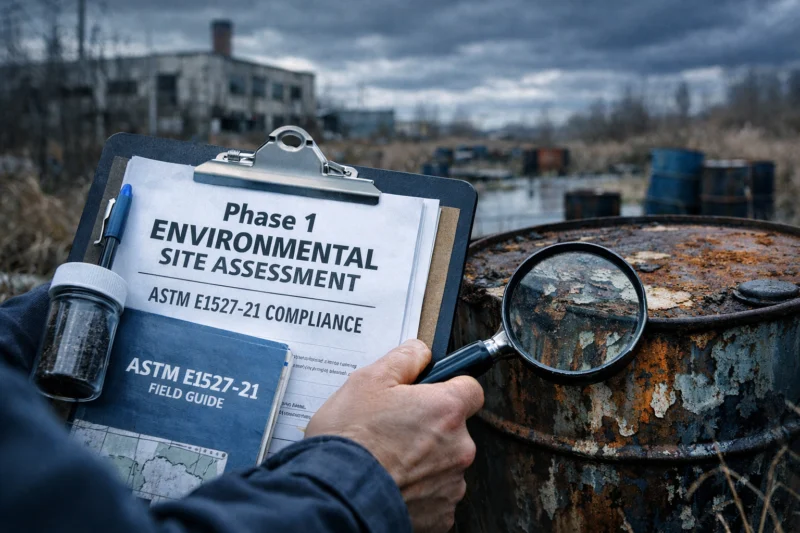
In practice, a Phase 1 Environmental Site Assessment (ESA) is governed by a layered regulatory and standards framework: federal environmental due diligence concepts that influence “reasonable steps,” an ASTM-based methodology that becomes the practical roadmap, and transaction-specific expectations from lenders, buyers, insurers, and local regulators. That layering is exactly why it can feel complex—what matters is not just whether a report exists, but whether the scope, evidence, and documentation align with the defensibility logic the transaction is relying on. When teams apply the ASTM E1527-21 regulations approach correctly, they are usually trying to operationalize those due diligence expectations into a consistent, auditable Phase 1 process. In 2026, the biggest source of risk is still mismatch: the standard of method gets used as a checklist while the “regulatory” expectations are actually about the quality of inquiry, the treatment of uncertainty, and the clarity of conclusions.
This article is informational and written for readers who want to understand which authorities shape Phase 1 scoping and reporting in the United States. It is not legal advice, and “compliant” can vary depending on what the buyer, lender, or insurer needs for their risk posture and how the parties define acceptable deliverables in the contract. You should treat this as a practical map to help you evaluate whether a Phase 1 ESA is defensible, explainable, and fit-for-purpose—especially when issues like incomplete records, access limitations, or ambiguous site history arise.
What “regulatory framework” controls a Phase 1 ESA in real life (and why it varies by transaction)
The “regulatory framework” governing a Phase 1 ESA is not one single rulebook; it is a set of federal due diligence concepts, ASTM methodology requirements that are commonly treated as the method, and transaction-driven expectations that determine what “good” looks like. Complexity exists because federal language often describes outcomes like “reasonable steps,” while ASTM provides the procedural structure to demonstrate how those outcomes were pursued. In parallel, parties in a specific deal—lenders, buyers, insurers—may require stricter documentation, different scoping boundaries, or clearer narratives about uncertainty.
In a typical U.S. transaction, the federal due diligence concept most often referenced is connected to environmental risk management and defenses through the “appropriate inquiry” framing (discussed in the context of 40 CFR Part 312 (AAI)). While that federal language is not a Phase 1 recipe in the way ASTM is, it shapes what stakeholders expect the environmental professional to do: gather relevant records, conduct interviews and site reconnaissance, and evaluate findings in a way that can be explained later. That is why Phase 1 scope decisions—how far back you search, what you interview, and what access you attempt—become “regulatory” in effect, even when no new federal sampling requirement is triggered.
Then ASTM becomes the method stakeholders commonly trust. ASTM E1527 (including ASTM E1527-21) is widely used as the framework for the Phase 1 ESA process, so the report’s structure tends to mirror ASTM’s organization: records review, interviews, site reconnaissance, and evaluation leading to the presence or absence of recognized environmental conditions (RECs) and (where applicable) controlled conditions. However, the regulatory defensibility conversation is broader than “following the checklist.” A defensible report shows consistent maps and timelines, documented limitations, and reasoning that connects evidence to conclusions—especially when the data is incomplete or ambiguous.
Tradeoffs are real. A highly constrained site access situation can force tradeoffs between completeness and feasibility, but the framework expects you to document what you could not reasonably obtain and how you handled it. Real-world scenario: consider a redevelopment property where long-tenure staff are no longer employed and county records access is delayed; a defensible approach documents efforts, updates timelines with what is available, and explains why any remaining uncertainty does not undermine the evaluation. What most guides get wrong is treating defensibility as a binary label (“met ASTM” vs. “not met”) instead of seeing it as an evidence-and-scope story that can survive third-party scrutiny.
How 40 CFR Part 312 (AAI) shapes Phase 1 scope and the defensibility story
40 CFR Part 312 (AAI) shapes Phase 1 scope by grounding the due diligence expectation in “reasonable steps” and a structured approach to gathering information about a property’s environmental history. Even though Phase 1 ESAs are typically conducted under ASTM methodology, the AAI concept influences what the stakeholders think the environmental professional was supposed to attempt and document. That’s why the relationship between the two is central to understanding the regulatory framework governing a Phase 1 ESA.
Conceptually, AAI expects an “appropriate inquiry” process that includes identifying and reviewing relevant information sources, conducting site reconnaissance, interviewing knowledgeable persons, and taking into account land use and environmental conditions that are plausible based on the property’s history. When you translate that into the Phase 1 world, it becomes: how thorough were the records searches, how meaningful were the interviews, and how well did the site visit support the evaluation of recognized conditions? In many transactions, ASTM is used to demonstrate a consistent method for those activities, which is why ASTM E1527-21 becomes a practical reference point for scoping and report organization.
Practically, Phase 1 report elements commonly map to AAI-aligned “reasonable steps”: the scope and results of records review (historic aerials, regulatory database searches, local land use references), interviews with current and former occupants or operators, and a structured site reconnaissance that looks for evidence of chemical storage, waste handling, releases, and conditions that could indicate migration pathways. The “why it matters” piece is that a later challenge often focuses on whether the inquiry was reasonable given the circumstances and whether the report explained how information gaps were handled.
A deeper nuance is that defensibility is strongly tied to documentation quality and scope choices. Edge case: if historic aerial imagery for a certain portion of the search period is unavailable or paywalled, a report may still be defensible if it documents the limitation, uses alternative primary sources where possible, and clearly ties conclusions to what was actually reviewed. Common mistake: overstating what was “confirmed” when the information was merely reviewed or inferred, or labeling findings as RECs without a documented basis. Another frequent pitfall is failing to align the timeline narrative with the map evidence, which makes it harder to defend why certain past uses were treated as implausible or unsupported.
Where to ground the conversation: in addition to 40 CFR Part 312 (AAI), stakeholders often look to EPA’s broader guidance concepts for environmental due diligence and definitions of “appropriate inquiry.” For understanding ASTM usage in the market, ASTM’s standard development and implementation materials are also referenced by professionals; additionally, market participants frequently point to professional guidance on Phase 1 structure and “recognized conditions.” (For a regulatory baseline, EPA Brownfields program resources can provide useful context on property assessment concepts even when the details differ from ASTM wording.)
Achieving regulatory defensibility with ASTM E1527-21 regulations: a scoping and decision path
Regulatory defensibility in a Phase 1 ESA is achieved by translating due diligence concepts into a defensible sequence: scoping, information collection, evaluation, and transparent handling of uncertainty. ASTM E1527-21 regulations are commonly used to structure that method, but what matters most is the decision path and how well the final narrative demonstrates that the process was “reasonable” given the facts. A strong Phase 1 is less about producing a report and more about producing an auditable reasoning chain.
A practical conceptual workflow starts with scoping: define the target property, establish search distances (including adjacent property considerations where applicable), determine historic use windows, and confirm what information sources are reasonably obtainable. Then identify land uses and potential hazardous conditions that are plausible based on property history and operational context. Next comes information collection—records review, interviews, and site reconnaissance—followed by an evaluation stage that considers what evidence supports “recognized environmental conditions” versus what is better described as negative findings or controlled conditions. This is the stage where the regulatory framework really becomes visible: the report must show that conclusions were derived from evidence, not from assumptions or omissions.
How it works in real transactions is often easiest to understand as a decision tree. If records searches and interviews suggest potentially relevant past uses, and reconnaissance observations align with those possibilities, the evaluation must address whether those facts translate into RECs. If the evidence contradicts, the report should explain the reconciliation—what data was favored and why. If certain information is missing or access was denied, a defensible path documents the limitation and evaluates whether “not reasonably obtainable” data materially changes the conclusions. The tradeoff is that every added inquiry step costs time and money, so scoping discipline matters: the “right” scope is the one that fits the circumstances and transaction expectations.
Deeper insight: “recognized environmental conditions” and “controlled conditions” labeling can be transaction-critical because it directly affects risk allocation and downstream decisions. Edge case: a property’s database flags historical activity, but interviews and site reconnaissance show no supporting evidence of the flagged concern. A defensible report will not ignore the flag; it will attempt to corroborate it, document the investigation logic, and explain why the flag does or does not elevate to a REC. Common mistake: treating database flags as automatically establishing RECs, or conversely dismissing them without adequate corroboration. What most guides get wrong is implying that sampling is required to “unlock” defensibility; in many cases, the defensible outcome is supported by non-intrusive inquiry and transparent evaluation—provided documentation is tight.
What records, interviews, reconnaissance, and documentation quality must cover
Phase 1’s regulatory credibility depends on four core input categories—records review, interviews, site reconnaissance, and documentation quality—because those inputs are what allow the evaluation to be explained later. The regulatory framework cares less about the presence of a completed report and more about whether the evidence base is complete enough, within reasonable constraints, to support the conclusions. When any input category is weak or poorly documented, defensibility becomes fragile.
Records review is typically the longest pole. It should cover historic maps and aerials, regulatory databases relevant to the property and surrounding area, chain-of-use cues, and other sources that help identify past operations and plausible uses. In practice, inconsistencies in boundaries, dates, or source credibility can turn into disputes later: for example, if the timeline references one parcel footprint while the map evidence uses another, the report becomes harder to defend. Why it matters: records review underpins the “plausible concern” narrative that drives reconnaissance focus and interview questions.
Interviews are equally important because they connect people’s knowledge to operational realities. A strong interview process is not just “did they smell something” but includes structured questions about historic and current operations, chemical storage, waste handling, maintenance activities that could involve releases, and any known incidents. How it works: conflicts between accounts must be documented, with the report indicating the basis for choosing which statements are more credible. Practical application: if a property manager cannot identify a prior tenant or provides only partial dates, the report should note that limitation and avoid overstating precision.
Site reconnaissance provides the observational link to the evidence. Reconnaissance should go beyond obvious stains or odors and include drainage patterns, evidence of below-grade risks (such as pits or depressions), loading areas, equipment pads, former tank locations (even if tanks are removed), and indications of spills in utility corridors or waste staging areas. A deeper nuance is negative findings: they can be misleading if the reconnaissance window does not align with likely conditions (seasonal soil moisture effects, vegetation that hides subsurface indicators, or access limitations that remove key vantage points). Common mistake: assuming absence of evidence is evidence of absence when access constraints selectively prevented viewing the most relevant areas.
Documentation quality is the glue that allows third parties to audit the process. Typical expectations include source citations, clear map legends, dated photographs with locations, and traceability between the narrative and the underlying evidence. Edge case: if database sources are paywalled or unavailable at the time of the report, the report should document the limitation and what was used instead. When these documentation gaps exist, a lender or insurer may request an updated or supplemental report, which is why the “tradeoff” decision at scoping time is so important.
Common mistakes and misconceptions about ASTM E1527-21 regulations (and how disputes start)
Many disputes around Phase 1 ESAs start from misconceptions: teams assume that “following the checklist” automatically equals defensibility, or they misunderstand what RECs labeling implies. While ASTM E1527-21 regulations are often treated as the compliance baseline, the regulatory framework ultimately rewards defensible scope choices, evidence traceability, and careful narrative discipline. When those elements are missing, stakeholders can challenge the report even if it follows the general Phase 1 structure.
One common misconception is that a Phase 1 is either compliant or not compliant based solely on whether certain categories were included (records, interviews, site visit). In reality, regulatory defensibility depends on tailoring the scope to reasonable steps given the specific property and documenting constraints. Pitfall: shallow records searches or stale historical data can under-identify plausible past uses—especially for long-tenure properties or redeveloping parcels with multiple operational eras. If a report later omits a credible past industrial use that would have driven the “RECs vs. no RECs” evaluation, the narrative may look unreasonable.
Another error pattern is poor integration between timelines, property boundaries, and adjacent site data. Mixing parcel boundaries, misreading locations, or attributing an adjacent use to the wrong property can lead to an evaluation that sounds plausible but is factually inconsistent. How disputes begin in real transactions: the opposing side points to mapping and evidence mismatches, then argues the process was not “reasonable” because it did not correctly interpret the evidence available.
Deeper insight: misunderstandings about what not to do can also cause trouble. Phase 1 is not intended to conclude that no contamination exists, and it is not an intrusive investigation. However, reports sometimes accidentally imply sampling-grade conclusions when no sampling occurred. The “failure mode” can be RECs overreach (labeling a REC without sufficient evidence tie-back) or omission (missing evidence that would support a REC). What most guides get wrong is treating “RECs present” as the only debate; in practice, wording choices matter as much as conclusions because they shape how buyers and lenders interpret risk allocation and next steps.
These mistakes can be prevented by disciplined language. For example, the report should clearly separate observed facts, source-derived claims, and the professional evaluation that connects them. It should also document what the team did when confronted with uncertainty—rather than allowing gaps to remain silent.
When Phase 1 is enough versus when you should adjust strategy (supplemental work or enhanced inquiry)
Phase 1 ESA is often sufficient when non-intrusive information gathering and evaluation can support clear conclusions about RECs and controlled conditions within the reasonable steps framework. But when evidence conflicts, when key information is missing in a way that undermines the evaluation, or when findings suggest plausible releases, teams may need to adjust the strategy with supplemental inquiry or a move toward enhanced due diligence. The regulatory framework does not force a one-size-fits-all answer; it requires reasoned decisions and documentation.
Consider four strategy categories. First, a standard Phase 1 ESA (no sampling) is appropriate when records review, interviews, and reconnaissance provide enough evidence to evaluate plausible concerns and determine whether RECs exist. What should be clarified contractually is the treatment of limitations: the report should explicitly describe access constraints and explain how they affect confidence without overpromising. This matters because transaction stakeholders may interpret “limitations” differently, and the report needs to frame them in a way that supports the intended risk posture.
Second, Phase 1 with targeted supplemental work often fits when the initial inquiry identified a plausible issue but additional non-intrusive effort could clarify it. Examples include additional records searches for a narrower time window, follow-up interviews with a more knowledgeable person, or limited additional reconnaissance focused on specific concerns. This category can reduce uncertainty without crossing into intrusive investigation.
Third, enhanced due diligence beyond Phase 1 becomes relevant when stakeholders’ defense requirements are stricter than typical transactions, or when the evidence suggests likely RECs that require more definitive understanding before decisions are made. Fourth, sampling-focused pathways (often described as Phase II-type investigations) are generally triggered by stronger evidence of actual releases, unacceptable risk perception, or conflicting data that cannot be resolved through non-intrusive inquiry alone. Tradeoffs: sampling can increase cost and schedule, and it may trigger regulatory notification obligations depending on conditions and jurisdiction; therefore, the decision must be documented as a reasoned next step rather than an automatic reaction.
Deeper nuance: stakeholders may expect different rigor. Lenders and insurers sometimes require particular defensibility narratives, while buyers may push for more aggressive clarity. The regulatory framework supports reconciliation if the report scope and next-step recommendations are clearly tied to evidence. Common mistake is to treat “Phase 1 as a box to check” and only later decide that supplemental inquiry should have been done; the fix is to align stakeholder expectations early and document the planned approach to uncertainty.
How GIS, digital workflows, GPR, drones, and data platforms can modernize Phase 1 without breaking defensibility
Modern tools can improve the accuracy and repeatability of a Phase 1 ESA, but they must support the ASTM evaluation criteria rather than replace required Phase 1 elements. Innovations like GIS mapping, digital records workflows, and optional non-intrusive sensing (such as GPR or drones) can strengthen documentation and interpretation, provided limitations and calibration are transparent. The regulatory framework rewards “reasonable steps” and auditable reasoning, and good technology can help deliver those outcomes.
GIS and digital workflows are often the safest modernization path. They help teams layer land use history, parcel boundaries, and adjacent features with better spatial consistency, and they support version control and audit trails. Practical application: if historical aerials are compared to current site conditions, GIS can help ensure that timeline observations map to the correct geographic footprint. Tradeoff: modern outputs can create false confidence if the georeferencing is inaccurate or if the report does not document how layers were created.
GPR and drones can add useful non-intrusive context, but they should be framed carefully. For instance, GPR may help identify subsurface anomalies consistent with former utility corridors or buried structures, but it does not automatically establish contamination conditions. Drones can improve reconnaissance coverage and capture high-resolution imagery for documentation, though they cannot replace interviews or records review. Deeper insight: defensibility depends on calibration, limitations, and interpretability. Common mistake is presenting GPR or drone outputs as confirmation of specific hazardous conditions when they only indicate anomalies.
Data platforms and automated record pulls can speed up records review, but defensibility still relies on verifying coverage and ensuring that the tool’s extracted results are consistent with primary documentation. Edge case: an automated pull may miss a relevant database due to coverage gaps, a paywall, or outdated source configuration. In that situation, a defensible report should document what the tool returned, what was missing, and what manual or alternative sources were used to fill gaps.
To keep innovation aligned with ASTM E1527-21 evaluation logic, the report should explicitly connect tool outputs to the professional reasoning: what did the tool observe, what did it not observe, and how did that affect the REC/controlled condition evaluation? That narrative discipline protects the report from later claims that the team “outsourced judgment” to technology.
How state and local requirements intersect with the federal framework (without confusing scope)
The federal due diligence concept anchors why a Phase 1 ESA is conducted, but state and local requirements often shape what information must be disclosed, what databases matter, and what reporting practices stakeholders expect. This intersection is where complexity becomes practical: a report can be method-consistent with ASTM while still failing to address state-specific expectations that affect transaction risk. Understanding how jurisdictional rules intersect with the federal framework is therefore part of managing Phase 1 regulatory defensibility.
At a high level, the federal concepts influence the “reasonable steps” logic, while state and local practices influence the “reasonable scope” of what must be checked. For example, many jurisdictions maintain tank programs, remediation databases, or deed disclosure systems that can affect what should appear in the records review. Practical application: your records search should include relevant state agency databases where appropriate, plus local land records that help establish a reliable timeline of ownership and operations. Because access can change (public portals, staffing delays, or record request processing times), document what you could obtain and when.
Coordination also matters for local land records systems. County clerk/recorder systems may require physical visits or specific request forms, and delays can reduce the completeness of a historic record review. Edge case: cross-boundary complications arise when adjacent parcels have shared utilities, different responsible parties, or historic land use that predates current zoning. In those cases, the property narrative and maps must be consistent about boundaries, utility corridors, and which entities are associated with which operational periods.
A practical coordination playbook at the outline level includes: identify the state for the property, screen for required disclosures and agency databases relevant to Phase 1 scoping, request or verify access to local land records, and document efforts when access is delayed or records are unavailable. The deeper insight is to avoid confusing scope with process: you can maintain ASTM-aligned methods while still expanding jurisdictionally relevant sources because the transaction’s “reasonable steps” expectation can be influenced by what local practice treats as necessary to evaluate plausible hazardous conditions.
Advanced edge cases: access limitations, conflicts in evidence, and “why RECs exist without sampling”
Advanced Phase 1 edge cases often decide whether a report will hold up under scrutiny: access limitations, conflicting evidence, and how to explain RECs and controlled conditions when no sampling was performed. The regulatory framework expects defensible documentation of “not reasonably obtainable” information and a transparent evaluation narrative that reconciles contradictions. When these issues are handled poorly, stakeholders may question the report’s reliability even if it follows the general Phase 1 format.
Access limitations are a common trigger for disputes. For example, occupant refusals, locked areas, weather constraints, or delayed records acquisition can limit what the environmental professional can observe or verify. How it works in a defensible report: limitations should be documented precisely, including what areas or records were not accessible and how that limitation affects the evaluation. Tradeoff: the goal is not to eliminate limitations, but to show that you still took reasonable steps and did not ignore key concerns because access was inconvenient.
“Why are there RECs if there’s no sampling?” is another predictable objection. The answer is that Phase 1 RECs can be based on evidence other than sampling—such as documented releases, credible observations of hazardous conditions, or conditions likely to have been associated with releases even without direct analytical confirmation. Common mistake is to treat RECs as synonymous with “confirmed contamination.” Better language distinguishes observed facts and source-supported conditions from professional evaluation and avoids implying intrusive certainty that the Phase 1 process cannot provide.
Edge cases also include redevelopment with phased ownership changes and parcels with multiple buildings or leases. For redevelopment, you must separate “current owner practices” from historic operations without creating a timeline confusion that undermines the evaluation. For multi-tenant or multi-building scenarios, interviews and reconnaissance must represent the full operational footprint; otherwise, the report may miss relevant processes and create an unbalanced record.
Deeper insight: when evidence conflicts—database flags versus interview contradictions versus visual observations—the evaluation narrative must explain how contradictions were resolved. If uncertainty remains, the report should acknowledge it rather than forcing a conclusion. What most guides get wrong is treating uncertainty as a defect instead of as a documented condition of the inquiry; a well-managed uncertainty narrative can still be defensible, provided it ties back to evidence and documented scope.
Frequently Asked Questions About Unlocking the Complexities: The Regulatory Framework Governing Phase 1 Environmental Site Assessment
What does a “regulatory framework” mean in a Phase 1 ESA, beyond ASTM?
It means more than following a single method. In a Phase 1 ESA, the federal due diligence concept tied to appropriate inquiry expectations helps define what stakeholders consider “reasonable steps,” while ASTM provides an operational methodology. Then the specific transaction (lender requirements, buyer risk posture, insurer expectations, and any state disclosure practices) can add practical scope demands that are not stated in ASTM alone.
How do ASTM E1527-21 regulations relate to 40 CFR Part 312 (AAI)?
They relate by function: AAI provides the due diligence concepts used to justify “reasonable steps,” while ASTM E1527-21 is commonly used as the method to perform and document those steps. Put simply, AAI drives what “should have been done,” and ASTM helps show how the inquiry was conducted in a structured, auditable way. The relationship matters because defensibility often turns on documentation of scope and uncertainty, not only on the report format.
If a Phase 1 ESA finds no contamination, can it still be considered defensible?
Yes, but it depends on what was concluded and how the report supports “no RECs” (or equivalent conclusions). A defensible Phase 1 can report no recognized environmental conditions based on records review, interviews, and reconnaissance without sampling. The key detail is that negative findings must be tied to documented evidence and the handling of limitations, rather than implying certainty that contamination does not exist.
What scope changes are allowed when records are missing or interviews are unresponsive?
Scope changes are allowed as long as the environmental professional documents why the information was unavailable and still performs reasonable steps with what remains. For example, if historic records cannot be obtained due to access delays, the report should document efforts and explain how alternative sources were used. If interviews are unresponsive, the process should still document attempts and use other evidence sources to evaluate plausible concerns.
How should RECs be described to avoid misinterpretation by buyers or lenders?
RECs should be described with evidence tie-back and careful wording that distinguishes observed or source-supported conditions from sampling-grade confirmation. The report should clearly explain the basis for any REC determination, including the relevant source citations and how the professional evaluation connects them to conclusions. A common detail lenders look for is consistency between the narrative, maps/timelines, and the documented limitations that influenced the evaluation.
Can innovative tools like GIS or drones improve a Phase 1 without changing its defensibility?
Often yes—if they improve documentation, mapping accuracy, and reconnaissance coverage while preserving the Phase 1 inquiry structure. GIS can improve spatial traceability of historic and current conditions, and drones can support photographic documentation. Defensibility depends on documenting tool limitations and ensuring that outputs supplement, rather than replace, records review, interviews, and evaluation under ASTM criteria.
When should a Phase 1 ESA lead to supplemental inquiry or sampling?
It should lead to supplemental inquiry when evidence conflicts, key information gaps materially affect the evaluation, or plausible concerns remain unresolved after reasonable steps. Sampling may be appropriate when the evidence suggests actual releases or when non-intrusive methods cannot clarify risk enough for the stakeholder’s needs. The decision should be documented as a reasoned next step tied to evidence strength—not as an automatic response.
What documentation is most important if someone challenges the Phase 1 scope later?
The most important documentation is the audit trail: what sources were reviewed, what dates were used, how boundaries and maps were created, and how limitations were handled. Detailed citations for records and a clear narrative explaining the evaluation logic help demonstrate that scope choices were reasonable. Photographs with locations and dated reconnaissance notes are also critical because they connect observations to conclusions.
How do you reconcile database flags with site reconnaissance that looks clean?
The report should corroborate database flags through records review and interviews where possible, and explain any contradictions. If reconnaissance observations are clean, the evaluation should state whether the database information remains plausible or whether it was outweighed by other evidence. A specific detail that matters is whether the report documents what you searched for, what you could not confirm, and why the final REC determination follows from that evidence.
Are there state-specific requirements that materially change what the Phase 1 must include?
Yes, because state and local rules can affect what disclosures are required and what agency databases are expected to be reviewed. While ASTM and federal due diligence concepts influence the method, state practice can require specific database checks (like tank programs or remediation lists) and careful disclosure narratives. The report may need additional jurisdictionally relevant scoping details even if it remains a Phase 1 with no sampling.
What are the most common wording mistakes that create legal or transactional risk?
Common wording mistakes include implying sampling conclusions when no sampling occurred, overstating certainty about environmental condition status, or describing RECs without adequate evidence tie-back. Another risk is inconsistent language between the narrative and the report’s maps or timelines, which can make the evaluation appear unreasoned. Good defensibility wording separates observed facts, source-derived information, and professional evaluation outcomes.
Conclusion
The regulatory framework governing a Phase 1 ESA is best understood as three layers working together: federal due diligence concepts reflected through appropriate inquiry thinking (including the AAI framework in 40 CFR Part 312 (AAI)), ASTM methodology used as the practical roadmap (including ASTM E1527-21 regulations as the common method reference), and transaction-specific expectations that can tighten scoping and documentation requirements. Complexity arises when teams treat the process like a checklist rather than an evidence-and-uncertainty narrative that stakeholders can audit later.
In 2026, the most defensible Phase 1 reports are the ones where scope is tailored to the property and circumstances, evidence is traceable, limitations are documented, and the evaluation clearly explains how conclusions were reached. That does not necessarily mean “more effort” in every case; it means the right effort in the right places—records that establish history, interviews that fill operational context, reconnaissance that looks for plausible conditions, and wording that avoids implying intrusive certainty.
If you want a practical next step, align stakeholder expectations early (lender, insurer, buyer), confirm what database access and records retrieval are feasible for the state and locality, and plan how uncertainty will be handled in the report narrative. Then hire qualified environmental professionals to scope and document the Phase 1 appropriately for the specific transaction and state context. When those steps are done consistently, you reduce the likelihood that a future challenge focuses on what was missing—or on what was implied beyond the evidence.
Updated August 2026