
A Phase 1 Environmental Site Assessment protects you by flagging potential contamination risks early, before you commit money and assume liability—so you can plan, negotiate, and (if needed) pivot to deeper testing. In plain terms, it’s an “unseen safety net” because the biggest environmental problems are often historical, off-site, or buried in records, not obvious during a walk-through. For many purchases, a phase 1 ESA for homebuyers becomes the evidence that helps lenders and insurers feel comfortable and helps buyers avoid surprises after closing.
This article explains what a Phase 1 is (and what it isn’t), how the process works in 2026-era workflows, and how to interpret results—especially if Recognized Environmental Conditions (RECs) appear. You’ll also see the common failure points that reduce defensibility, plus the practical decision path for moving to Phase 2 or targeted follow-up.
What a Phase 1 ESA reveals before you buy—your “unseen safety net”
A Phase 1 Environmental Site Assessment reveals potential contamination concerns grounded in evidence, helping you anticipate environmental risk before it becomes an expensive—and sometimes legal—problem. Think of it as record-based due diligence plus a walk-around reconnaissance: it does not “prove” contamination, but it identifies where contamination is plausible enough to matter for pricing, financing, insurance, or future renovations.
This matters to homebuyers because environmental issues tend to surface in the wrong moment: after underwriting, during a title or insurance review, after you disturb soil, or when you discover remediation history that was never captured in routine disclosures. A defensible Phase 1 can reduce that risk by documenting what was searched, what was observed, and why any concerns were (or weren’t) carried forward as RECs. When a deal goes sideways, those details are often what you use to explain your position and protect your interests.
How it works is relatively straightforward in concept, even if the implementation is technical: the environmental professional reviews historical and current land-use records, checks regulatory and agency information, interviews people with local knowledge where appropriate, and performs site reconnaissance for visible clues. If the record review and observations suggest conditions that could be tied to hazardous substances or petroleum, the findings are summarized as RECs or historical conditions.
A concrete example: imagine a charming older property near a strip of businesses where a dry cleaner operated decades ago. The house might look pristine today, but Phase 1 can connect the dots—current land use, historic business records, and proximity—so you’re not blindsided by the possibility of former releases. Even if the Phase 1 does not confirm contamination, it can change your risk posture by prompting targeted follow-up or by affecting negotiation terms.
One deeper nuance: absence of RECs is not a guarantee of “no risk.” It’s a reasoned conclusion based on the scope of record sources reviewed, interview availability, and the level of site access. If records are incomplete or site conditions limited, your confidence level should reflect that limitation. Misreading Phase 1 as a pass/fail safety inspection is one of the most common ways buyers lose protection.
The Phase 1 ESA process homebuyers can actually follow (decision path)
You can follow a Phase 1 ESA decision path by treating it as a structured due diligence workflow: review the records first, validate with on-site reconnaissance and interviews, then use the report findings to decide your next move. The “unseen safety net” becomes real when you use the output to guide financing, contingencies, and whether you should upgrade to more intrusive investigation.
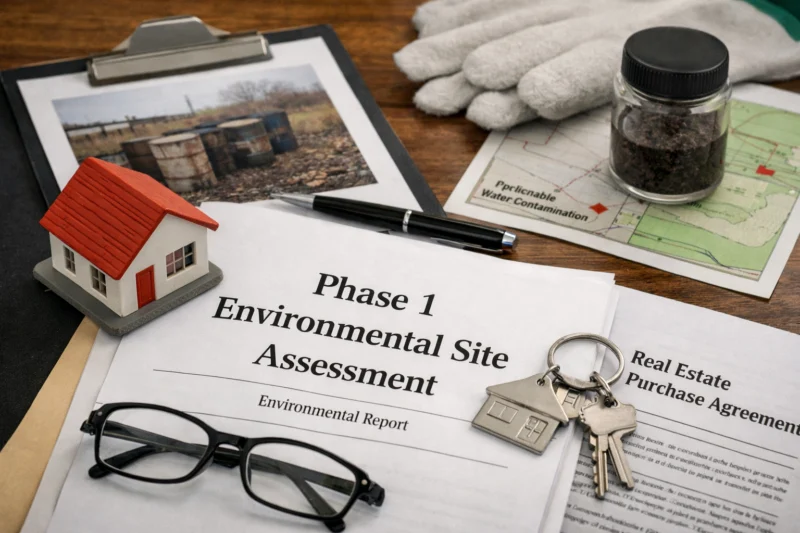
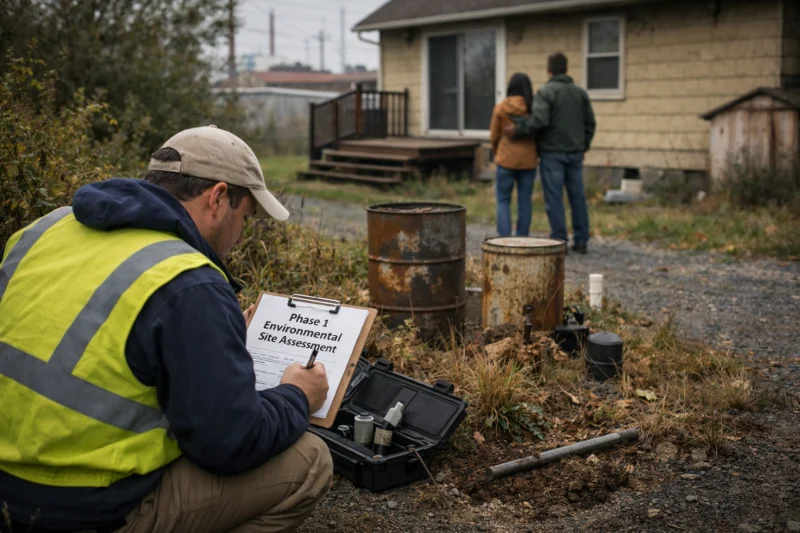
At a high level, Phase 1 typically follows a sequence of records research, site reconnaissance, interviews/observations, and formal documentation in the final report. Records research focuses on how the property and nearby land uses evolved over time and whether there are clues that hazardous materials or petroleum-related releases may have occurred. Site reconnaissance looks for signs that are often overlooked: staining, stressed vegetation, abandoned equipment, unusual odors (where lawful and safe), buried fill, drums or tanks not described in records, or evidence of past spills.
For homebuyers, the practical part is knowing how to use the report in your purchase. A defensible Phase 1 supports contingencies tied to environmental risk, helps align seller disclosures with what the buyer’s professionals found, and gives lenders and insurers a consistent narrative. If the report identifies RECs, you should expect a higher level of scrutiny during underwriting or insurance review, and it may influence redevelopment or renovation planning.
If you want a decision tree in real terms, it looks like this: if no RECs are identified, you still keep the documentation as a risk reference and ask follow-up questions only if the property has unusual facts (like visible staining or unexpected access restrictions). If RECs are identified, the next step is often Phase 2 or a targeted approach—guided by the nature and location of the concern. Importantly, you’re using the report’s logic to choose what makes sense for your specific scenario, not adopting a generic “always sample” rule.
A common misunderstanding is treating Phase 1 as if it provides the same certainty as an inspection with test results. Phase 1 is evidence-based but non-intrusive, so its power is defensibility and risk flagging. What most guides get wrong is not stressing that the process quality—how thorough the sources were, how the professional documented assumptions, and how well interviews captured local knowledge—can meaningfully change the outcomes.
ASTM E1527-21 and AAI: the standards that make Phase 1 defensible in 2026
ASTM E1527-21 and All Appropriate Inquiries (AAI) are what make a Phase 1 defensible, because they govern how the assessment is planned, documented, and supported with credible sources. For homebuyers, this is crucial: the “unseen safety net” isn’t just the report’s conclusions—it’s the standard-aligned method behind them.
ASTM E1527-21 is the methodology framework that generally guides how Phase 1 should be conducted and documented. It’s the backbone for consistency: what to review, how to describe the search and reconnaissance, how to handle missing information, and how to present the final findings. AAI, discussed in the context of U.S. regulatory expectations for liability, matters because it’s about demonstrating that you made qualified efforts to identify environmental conditions during your property due diligence.
In 2026-era transactions, these ideas are often practically connected through “defensibility expectations.” Your goal is not only a Phase 1 report, but a report that clearly shows where the professional looked, what sources were used, and what limitations existed. In the AAI framework (tied conceptually to 40 CFR Part 312 (AAI)), defensibility is enhanced when searches are documented with appropriate dates, property boundary reasoning, and credible inquiry methods.
Real-world defensible documentation looks like: clear identification of the property reviewed, dates of record searches, summary of environmental agency searches, explanation of how property boundaries were established, and thoughtful reasoning for why conditions were or were not categorized as RECs. It also means the consultant doesn’t hide uncertainty—good reports explain limitations and how those limitations could affect confidence.
Common gaps that undermine protection include stale searches (when records are outdated relative to the decision timeline), missing interview notes, unclear data quality, vague site reconnaissance narratives, and incomplete historical context. If a lender or insurer asks “how do we know this was done properly,” the ASTM/AAI alignment is often the answer that matters most.
If you want a credible anchor for what “All Appropriate Inquiries” is conceptually aimed, review U.S. EPA guidance on All Appropriate Inquiries and the regulatory AAI rule found in 40 CFR Part 312. For the Phase 1 methodology context, consult the summary information available through ASTM E1527-21 resources (note that full standard text may require purchase).
Common mistakes and misconceptions that can undermine homebuyer protection
The most common mistakes in Phase 1 ESA usage are misconceptions about what Phase 1 guarantees and misunderstandings about timing, scope, and how report limitations affect real risk. These errors can quietly strip away the “unseen safety net” when you need it most—during financing, negotiations, or after closing.
First misconception: assuming Phase 1 guarantees safety. Phase 1 typically doesn’t involve intrusive sampling, so it cannot confirm contamination. What it can do is identify conditions that might indicate environmental risk and support defensible decision-making. If you treat it like a guarantee, you may miss the need for Phase 2 or targeted follow-up when the report indicates RECs or residual concerns.
Second mistake: doing Phase 1 too late—or relying on an expired report without updating scope. Environmental due diligence is often time-sensitive because lender review cycles and contingency deadlines are real. If a Phase 1 was completed months earlier, record changes, new information, or settlement of uncertainty might make an update necessary. Waiting until the last minute also compresses your ability to negotiate based on the findings.
Third mistake: using a generic assumption about “neighboring properties” instead of property-specific records and reconnaissance. Environmental risk is location- and history-specific. A consultant’s ability to understand the property’s former uses, surrounding land-use evolution, and evidence quality is what changes the REC determinations.
Another frequent trap: treating “no RECs” as the end of the conversation. If you observed unusual odors, staining, or evidence of past earth disturbance, those site-specific facts may warrant follow-up even if the Phase 1 executive summary is reassuring. What most guides get wrong is failing to explain that the “scope” can shift outcomes—small differences in historical research depth, interview quality, and site access can influence whether concerns are carried forward.
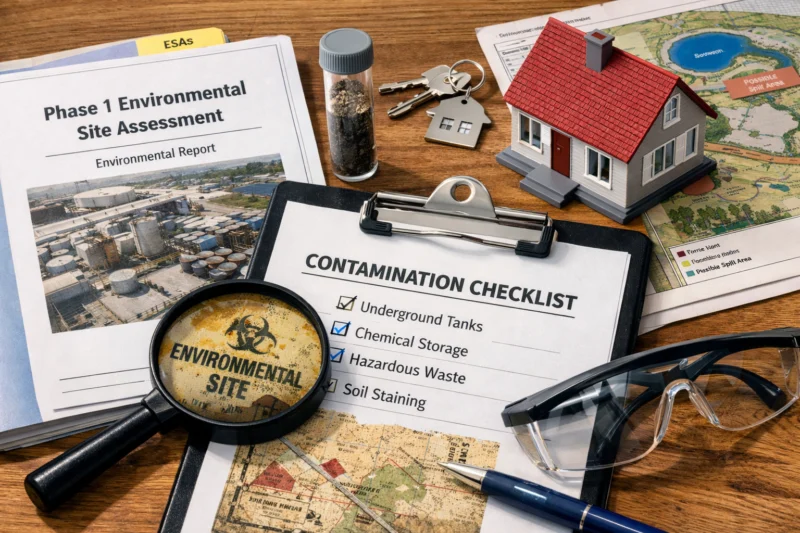
A practical example: suppose the site reconnaissance was limited because fencing or renovation prevented a meaningful observation of certain areas. Even if no RECs were identified, you should ask how those limitations were handled and whether any clarifications or targeted checks would reduce uncertainty.
Options and comparisons: how to choose between Phase 1, Phase 2, and other due-diligence approaches
Choosing between Phase 1, Phase 2, and other due-diligence approaches is about matching the level of investigation to the risk indicated by records, reconnaissance, and any RECs. Phase 1 is the evidence-based screening and defensibility step; Phase 2 is the intrusive investigation step when the story created by Phase 1 calls for testing.
Phase 1 is typically used for screening and documentation: it reviews historical sources, performs site reconnaissance, and determines whether conditions warrant further evaluation as RECs. Phase 2 generally involves sampling or testing to evaluate whether hazardous substances or petroleum-related issues are actually present at concentrations of concern. A targeted assessment can sit between them: it focuses on specific questions raised by Phase 1, which may be more efficient than a full Phase 2 scope in some circumstances.
Tradeoffs matter. Phase 1 is less intrusive and often faster, which is why it’s commonly used early in transactions and can support lender/insurer review. Phase 2 can be more expensive and more disruptive because it often requires soil or material sampling, but it provides the higher certainty that negotiations and remediation decisions sometimes require.
When each approach is appropriate for homebuyers: older properties near former commercial corridors, inherited homes with uncertain histories, and properties planned for renovation with ground disturbance often benefit from Phase 1 early. If Phase 1 identifies RECs tied to historic use—like petroleum storage, dry cleaning operations, or industrial activities—Phase 2 or targeted sampling becomes more justified.
When shopping for a consultant, request a scope narrative, not just a price. Ask how recommendations connect to findings, what sources will be searched, how property access limits are handled, and what assumptions are documented. Deeper insight here is that “upgrading to Phase 2” is not automatic; sometimes better records and stronger interviews resolve uncertainty, while other times immediate testing is the most rational step.
Advanced considerations most guides skip: edge cases, overlays, and real transaction friction
Many homebuyers get caught in edge cases where Phase 1 conclusions are harder to interpret, such as complex property boundaries, limited site access, or layered historic land-use data. These situations don’t mean Phase 1 is useless; they mean the report’s limitations need to be actively managed.
Consider split ownership or complex boundaries: if the environmental professional can’t confidently define the area of concern (for example, due to boundary disputes or unclear parcels), the scope narrative becomes critical. Access limitations are another common friction point—locked gates, renovations, landscaping that obscures soil conditions, or tenant-controlled areas can reduce the quality of site reconnaissance. A good consultant documents these constraints clearly and explains how they affect the investigation’s uncertainty.
Overlay areas—places where records are inconsistent or where multiple land uses stacked over time—also complicate interpretations. Redevelopment zones can create gaps in historical documentation, and even a thorough Phase 1 depends on the quality of publicly available sources. This is why the report should read like a coherent story: what was searched, what was found (or not), and why the professional categorized the conditions as RECs or not.
Even after Phase 1, you may face “residual concern.” That’s not the same as RECs, but it can show up in qualifiers, observations, or recommendations. For example, a report might conclude no RECs are present but recommend further evaluation if certain renovation work exposes deeper soil. Your job as a homebuyer is to treat those recommendations as decision inputs—not as vague suggestions.
In real transactions, you’ll likely hear objections: a seller pushing back on contingencies, a lender asking for clarity, or an insurer requesting evidence. The best responses typically involve pointing to the report’s standard-aligned scope and documented logic. Technology can help, but innovation must support ASTM E1527-21/AAI-aligned reasoning rather than replace it.
Technology and innovation in Phase 1 reporting: GIS, GPR, drones, and digital data platforms (what’s useful vs hype)
Modern technology can strengthen Phase 1 reporting by improving how historical land-use context is mapped, how reconnaissance coverage is documented, and how source material is tracked. However, the best results come when technology supports—rather than replaces—the standard-based reasoning behind RECs determinations.
GIS tools are commonly useful because they help contextualize a property relative to historic land uses, right-of-way corridors, and neighboring potential sources. Digital workflows can also enhance traceability: document management systems store source citations, version histories, and supporting evidence so the report remains auditable. When a buyer or lender asks “what was looked , and when,” the ability to produce a defensible record can be a decisive advantage.
Remote imagery such as drones (when lawful and appropriate) can improve reconnaissance coverage by showing rooflines, site grading patterns, or features that might be missed from the ground. The limitations are important: remote imagery doesn’t replace in-person safety-appropriate observations, and it can create false impressions without verification. Geophysics like GPR (Ground Penetrating Radar) is more commonly associated with Phase 2 or targeted investigations, but it may sometimes inform decisions when used appropriately—always with clear explanation of what it can and cannot show.
What you should ask vendors if tech is part of their approach: what data sources were used, how inputs were validated, whether the findings were tied back to standard-based conclusions, and how uncertainty was handled. A common mistake is overvaluing flashy maps while the REC logic remains thin. Maps help, but the defensibility is in the written reasoning, the scope narrative, and the documentary support.
For quality assurance, ensure the final report remains human-legible and transparent. Tech-enabled Phase 1 reports should clearly show REC logic tied to evidence and explain limitations in accessible language. Even in 2026, the standard remains the backbone, and advanced tools should only augment that foundation.
Regional considerations for homebuyers (U.S. context) and how geography affects findings
Geography changes what Phase 1 is likely to uncover because local land-use history, record availability, and common historic activities vary by region. For homebuyers across the U.S., the “unseen safety net” works best when the consultant adapts record searches and reconnaissance expectations to the realities of the area.
Coastal and river-adjacent properties, for example, may have different historic fill practices and waterfront industrial uses than inland residential neighborhoods. Legacy industrial belts can show higher historical density of potential sources—manufacturing sites, rail-adjacent operations, or petroleum infrastructure—so the record review becomes more consequential. In agricultural regions, historic use patterns (including storage and transport of fuels or chemicals) can affect how RECs are evaluated even when today’s land use appears clean.
State and local records can also vary in completeness and search interfaces, which can influence the strength of the narrative. A strong consultant compensates by planning broader, reliable records strategies and documenting the data quality and dates. This is why two Phase 1 reports for similar-looking properties can produce different outcomes—one consultant may have accessed richer historic sources or better-quality agency records for that jurisdiction.
Regional factors also influence practical next steps. Lenders and insurers may apply different internal underwriting expectations depending on their risk model and your region’s prevalence of certain issues. If Phase 1 flags RECs, the follow-up pathways (and typical Phase 2 triggers) can differ based on local regulatory norms and common remediation programs.
Deeper insight: record quality differs widely even within the same state. If local archives are incomplete or if historic business identifiers are difficult to match to a parcel, a professional should clearly explain uncertainty and avoid overconfident conclusions. As a homebuyer, you should ask how the consultant handled these limitations and whether targeted follow-up would reasonably reduce uncertainty.
Frequently Asked Questions About Phase 1 Environmental Site Assessments for Homebuyers
What is a Phase 1 Environmental Site Assessment, and what does it actually test?
A Phase 1 ESA is a due diligence process that reviews records, performs site reconnaissance, and may include interviews to identify potential environmental concerns. It does not typically include intrusive soil or groundwater sampling. Instead, it identifies whether there are conditions that could be potential sources of contamination and summarizes them using concepts like RECs.
How does a phase 1 ESA for homebuyers differ from a home inspection?
A home inspection evaluates the property’s physical condition—systems, structure, and visible defects—while a Phase 1 ESA screens for environmental risk based on evidence. Phase 1 focuses on historical and contextual clues that may not be visible on the surface. The outputs are typically used to inform environmental risk decisions rather than repair lists.
What does “no Recognized Environmental Conditions” mean for my purchase?
“No Recognized Environmental Conditions” means the professional did not identify evidence that meets the criteria to classify conditions as RECs within the Phase 1 scope. It is not a guarantee that contamination does not exist. If there were access limitations or sparse historical records, your confidence should reflect those qualifiers.
When should I request a Phase 1 ESA during the buying process?
Request it early enough that you can review the report, ask questions, and adjust your contingencies or negotiation position before deadlines. Many buyers tie it to their due diligence period so they are not forced into decisions after time runs out. Also note that environmental reports may require renewal or update if the transaction drags on or facts change.
Will a lender or title company require a Phase 1 ESA?
Sometimes. Lenders may request it based on their risk policies, the mortgage type, and property characteristics, while insurers may ask for environmental documentation in certain cases. It is not universal, but having a standard-aligned Phase 1 can reduce friction when they do ask.
What if the Phase 1 finds RECs—does that automatically mean contamination?
No. RECs generally indicate conditions that could involve releases of hazardous substances or petroleum products, based on evidence and professional judgment. RECs often trigger discussion of whether Phase 2 sampling is warranted to determine actual presence and concentrations.
What should I look for in the final Phase 1 ESA report before signing?
Look for a clear scope description, documented records sources and dates, site observations, and a transparent REC summary. The report should explain limitations, assumptions, and the logic connecting evidence to conclusions. It should also include consultant recommendations and what follow-up they believe is appropriate.
How do ASTM E1527-21 and 40 CFR Part 312 (AAI) relate to homebuyer protection?
ASTM E1527-21 generally governs the planning and execution framework for Phase 1, while AAI concepts emphasize qualified efforts to identify environmental conditions. Together, they support defensibility by showing that the assessment followed recognized best practices and was properly documented. For many buyers, that defensibility is what matters when negotiating or responding to lender and insurer questions.
What questions should I ask the consultant if I’m worried about property access limitations?
Ask how access limitations affected site reconnaissance and whether any areas could not be observed. Request clarification on how the consultant documented those limitations and whether the Phase 1 recommended any follow-up due to the restricted observation. If access was limited by renovations or landscaping, ask what specific conditions were not verified.
Can I use a previously completed Phase 1 ESA from an earlier transaction?
Often you can reuse the report only if it is still current and consistent with the current property facts and intended use. A re-check may be needed if the search dates are old, if property boundaries or ownership changed, or if new information emerged. Ask the consultant to evaluate whether updating the scope is necessary.
How does geography—like being near industrial sites or former commercial areas—change Phase 1 outcomes?
Local history drives what the record review and reconnaissance are likely to find, so proximity to industrial corridors, rail lines, or historic commercial strips can increase the number and significance of potential concerns. Even with the same house appearance, the parcel history and available data can differ. Your consultant should tailor the records search strategy to match local land-use patterns.
What are common red flags in Phase 1 reports that suggest the scope wasn’t adequate?
Red flags include vague methodology, incomplete or unstated records sources, stale search dates, unclear assumptions, and REC logic that doesn’t map clearly to evidence. Another red flag is insufficient explanation of how limitations were handled. If the report feels more like a summary than a documented inquiry aligned to the standard, ask for clarification or a revised scope.
Conclusion: make Phase 1 your evidence-based safety net—not a checkbox
Phase 1 Environmental Site Assessments act as the unseen safety net because they help you identify potential environmental risk before you buy, document defensibility, and negotiate with evidence rather than assumptions. When you treat Phase 1 as a real due diligence decision tool—understanding what it can conclude and what it can’t—you reduce the odds of post-closing surprises.
Your action path is straightforward: choose a qualified, standard-aligned Phase 1, interpret RECs realistically, and decide intelligently whether Phase 2 or targeted follow-up is warranted. Be proactive about asking for scope details aligned with ASTM E1527-21 and AAI expectations, review the report limitations, and keep the documentation as part of your purchase record.
Finally, consult a qualified environmental professional and integrate Phase 1 findings into your purchase and contingency strategy—so the report becomes a decision asset, not just a document you file away. If you want practical decision-making frameworks, keep reviewing your due diligence options and how evidence supports negotiations.
Updated August 2026