

Most Phase 1 Environmental Site Assessments (ESAs) are completed in roughly 2–6 weeks after kickoff, but the answer depends on what “completion” means—especially whether the assessor has all records needed to finalize conclusions and QA the report. In practice, the phase 1 ESA timeline is driven less by the site walk and more by records retrieval, scheduling interviews (if needed), site access logistics, and report drafting/quality review against ASTM E1527-21 expectations.
This article explains the timeline to complete a Phase 1 ESA report—not the broader remediation or redevelopment lifecycle—and why variability is normal in 2026. You’ll learn: the true meaning of “done,” realistic time ranges by site type and information readiness, the decision points that control calendar time, common failure modes that trigger rework, and practical ways to reduce delays without undermining defensibility.
What “completing” a Phase 1 ESA actually means (and where delays usually begin)
“Completion” usually means the client receives a final Phase 1 ESA report that meets the expectations of ASTM E1527-21 (including documented sources, a defensible narrative, and appropriate handling of document gaps). Many delays happen after the field work is already done, because the report must still reconcile history, photographs, and conclusions—and then pass QA and risk review.
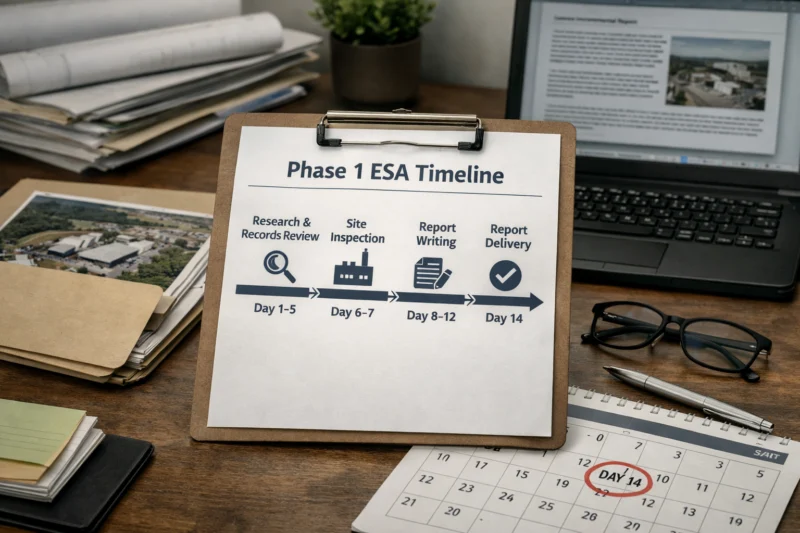
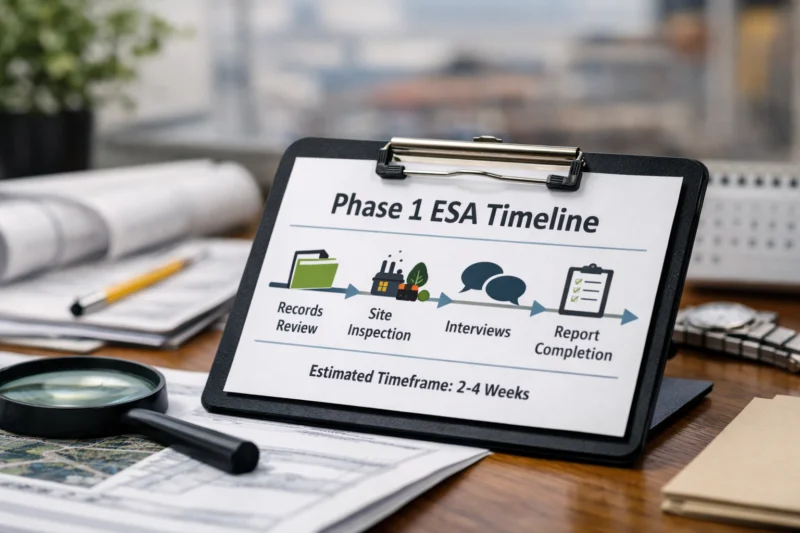
To map the timeline to complete a Phase 1 ESA, it helps to think in deliverables rather than days on site. A typical sequence looks like: records request and file assembly → records review and initial hypotheses → site reconnaissance planning and field work → interviews (if applicable) → document gap resolution decisions → report drafting → technical/consistency QA → final review and delivery. Even when the field reconnaissance is quick, the report can’t be finalized until the assessor can support findings and document gap treatment.
Why it matters: Phase 1 ESAs are used to support diligence decisions, including underwriting and risk communication. If the report is delivered without a complete evidentiary trail—or with unresolved gaps left “unexplained”—stakeholders often request revisions. How it works in the real world: the assessor uses the records review and reconnaissance observations to identify areas of potential concern (if any), then ties conclusions to the evidence collected. Practical application: when you schedule your transaction or internal review deadlines, build time for QA and possible rework caused by missing files, unclear boundaries, or new third-party documentation. A common tradeoff is that “faster” deliveries that skip document gap handling can be slow later if stakeholders request revisions for defensibility.
Deeper insight: a Phase 1 can be fieldwork-complete but not report-complete. For example, the assessor may photograph all visible conditions, but still need additional historical records to finalize chronology or to confirm prior land uses. Edge case: a property owner or tenant may be unavailable for interviews during your preferred window; the assessor can proceed, but the interview gap may require careful documentation and conservative interpretation. A common mistake is assuming “Phase 1 equals a site walk.” Guides that focus only on reconnaissance underestimate how much calendar time is consumed by records reconciliation, map/photo consistency checks, and report revisions after draft feedback.
Internal linking awareness: People often also look for guidance on “how environmental due diligence documentation is prepared,” “field notes vs. report deliverables,” or “QA checklists for reports.” If you’re building related content, those are natural supporting topics around this timeline reality.
Typical timeline ranges in 2026: realistic durations by site type and information readiness
In 2026, most Phase 1 ESAs fall into a practical range of about 2–6 weeks to reach final report delivery, with faster outcomes when records are readily available and slower outcomes for complex sites with incomplete histories. The key driver is not whether the assessor can walk the property quickly—it’s whether the assessor can assemble enough credible documentation to draft, QA, and defend conclusions.
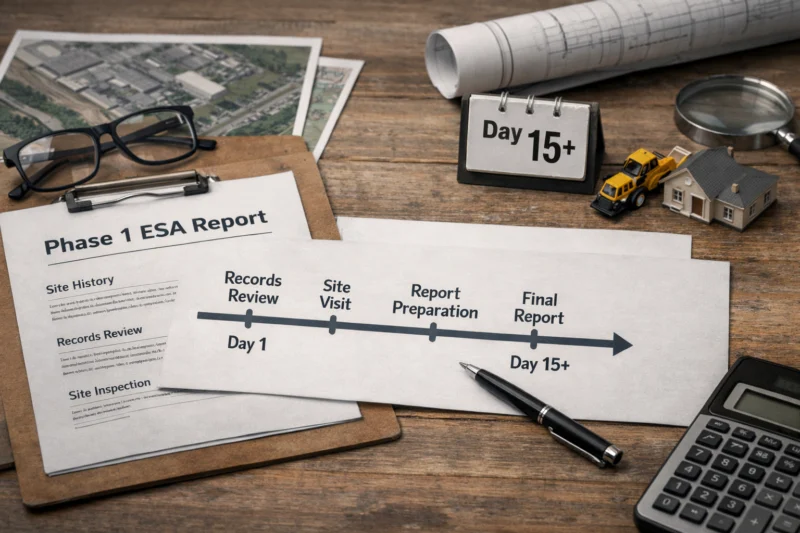
How to think about ranges: many projects cluster into three planning buckets. “Fast” schedules are common for straightforward properties (for example, smaller parcels with stable land use, available plats/surveys, and fewer structures or prior uses). “Typical” schedules often apply to mixed-use or lightly complex sites where historical research is manageable but still requires multiple records sources and coordination. “Complex” timelines are more likely for former manufacturing, multi-tenant commercial properties, larger acreages, or properties with frequent address changes, redevelopment, or confusing jurisdictional boundaries.
What matters for information readiness: the availability of surveys/plats, building plans, prior ESA reports, utility records, and easements can significantly reduce rework. If you already have an older Phase 1 report from a prior transaction, it may shorten initial scoping time, but the assessor still must confirm its currency and whether it remains adequate for the current boundary and conditions. Tradeoffs: rushing to meet a deal deadline can increase the chance that document gaps are discovered later or that stakeholder feedback triggers additional draft revisions. Real-world scenario: for an industrial property, the assessor may need more time to reconcile historical addresses and confirm the footprint of demolished structures; that’s not optional if the report is expected to remain consistent with ASTM E1527-21 expectations.
Deeper insight: procurement and transaction mechanics can distort what feels like an “ESA timeline.” For instance, if the closing date is fixed and stakeholders require the Phase 1 to be “final” by a particular week, the assessor may have to compress records collection windows, parallelize work, or ask for stronger document gap mitigation earlier. Another subtle factor is seasonality: reconnaissance may be slower if access permits are delayed, vegetation is dense, or weather affects visibility for surface observations. Edge case: multi-county properties may require additional coordination with different municipal or county record offices, lengthening historical document retrieval.
Internal linking awareness: Readers searching “Phase 1 deliverables” and “what to send the assessor” are often the same people who want “records request checklists” and “scope alignment for environmental reports.” Those topics naturally pair with timeline planning.
The decision path that controls time: document review, interviews, reconnaissance, and report QA
The Phase 1 ESA timeline is controlled by a decision path: the assessor proceeds when evidence is sufficient, pauses or revises when document gaps must be addressed, and reworks drafts when conclusions can’t be supported cleanly. Understanding these decision points helps you predict when time will be consumed and what you can influence.
How it works from a process perspective: the records review informs what the assessor plans to look for in reconnaissance and whether interviews are likely to be needed or useful. In many cases, the assessor starts with chain-of-ownership and historical land use research, then uses that to decide how much focus to place on specific eras of development, industrial activities, or areas with evidence of past releases. Interviews (when applicable) can tighten chronology and reduce uncertainty, but they also introduce a dependency on third-party availability.
Report QA is a common underestimator of calendar time. QA often includes technical consistency checks across maps, photos, chronology, and narrative statements; it may also involve a procedural review to ensure the report structure matches ASTM E1527-21 documentation expectations. Practical application: if you want to reduce schedule slippage, treat QA as a fixed stage, not a “quick final edit.” Tradeoffs: if stakeholder feedback arrives late (for example, legal or risk reviewers asking for additional documentation after draft submission), the assessor may need to update the narrative, re-check references, and potentially revise document gap handling language.
Deeper insight: outcomes influence effort. If evidence is strong enough to support “no evidence of release,” the narrative may be straightforward; if results are “inconclusive” due to incomplete information, the assessor may need extra documentation, clarification, or conservative recommendations for next steps. Common mistake guides make: they describe “timeline = field days” rather than “timeline = evidence readiness + QA.” Edge case: boundary ambiguity can cause rework, because photos and observations may need to be re-labeled relative to correct property extents. Another rework driver is updated historical information received late (for example, a corrected address record or newly located prior report), which can require chronology updates and re-interpretation.
Internal linking awareness: This section pairs well with content about “how to interpret Phase 1 findings,” “document gap strategies,” and “QA and defensibility for environmental reports.” Those themes help readers connect timeline planning to outcomes.
How to accelerate the phase 1 ESA timeline without compromising quality
You can often accelerate the Phase 1 ESA timeline by front-loading information, securing access early, and coordinating third-party responsiveness—while still preserving document gap defensibility and QA integrity. The goal isn’t cutting corners on evidentiary support; it’s removing avoidable calendar friction.
Start with a practical checklist you can act on immediately. Provide surveys/plats and any known boundary documentation; identify responsible contacts for interviews (property manager, long-term owner, tenant contacts); and confirm property access windows. If you can, share historical documents you already have—prior ESAs, site plans, lease area descriptions, demolition permits, or utility correspondence. How it works: this reduces time spent chasing missing files, and it lowers the probability that the assessor must introduce conservative language later due to gaps.
Use a “front-loading” approach for historical research. Ask the assessor for their records request list early and clarify how they expect to source utilities, address history, and building footprints. Practical application: schedule interview availability before field work begins so the assessor can incorporate testimony into the chronology rather than leaving it as a later add-on. Scope alignment matters too—confirm boundaries, target research dates or land-use periods relevant to the site, and what counts as an acceptable document search for the project’s risk posture. Tradeoff to understand: aggressive compression can backfire if it leads to weak document gap handling or inadequate source documentation, which can trigger revisions during QA or stakeholder review.
Deeper insight: acceleration should include coordination, not only speed. Align lender/insurer/transaction counsel expectations early so they understand what the final report includes (and what typically requires supplemental documentation). A common mistake is to treat the Phase 1 report as a black box that will automatically satisfy every internal reviewer on the first pass. Edge case: if access is restricted due to safety requirements (industrial hazards, escort rules, or security protocols), failing to plan for escort logistics can delay reconnaissance and create cascading impacts on report drafting.
Internal linking awareness: If you’re also publishing educational material, this topic connects naturally to “risk communication for environmental reports” and “how to prepare documentation for due diligence.”
Common mistakes and misconceptions that extend the timeline (and how to avoid them)
The biggest misconceptions that extend the Phase 1 ESA timeline are that the assessor controls everything and that the “Phase 1” label means a quick site walk. In reality, schedules expand when records are incomplete, when third parties are slow to respond, or when report QA reveals gaps or inconsistencies that require rework.
First, avoid the mistake of treating Phase 1 as purely observational. For complex or historically active properties, historical records research can dominate the schedule because it must support the report’s chronology and the assessor’s conclusions. How it works: the assessor cross-references sources to reconstruct what land uses occurred and when; if the evidence is inconsistent, the assessor may need additional documentation or conservative interpretation. Practical application: ensure the assessor has enough boundary information and historical context to avoid repeating research work after draft comments.
Second, address dependency misconceptions. The assessor may not be able to control property owner responsiveness, municipal record retrieval delays, or interviewee scheduling. Misconception: “If we hire the assessor early, we’re safe.” Reality: if key records are only available by in-person archive retrieval or slow agency processes, the calendar will still stretch. Third, pitfall underestimation of QA and interpretation time. Even when field work is completed, QA can reveal mismatched dates, inconsistent map references, photo labeling issues, or a narrative that doesn’t fully tie evidence to conclusions.
Deeper insight: deal term changes can effectively reset the timeline. If the property configuration changes, the scope boundaries shift, or the closing date changes late, the assessor may need to redo scoping and potentially re-run parts of records review. Edge case: documents delivered late can force additional map/chronology updates, which can trigger a re-approval cycle. What most guides get wrong is the “linear timeline” assumption: Phase 1 work is iterative because new evidence can prompt updated interpretation and document gap handling decisions.
Internal linking awareness: These issues connect to content about “why environmental reports need documentation quality” and “how to manage stakeholder feedback loops.”
Options and alternatives when timelines are constrained (what to look for in realistic categories)
When timelines are tight, there are legitimate ways to plan around the Phase 1 ESA purpose—usually by changing workflow sequencing, clarifying scope inputs, or adding targeted information collection—rather than abandoning defensibility. You still need to address document gaps and maintain consistency with ASTM E1527-21 expectations; “alternative” should not mean “noncompliant.”
Category 1: expedited scheduling/workflow. This often means resource allocation earlier, running records review in parallel with interview coordination, and securing field access windows sooner so reconnaissance can happen as soon as the assessor is ready. Category 2: modified scope planning within defensible bounds. For example, clarifying boundary definitions and agreeing on a document gap strategy can prevent later rework, but it should remain aligned with the Phase 1 framework’s intent. Category 3: early-stage gap mitigation information collection. This may involve targeted supplementation—such as obtaining known surveys, plats, or prior reports—before final reporting, reducing uncertainty that would otherwise linger into QA.
Category 4: decision routing to the next step. If Phase 1 results suggest controlled conditions or indicate that additional investigation may be appropriate, the “acceptable timeline” shifts from “final due diligence readiness” to “timely next-step routing.” Tradeoffs: speed-oriented categories can reduce calendar time but may increase costs, require more coordination effort, or shift risk allocation depending on how stakeholders use the report. Practical application: if you truly need an earlier deliverable, ask how the assessor plans to handle document gaps and whether an interim deliverable is possible that still supports underwriting decisions.
Deeper insight: alternatives can’t eliminate the need to address document gaps. If the site history is genuinely incomplete, stakeholders may still require additional documentation to support conclusions or to interpret potential risk. A common mistake is assuming that “expedited” means “shorter evidence requirements.” Edge case: if “good enough for underwriting” differs from “final due diligence readiness,” you may still end up with revised language later. This is why it’s critical to align expectations in writing with the assessor—what will be considered final, what will trigger updates, and how those updates will be documented.
Internal linking awareness: This section supports readers who need guidance on “environmental due diligence planning” and “how underwriting uses Phase 1 outcomes.”
Beyond the typical schedule drivers, several edge cases and data pitfalls can materially impact the Phase 1 ESA timeline by forcing additional research, remapping, and report revisions. In 2026, the defensibility of documentation also matters because Phase 1 findings can influence subsequent obligations and decision-making—especially when stakeholders interpret what the report implies for future assessment work.
Edge cases that complicate timelines include limited site access (security restrictions or unsafe conditions), refusal or inability to interview key parties, demolished structures that complicate footprint confirmation, and rapidly changing land use that makes “what happened” harder to reconstruct. Another complexity is incomplete utilities mapping: if utility corridors can’t be verified with credible records, the assessor may need conservative assumptions that require more narrative support. A practical scenario: on a redevelopment site, the assessor might need to confirm what parts of the prior footprint are still discoverable through records and what can only be inferred from outdated maps or aerial imagery.
Nuanced data pitfalls can be surprisingly schedule-breaking. Inconsistent historical addresses can lead to mismatched chronology; map scale mismatches can require re-labeling photos; and chain-of-custody issues for third-party documents can force requests for re-issuance of PDFs or scanned records. Even when the assessor “has” documents, the report must still show that sources are credible and relevant. Why this matters: report QA checks aren’t just clerical—they help ensure statements are consistent across maps, dates, and evidence. Tradeoff: avoiding these pitfalls via shortcuts can create defensibility gaps that surface during stakeholder review, causing rework.
AAI-related context (2026): while Phase 1 ESAs are structured around the ASTM framework and environmental professional expectations, outcomes and documentation quality can influence how stakeholders plan next steps. In some cases, additional regulatory considerations—such as potential AAI (all appropriate inquiry) expectations for certain decisions—make transparent documentation and clear handling of document gaps particularly important. A deeper nuance is “new information after issuance”: if new releases or conditions emerge during the transaction timeline, the client may need supplemental documentation or a revised assessment strategy, which can reopen parts of the Phase 1 narrative.
Deeper insight: credibility markers that reduce future timeline risk include clear documentation, transparent document gap treatment, strong photo logs with correct reference points, and coherent historical chronologies. Common mistake: waiting until after final delivery to discover that a key evidence set (like boundary documentation or historical address references) was missing or unclear. Edge case: if the client later provides corrected survey information, the report may require updates to align observations with corrected boundaries.
Internal linking awareness: If you publish supplementary content, this section naturally aligns with “understanding AAI documentation expectations” and “how new information triggers supplemental reports.”
Where location matters: how regional factors change records availability and scheduling (U.S.-wide)
Location significantly affects the Phase 1 ESA timeline because records availability and retrieval lead times vary across U.S. regions and agencies. A site near well-digitized databases can move faster, while properties relying on archived records, in-person retrieval, or slower municipal workflows may take longer to complete the evidentiary package.
Regional variability often shows up in the responsiveness of planning departments, fire departments, county record offices, and state or municipal databases. Archived newspapers, older building permit records, and historic aerial sources can also vary in accessibility and turnaround. How it works: the assessor’s records research plan may depend on whether certain documents are available online, on microfilm, or via request workflows with limited staffing. Practical application for readers: ask the assessor early about expected records retrieval lead times for the project’s region and whether any archives typically require extended scheduling.
Site-access culture and permitting can also change calendar time. Some regions or property types require escort logistics, specific hazard communication steps, or additional safety paperwork before reconnaissance. Climate and environment can influence field observations and timing: snow cover affects visibility, drought changes surface conditions, and flood history may change how practical it is to conduct thorough visual reconnaissance. Edge case: cross-jurisdiction properties—multi-parcel sites that extend across county or municipal boundaries—can require coordination with multiple offices and therefore add schedule risk.
Deeper insight: regional variability is not just about field days. It affects the records review stage that feeds report drafting and QA. Common mistake guides make: treating timelines as universal. In reality, two similar sites in different regions can experience different phases of delay. Practical mitigation: align timelines with regional retrieval expectations—especially for historical documents and property address changes—so the assessor isn’t forced to wait late in the process.
Internal linking awareness: For broader education, this pairs with content on “how to plan due diligence across jurisdictions” and “how local records impact environmental research.”
Frequently Asked Questions About Accelerating Your Understanding: The Timeline for Completing a Phase 1 Environmental Site Assessment
How long does a Phase 1 ESA usually take from kickoff to final report?
Most projects land in a practical range of about 2–6 weeks from kickoff to final delivery, assuming standard complexity and responsive stakeholders. The biggest timing swings usually come from records retrieval, interview availability (when needed), and report QA/rework after draft review. “Final report” typically includes documented sources and clear handling of any document gaps, not just a field reconnaissance summary.
What causes the biggest delays in a phase 1 ESA timeline?
The most common delay drivers are incomplete or hard-to-retrieve historical records, slow responses from property owners or interviewees, and late property access approvals for reconnaissance. Report QA and rework also frequently extend schedules when maps, chronologies, or boundaries need correction after drafts. Another surprise delay is receiving new third-party documentation late, which can force updates to interpretation and narrative.
Can a Phase 1 ESA be completed in 2 weeks for a time-sensitive transaction?
Sometimes, but it depends on site complexity and information readiness, and it may require careful workflow planning. Two-week schedules are most feasible when records are readily available, boundaries and documents are provided promptly, and interviews aren’t dependent on hard-to-reach third parties. Clients should clarify in advance whether the project will still meet ASTM documentation expectations for document gap handling and QA.
What documents should a client provide to avoid extending the Phase 1 ESA schedule?
Clients typically help by providing current and historical boundary documentation (surveys/plats), known land-use descriptions, building plans or site plans if available, prior ESA reports, and any easements that affect access or footprints. They should also identify contacts for interviews and confirm who can grant site access. Supplying these items early reduces both records-request churn and the likelihood of report rework during QA.
How does the ASTM E1527-21 framework affect how quickly a Phase 1 ESA can be finished?
The ASTM E1527-21 framework emphasizes traceable documentation and structured decision-making, which means the assessor must support conclusions with credible sources and transparent document gap treatment. That requirement can add time when records are missing or inconsistent. It also helps explain why “quick field work” alone doesn’t guarantee a fast final report.
What happens if the assessor finds missing historical records during the Phase 1 ESA?
If records are missing, the assessor typically documents the gap and explains what was attempted and what the limitations mean for the conclusions. Resolving document gaps can extend the timeline if additional research or supplementation is needed before finalization. In some situations, the assessor may still produce conclusions with appropriate limitations, but stakeholder review can still prompt follow-up questions and revisions.
Do interviews slow down the Phase 1 ESA, and can they be scheduled quickly?
Interviews can slow schedules when interviewees are unavailable or difficult to reach, because the assessor may need testimony to refine chronology and context. Interviews can often be scheduled quickly if the client provides identified contacts early and secures availability windows before reconnaissance. If interviews cannot happen, the assessor will typically document limitations and may adjust interpretation accordingly.
How does the Phase 1 ESA timeline change for industrial properties versus vacant land?
Industrial properties usually require more extensive historical research and map/footprint reconciliation because prior uses can be varied and evidence may be complex. Vacant land may be faster when there’s stable land use history and fewer structures to confirm, though it can still take longer if address history is unclear or records are difficult to retrieve. The presence of multiple structures, prior industrial activities, and redevelopment cycles typically increases schedule risk for industrial sites.
What should I do if new information emerges after the draft Phase 1 report is issued?
If new information emerges—such as newly provided records, corrected boundaries, or evidence of prior activities—the assessor can often incorporate it through supplemental documentation or revised sections. The extent of revision depends on how the new information affects conclusions and document gap treatment. Communicating the update quickly helps prevent multiple rework cycles and improves defensibility.
Is there a best approach to reduce delays without cutting corners?
A strong approach is to front-load documentation and coordination: deliver surveys/plats and known records early, confirm access windows, and schedule interview availability if required. Ask the assessor to share a clear project schedule showing when QA and potential rework typically occur. This keeps acceleration aligned with ASTM E1527-21 documentation and reduces the chance of late-stage surprises.
How do AAI considerations influence what “done” means for a Phase 1 ESA?
AAI-related considerations can make documentation quality and clarity more critical because stakeholders may interpret Phase 1 evidence as part of broader diligence expectations. In that context, transparent document gap handling and consistent source documentation become central to defensibility. If AAI-related obligations apply, clarify expectations with your assessor early so report structure and documentation are aligned from the start.
Conclusion
“Finishing” a Phase 1 ESA isn’t just a matter of completing the site walk—it’s a chain of deliverables: records review, reconnaissance, interpretation, document gap decisions, and QA before final report delivery. That’s why the phase 1 ESA timeline varies: calendar time gets consumed by evidence readiness, third-party coordination, and the defensibility work required to finalize conclusions under ASTM E1527-21 expectations.
The main levers readers can control are straightforward: provide site documents early (especially boundaries and known records), secure access windows in advance, coordinate interview contacts where needed, and align scope so the assessor doesn’t have to restart parts of research or QA. Equally important, acceleration should preserve defensibility—strategies that weaken documentation or skip document gap treatment often create slower rework later.
Next step: request a detailed project schedule/process map from your Phase 1 assessor and align it to your transaction dates. This keeps everyone working from the same “what completion means” checklist and helps you avoid late-stage revisions that can derail the final delivery window.
External sources for standards and regulatory context (2026): ASTM E1527-21 (Standard Practice for Environmental Site Assessments) — EPA: Brownfields and Environmental Assessments background — eCFR: 40 CFR Part 312 (AAI-related context)
Updated August 2026